
Technical Field Report: Implementation of 30kW Fiber Laser CNC Systems in Pune’s Mining Machinery Sector
1.0 Executive Summary
This report analyzes the integration of ultra-high-power (30kW) fiber laser CNC beam and channel cutting systems within the heavy engineering corridor of Pune, Maharashtra. Specifically focusing on the mining machinery manufacturing sector, this evaluation examines the technical transition from traditional plasma and mechanical sawing to automated laser structural processing. Central to this transition is the “Zero-Waste Nesting” algorithm, which addresses the critical material yield challenges inherent in processing heavy-duty I-beams, H-beams, and C-channels.
2.0 The Pune Industrial Context: Mining Machinery Requirements
Pune serves as a strategic hub for global mining equipment OEMs and tier-one suppliers. The production of crushers, vibratory screens, and heavy-duty conveyors requires structural steel capable of withstanding extreme cyclic loading and abrasive environments. Traditionally, the fabrication of these frames relied on manual layout and oxygen-fuel or plasma cutting. However, the requirement for high-tensile alloys (S355JR, S460QL) and the need for precision bolt-hole alignment for modular assembly have necessitated a shift toward fiber laser technology.
The 30kW power bracket represents the current threshold for industrial viability in this sector, allowing for the processing of structural members with web thicknesses exceeding 20mm while maintaining a minimal Heat-Affected Zone (HAZ).
3.0 30kW Fiber Laser Source: Photon Density and Thermal Dynamics
The deployment of a 30kW fiber laser source is not merely an exercise in raw speed; it is a necessity for maintaining dimensional fidelity in heavy structural sections.
3.1 Kerf Consistency and Piercing Dynamics:
At 30kW, the power density allows for “flash piercing” on channels and beams up to 25mm thick. This reduces the localized heat accumulation that typically occurs during prolonged piercing cycles in lower-wattage systems. For mining machinery, where fatigue life is paramount, minimizing the thermal footprint is critical. The narrow kerf width (typically 0.4mm to 0.8mm depending on gas pressure) ensures that tolerances for interlocking joints and mortise-and-tenon connections are kept within ±0.1mm.
3.2 Assist Gas Dynamics:
In the Pune field tests, the use of High-Pressure Air (HPA) and Oxygen-Nitrogen mixes was evaluated. For mining structures, where paint adhesion is critical, Nitrogen cutting at 30kW prevents oxidation of the cut surface, eliminating the need for secondary shot-blasting of the edges.
4.0 Kinematics of Beam and Channel CNC Processing
Processing long-format structural steel (up to 12 meters) requires a sophisticated kinematic chain. Unlike flat-sheet lasers, the CNC Beam Cutter employs a multi-chuck system (often a 3-chuck or 4-chuck configuration) to facilitate 3D rotation and longitudinal movement.
4.1 6-Axis Robotic Head Integration:
The cutting head must navigate the flanges and webs of I-beams. A 30kW-rated 3D head allows for beveling (up to 45 degrees), which is essential for weld preparation in heavy-duty mining frames. The ability to perform V, X, and K-type bevels in a single pass directly replaces several hours of manual grinding.
4.2 Structural Deviation Compensation:
Standard hot-rolled beams often exhibit “bow” or “twist” according to ISO tolerances. The CNC system utilizes laser displacement sensors or touch-probes to map the actual geometry of the beam in real-time. The 30kW system’s software then adjusts the cutting path to ensure that holes and notches remain concentric to the beam’s neutral axis, regardless of material deformation.
5.0 Zero-Waste Nesting Technology: Algorithmic Efficiency
Material costs account for approximately 60-70% of the total cost of mining machinery fabrication. Standard laser cutters require a “dead zone” at the end of the beam (often 150mm to 300mm) to allow the chucks to maintain a grip.
5.1 The Zero-Waste Mechanism:
Zero-Waste Nesting technology utilizes a synchronized chuck-over-chuck handoff system. As the laser approaches the end of a structural member, the secondary and tertiary chucks reposition to support the “remnant,” allowing the laser to cut right up to the edge of the material. In high-volume environments like Pune’s fabrication shops, reducing the scrap rate from 5% to less than 1% translates to significant annual savings.
5.2 Common-Line Cutting in Structural Steel:
The nesting software optimizes the layout so that adjacent parts share a single cut line. For C-channels used in conveyor stringers, common-line cutting reduces the total path length by 15-20%, directly lowering assist gas consumption and extending the life of the 30kW laser’s protective windows.
6.0 Synergy Between Power and Automation
The integration of a 30kW source with an automated loading/unloading system creates a “lights-out” manufacturing capability.
6.1 Throughput Analysis:
In a comparative field study, a traditional plasma-based workflow for a mining screen frame required 14 hours of combined sawing, drilling, and plasma cutting. The 30kW CNC Beam Cutter completed the same sequence of operations—including all bolt holes, cope cuts, and weld preps—in 42 minutes.
6.2 Precision in Modular Mining Systems:
Mining equipment is increasingly modular to facilitate transport to remote sites. This requires high interchangeability of parts. The 30kW fiber laser ensures that every hole pattern in an 800mm H-beam is identical, facilitating “bolt-up” assembly in the field without the need for reaming or forced alignment.
7.0 Technical Challenges and Mitigation in the Pune Region
The implementation in Pune has highlighted specific environmental and infrastructure considerations:
7.1 Power Stability:
A 30kW fiber laser requires a robust power supply. Fluctuations in the local grid can affect the stability of the laser beam’s mode. High-capacity voltage stabilizers and dedicated transformers are mandatory to maintain the beam quality required for thick-section cutting.
7.2 Ambient Thermal Management:
Pune’s peak summer temperatures can exceed 40°C. The chiller units for 30kW systems must be oversized to maintain the laser source and the cutting head at a constant 22-25°C. Dual-circuit cooling is essential to prevent condensation on the optics while ensuring the diodes are sufficiently cooled.
8.0 Impact on Downstream Processes
The precision of the 30kW laser has a “multiplier effect” on downstream manufacturing:
1. Welding: The consistency of the bevels and the accuracy of the fit-ups reduce weld volume and the risk of distortion.
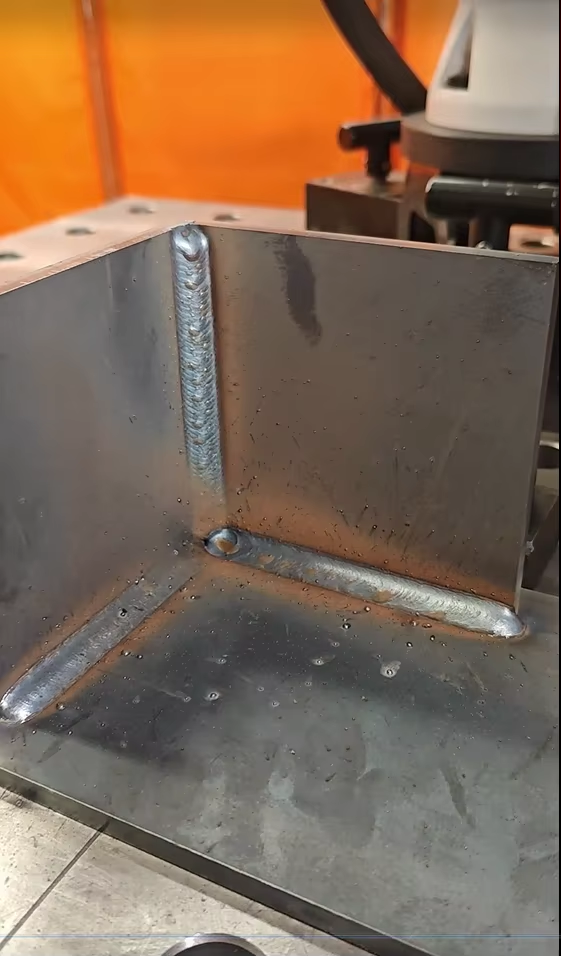
2. Assembly: Zero-clearance fits allow for the use of robotic welding cells, which were previously impractical due to the variability of manual plasma cuts.
3. Quality Control: Digital twin integration allows the CNC system to log the “as-built” dimensions of every beam, providing a traceable quality record for mining safety certifications.
9.0 Conclusion
The deployment of 30kW Fiber Laser CNC Beam and Channel cutters equipped with Zero-Waste Nesting represents a paradigm shift for Pune’s mining machinery sector. By combining extreme power density with sophisticated material handling and nesting algorithms, manufacturers can achieve levels of precision and material utilization previously considered impossible in heavy structural steel. The reduction in secondary operations and the optimization of raw material yield position this technology as the cornerstone of modern, high-efficiency heavy engineering.
10.0 Technical Recommendations
1. Optics Maintenance: At 30kW, even minor contamination on the cover glass will lead to rapid thermal lensing. Implement a Class-100 cleanroom protocol for lens changes.
2. Software Calibration: Ensure the nesting software is updated with the specific elastic modulus and tolerance data for locally sourced Indian Steel (JSPL, SAIL) to improve the accuracy of the deformation compensation algorithms.
3. Gas Selection: For S355 grade steels over 20mm, utilize a mixing station to introduce 2-5% Oxygen into the Nitrogen stream to increase cutting speed while maintaining a weld-ready edge.
















