The Dawn of 30kW Fiber Laser Power in Structural Fabrication
For decades, the fabrication of power towers—the massive lattice structures and monopoles that carry high-voltage lines—relied on a combination of mechanical sawing, punching, and high-definition plasma cutting. While effective, these methods often required significant secondary processing, such as grinding or reaming, to meet the stringent tolerances of the energy sector. The introduction of the 30kW fiber laser has fundamentally changed this calculus.
At 30,000 watts, the energy density of the laser beam is sufficient to vaporize thick-walled structural steel almost instantaneously. In Charlotte’s competitive manufacturing landscape, the 30kW source allows for high-speed nitrogen cutting on materials where oxygen was previously the only option. This is critical for power towers because nitrogen cutting leaves a clean, oxide-free edge. When these components are sent for hot-dip galvanization—a standard requirement for outdoor utility infrastructure—the lack of an oxide layer ensures superior zinc adhesion, significantly extending the lifespan of the tower in the field.
The Mechanics of the Infinite Rotation 3D Head
The “Infinite Rotation” 3D head is the component that elevates a standard laser cutter into a specialized beam and channel processor. In traditional 3D cutting, the laser head is often limited by internal cabling, requiring “unwinding” movements that slow down the cutting cycle. An infinite rotation head utilizes advanced slip-ring technology and specialized optical pathways to allow the cutting torch to rotate indefinitely around the C-axis.
When processing C-channels or I-beams for power towers, the laser must often navigate complex geometries, such as cutting bolt holes through flanges or creating “bird’s mouth” joints where diagonal bracing meets a main leg. The 3D head’s ability to tilt (often up to ±45 or even ±60 degrees) while rotating infinitely allows for complex bevel cuts. These bevels are essential for weld preparation. By cutting the weld prep (V, X, or K-type bevels) directly on the laser, fabricators eliminate the need for manual grinding, ensuring that every joint in the lattice tower fits perfectly and meets AWS (American Welding Society) standards.
Optimizing Beam and Channel Processing in Charlotte
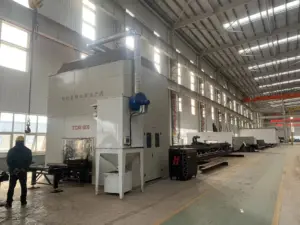
Charlotte, North Carolina, has emerged as a primary hub for energy-related manufacturing and logistics. The regional demand for grid modernization has placed immense pressure on local fabricators to produce more components in less time. A 30kW CNC beam and channel cutter addresses this by automating the material handling and processing of long-format structural members.
These machines are typically equipped with massive “chuck” systems—pneumatic or hydraulic grippers that rotate the entire beam while the laser head moves along its length. For power tower fabrication, which utilizes long L-angle iron and heavy channels, the ability to feed a 12-meter (40-foot) beam into the machine and have it emerge fully cut, drilled, and beveled is a massive leap in efficiency. In the Charlotte market, where labor costs and shop space are at a premium, the small footprint of a single laser machine compared to a line of saws, punches, and drills represents a significant ROI.
Precision Engineering for Power Tower Integrity
Power towers are subject to immense cyclical loading, wind resistance, and environmental stress. The precision of the bolt holes is perhaps the most critical factor in their fabrication. Traditional punching can create micro-fractures in the heat-affected zone (HAZ) around a hole, which may lead to structural failure over decades of service.
A 30kW fiber laser, however, creates an incredibly narrow HAZ. The CNC control of the laser ensures that every hole is perfectly cylindrical and positioned within tolerances of ±0.1mm. This precision ensures that during field assembly—often done by helicopters or cranes in remote locations—the bolts slide through the lattice members without the need for on-site reaming. This “first-time fit” is the gold standard in infrastructure fabrication, and it is made possible by the stability of the 3D laser head and the beam quality of a 30kW source.
Bevel Cutting and Weld Preparation Efficiency
The transition from 2D to 3D cutting is nowhere more apparent than in weld preparation. For the heavy-duty base plates and main leg segments of power towers, deep penetration welds are required. Utilizing the 30kW laser’s power, the 3D head can execute “K-bevels” on the ends of thick-walled channels in a single pass.
Previously, a fabricator would cut the beam to length with a saw and then use a handheld plasma torch or a milling machine to create the bevel. This was time-consuming and prone to human error. The 30kW laser manages the heat input so precisely that the metallurgical properties of the high-strength steel used in tower construction remain uncompromised. This leads to stronger welds and a more reliable overall structure.
The Economic Impact of Ultra-High-Power Lasers
From the perspective of a fiber laser expert, the economic argument for 30kW technology is centered on “Cost Per Part.” While the initial capital expenditure for a 30kW machine with an infinite rotation 3D head is higher than lower-powered alternatives, the throughput speed is exponentially greater.
In the context of Charlotte’s industrial growth, these machines allow local firms to outcompete international suppliers. The 30kW laser cuts through 20mm steel five to eight times faster than a 6kW laser. When you factor in the elimination of secondary cleaning, the reduction in scrap due to intelligent nesting software, and the ability to run 24/7 with automated loading, the machine pays for itself through sheer volume. For massive projects like regional grid expansions, the ability to produce a full tower’s worth of components in a single shift is a game-changer.
Environmental and Safety Considerations
Modern 30kW systems are designed with the environment in mind. Fiber lasers are significantly more energy-efficient than older CO2 lasers, converting more wall-plug power into light. Furthermore, the 30kW systems used in heavy structural work are equipped with sophisticated dust collection and filtration systems. This is particularly important when cutting galvanized steel or high-alloy materials, as it protects the workforce in the Charlotte fabrication shops from harmful particulates.
The “closed-loop” nature of CNC laser cutting also enhances safety. Operators are removed from the immediate vicinity of the cutting action, controlling the process from a shielded console. With infinite rotation heads, the risk of cable fatigue or mechanical snags—which can cause malfunctions in lesser machines—is virtually eliminated, ensuring a safer, more predictable shop environment.
The Future: AI Integration and Grid Modernization
Looking forward, the 30kW fiber laser cutters being deployed in Charlotte are increasingly integrated with AI-driven software. These systems can automatically adjust cutting parameters in real-time based on the grade of steel or the heat buildup in the material. For power tower fabrication, this means even higher consistency across thousands of parts.
As the United States moves toward a more decentralized energy grid—incorporating wind, solar, and battery storage—the need for new transmission infrastructure will only grow. The 30kW fiber laser CNC beam and channel cutter with infinite rotation 3D head is not just a piece of machinery; it is the cornerstone of a modern industrial strategy. It provides the speed, precision, and versatility required to build the backbone of our future energy system, ensuring that Charlotte remains at the forefront of the global manufacturing revolution.