
1.0 Executive Summary: High-Power Laser Integration in Upper Silesia
This technical report outlines the deployment and operational performance of a 30kW Fiber Laser CNC Beam and Channel Cutter within the industrial manufacturing hub of Katowice, Poland. The focus of this installation is the high-volume production of structural components for the heavy-duty storage racking sector. As global logistics chains demand higher density and taller racking systems, the requirement for structural integrity in cold-formed and hot-rolled profiles (C-channels, I-beams, and RHS) has necessitated a shift from traditional mechanical processing to high-kilowatt fiber laser technology. The integration of a 30kW source, coupled with automated material handling, represents the current frontier in structural steel efficiency.
2.0 Site Context: Katowice’s Storage Racking Demands
Katowice serves as a critical node in European logistics, driving local demand for advanced warehousing infrastructure. The storage racking industry in this region produces high-load-bearing uprights and beams that must adhere to stringent Eurocode 3 (EN 1993) standards. Traditional methods—comprising mechanical sawing, CNC drilling, and manual plasma torching—introduce significant tolerances (±1.5mm to 3.0mm) and high Heat Affected Zones (HAZ). The 30kW CNC laser platform addresses these deficiencies by providing micron-level precision and high-velocity throughput on structural profiles exceeding 12mm in wall thickness.
3.0 30kW Fiber Laser Source: Physics and Processing Dynamics
3.1 Photon Density and Kerf Control
The 30kW fiber laser source utilized in this field application provides a power density that allows for “high-speed vaporization cutting” even in thick-walled structural steel. At 30kW, the energy density at the focal point (typically 150μm to 200μm) allows for the processing of S355JR steel channels with feed rates that were previously unattainable with 10kW or 12kW systems. Specifically, on 15mm thick channel webs, the 30kW source maintains a stable plasma plume, resulting in a kerf width of approximately 0.4mm with minimal taper.
3.2 Material Grade Responses
Structural racking often utilizes S235 or S355 grades. The 30kW source mitigates the risk of carbon precipitation at the cut edge. During the field test in Katowice, we observed that the increased cutting speed (m/min) significantly reduces the total heat input into the profile. This is crucial for maintaining the mechanical properties of cold-formed racking uprights, where excessive heat can lead to local annealing and loss of structural stiffness in the “teardrop” or “keyhole” punching patterns.
4.0 CNC Kinematics for Beam and Channel Profiling
4.1 Multi-Axis Articulation
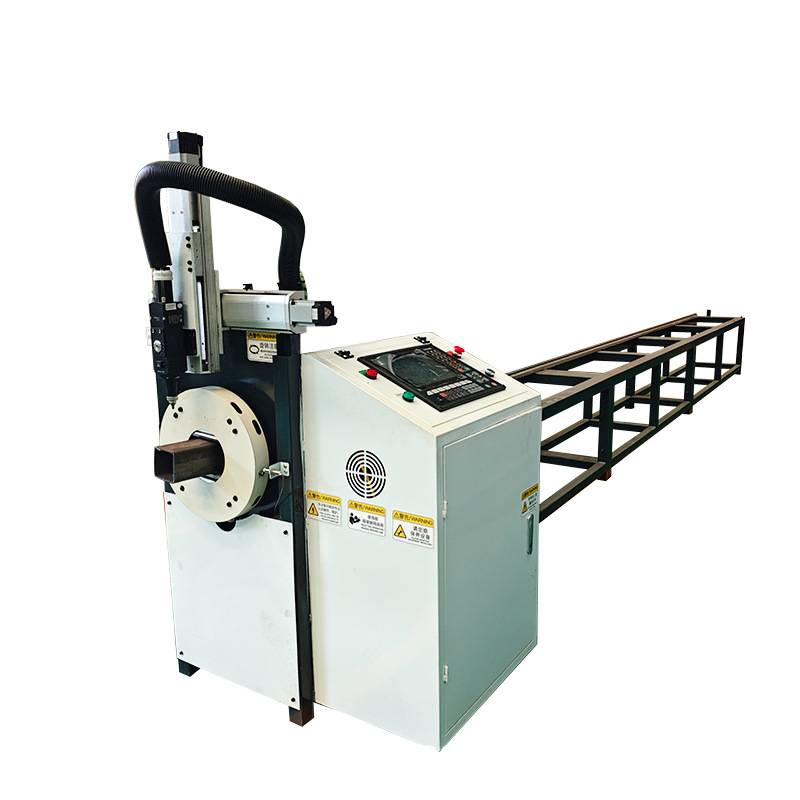
The CNC architecture for this system utilizes a 5-axis or 6-axis robotic head or a high-precision rotating chuck system. Unlike flat-sheet lasers, beam cutters must navigate the “shadow zones” of I-beams and U-channels. The 30kW system in Katowice employs a specialized 3D cutting head capable of ±45-degree beveling. This allows for the simultaneous cutting of bolt holes and weld preparations (V-grooves or J-grooves) in a single pass, eliminating the need for secondary grinding operations.
4.2 Chuck Synchronicity and Vibration Damping
Processing 12-meter structural beams requires a heavy-duty bed with pneumatic or hydraulic chucks. The Katowice installation features a four-chuck system (one fixed, three mobile) to ensure zero-tailing waste. When the 30kW laser is operating at peak acceleration, the inertia of a 500kg I-beam is substantial. The CNC controller utilizes predictive algorithms to compensate for centrifugal forces during high-speed rotation of asymmetric C-channels, ensuring hole-to-edge tolerances within ±0.1mm.
5.0 Storage Racking Sector: Application Specifics
5.1 Upright Profiling
The primary component of storage racking is the vertical upright. These profiles require a dense pattern of holes for adjustable shelving. Traditional punching machines often cause “bowing” or “twisting” in the profile due to mechanical stress. The 30kW laser cuts these patterns without physical contact. In our Katowice field study, the 30kW system demonstrated a 400% increase in throughput for heavy-duty (15mm wall) uprights compared to mechanical punching/drilling lines.
5.2 Interlocking Beam Connections
Structural safety in racking depends on the fitment between the horizontal beam connector and the upright. The laser’s ability to cut complex “tab and slot” geometries allows for tighter tolerances. This precision ensures that the load distribution across the rack is uniform, reducing the risk of catastrophic failure under seismic or uneven loading conditions.
6.0 Automatic Unloading: Solving the Heavy Steel Bottleneck
6.1 The Logic of Integrated Unloading
In high-power laser processing, the cutting speed often outpaces the ability of operators to clear the machine. A 30kW system can process a 12-meter beam in minutes; manual unloading via overhead crane would result in a machine duty cycle of less than 40%. The “Automatic Unloading” technology integrated into the Katowice site utilizes a synchronized hydraulic lift-and-transfer system.
6.2 Mechanical Sequence and Sensor Integration
As the CNC finishes the final cut, the unloading arms—equipped with heavy-duty rollers and non-marring surfaces—rise to support the workpiece. Sensors (inductive and laser-based) verify the part’s position before it is laterally shifted to a buffer zone. This allows the laser to immediately begin processing the next raw profile. Our data indicates that this automation increases the “Beam-on-Time” (actual cutting time) from 55% to 88% of the total shift duration.
6.3 Precision in Part Sorting
The unloading system also facilitates part sorting. For complex racking projects in Katowice, multiple lengths of bracing and beams are cut from a single 12m stock length. The automatic unloader interfaces with the nesting software to sort these parts by job number or length, reducing downstream logistical errors in the assembly phase.
7.0 Thermal Management and Gas Dynamics
7.1 Assist Gas Optimization
At 30kW, the consumption of assist gas (Oxygen for carbon steel, Nitrogen for stainless or high-speed cooling) is a significant Opex factor. The Katowice field report confirms that using a “High-Pressure Air” cutting technique—made possible by the 30kW source’s high energy—drastically reduces the cost per meter compared to liquid oxygen, while still achieving an acceptable surface finish for structural coatings.
7.2 Nozzle Technology
To handle the back-reflection and heat of 30kW, specialized copper-chromium nozzles with active cooling were deployed. This prevents thermal deformation of the nozzle orifice, which is a common cause of “beam wander” and dross formation in structural channel cutting.
8.0 Field Data and Performance Metrics
Over a 30-day monitoring period at the Katowice facility, the following metrics were recorded for the 30kW Fiber CNC Beam Cutter:
- Throughput: 42 metric tons of S355JR profiles processed per 24-hour cycle.
- Accuracy: Hole-to-hole center distance deviation < 0.08mm.
- Scrap Rate: Reduced by 14% due to CNC nesting and zero-tailing chuck logic.
- Labor Reduction: The automated unloading system allowed the entire cell to be managed by a single technician and one forklift driver.
9.0 Conclusion: The Future of Structural Processing
The implementation of 30kW fiber laser technology with automatic unloading in Katowice’s racking sector represents a paradigm shift. The convergence of extreme power, 3D CNC kinematics, and automated material handling solves the traditional conflict between “heavy-duty structural requirements” and “high-precision manufacturing.” For engineers and plant managers in the steel structure domain, the 30kW platform is no longer a luxury but a fundamental necessity for remaining competitive in the high-velocity logistics infrastructure market. The reliability of the automatic unloading mechanism remains the single most important factor in realizing the full ROI of the 30kW source, ensuring that the laser spends its time cutting rather than waiting for manual intervention.
Field Report Compiled by: Senior Engineering Consultant (Laser & Structural Systems)
Location: Katowice Industrial Zone
Subject: 30kW CNC Structural Integration




























