
Technical Deployment Overview: The Rayong Offshore Structural Sector
The deployment of 30kW Fiber Laser CNC Beam and Channel laser cutting technology in Rayong, Thailand, marks a significant shift in the fabrication of offshore platforms. As the primary hub for the Eastern Economic Corridor’s (EEC) heavy industry, Rayong demands high-volume production of jacket structures, topside modules, and subsea templates. Traditionally, these components—comprised of thick-walled H-beams, I-beams, and C-channels—were processed using plasma cutting or mechanical sawing and drilling.
However, the integration of 30kW fiber laser sources combined with multi-axis CNC kinematics has redefined the tolerances achievable in these high-stress environments. The offshore sector requires stringent adherence to AWS D1.1 and ISO 19902 standards. This report analyzes how the ultra-high-power laser source and synchronized automatic unloading systems mitigate the inherent challenges of heavy-gauge structural steel processing, specifically focusing on material grades such as S355JR+AR and S460G2+Q.
30kW Fiber Laser Dynamics: Penetration and Edge Characterization
Photon Density and Kerf Management
The transition from 12kW to 30kW fiber laser sources is not merely an increase in raw power but a fundamental change in the thermomechanical interaction between the beam and the substrate. At 30kW, the power density at the focal point allows for high-speed sublimation and melt-expulsion in sections up to 50mm in thickness. In the context of offshore beams, where flange thicknesses frequently exceed 25mm, the 30kW source maintains a narrow kerf width, reducing the Heat Affected Zone (HAZ) to negligible levels compared to oxy-fuel or plasma.
For Rayong-based fabricators, this translates to improved grain structure retention at the cut edge. The high photon density allows for a higher “cutting gas pressure to speed” ratio, which ensures that the dross is expelled cleanly from the bottom of deep channel sections. This eliminates the need for secondary grinding operations, which are labor-intensive and introduce dimensional variability.
Optimization of Thermal Input
One of the critical challenges in offshore structural steel is thermal distortion. Large-span H-beams are prone to longitudinal bowing if the heat input is too high. The 30kW source allows for significantly higher feed rates—often 3x faster than 10kW systems on 20mm plate—resulting in lower total heat input per linear meter. This preserves the structural camber and ensures that bolt-hole patterns across a 12-meter beam remain within the +/- 0.5mm tolerance required for modular offshore assembly.
Kinematics of CNC Beam and Channel Processing
Multi-Axis Beveling for Weld Preparation
The CNC Beam and Channel Laser Cutter utilizes a sophisticated 5-axis or 6-axis head configuration. In offshore platform construction, the ability to perform complex beveling (V, X, K, and J-cuts) on structural profiles is paramount. The system’s CNC controller orchestrates the simultaneous movement of the rotary chuck and the laser head to maintain a constant standoff distance even when navigating the radius of a channel or the web-to-flange transition of an I-beam.
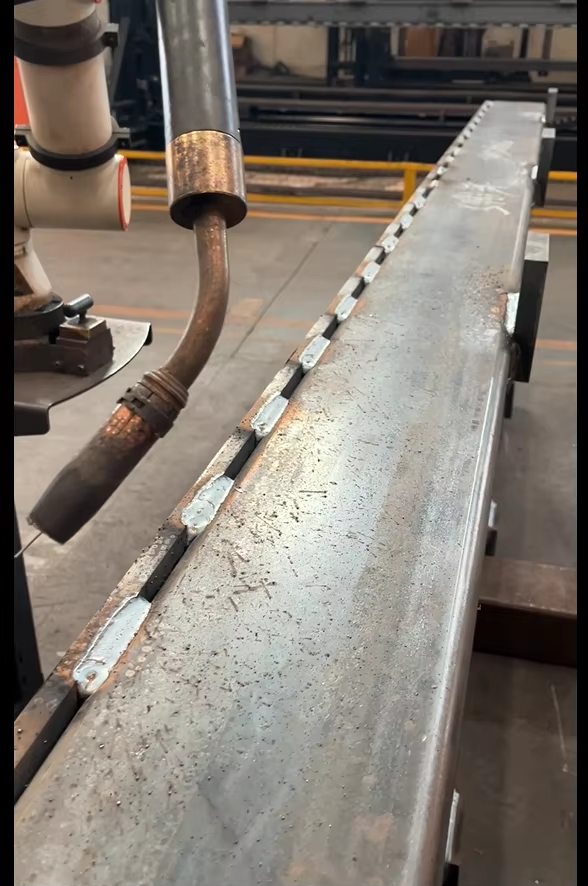
For the Rayong modules, which must withstand extreme fatigue and hydrodynamic loading, the precision of these weld preps is non-negotiable. The laser’s ability to execute a 45-degree bevel on a 30mm flange with zero “start-stop” gouging ensures that the subsequent robotic welding cells can maintain a high arc-on time with minimal fill passes.
Hole Precision and Bolt-Up Integrity
Offshore topsides are often assembled using high-strength friction grip (HSFG) bolts. The CNC laser provides a distinct advantage here by producing perfectly cylindrical holes with a surface finish that meets the friction requirements of the joint. Unlike plasma, which often produces a slight taper, the 30kW laser ensures the hole diameter is consistent through the entire depth of the beam flange, ensuring 100% bolt-to-bore contact.
Automated Unloading Systems: Mitigating Structural Latency
The Throughput Bottleneck in Heavy Processing
In traditional beam processing, the “bottleneck” is rarely the cut speed but rather the logistics of material handling. A 12-meter H-beam can weigh several tons. Manual unloading using overhead cranes is high-risk and slow, often leading to idle time for the laser source. The Automatic Unloading technology integrated into these 30kW systems solves this by using a synchronized conveyor and hydraulic lifting platform.
Mechanics of Synchronized Unloading
The unloading system employs a series of heavy-duty rollers and lateral transfer arms. Once the CNC program completes the final cut, the system’s “intelligent sorter” identifies the part weight and center of gravity. For offshore components, which may include short gussets or long primary beams, the automatic unloader adapts its grip and lift points.
1. **Vibration Damping:** As the laser finishes a cut on a heavy beam, there is a risk of the part dropping and damaging the machine bed or the cut edge. The automatic unloading system supports the part during the final millisecond of the cut, ensuring a smooth transition to the outfeed rack.
2. **Asynchronous Processing:** The system allows for “hidden” unloading. While the laser is piercing the next profile, the unloading arms move the previously processed beam to a secondary buffer zone. This increases machine utilization rates by up to 45% in a 24-hour production cycle in Rayong’s fabrication yards.
Safety and Structural Integrity
In the heavy-duty environment of Rayong’s industrial zones, safety is a primary KPI. Automatic unloading removes personnel from the “drop zone” of heavy steel. Furthermore, it prevents the mechanical deformation that can occur when using chains or magnetic lifters, which can occasionally induce localized bending or surface scarring on high-spec offshore steel.
Application in Offshore Jacket and Topside Fabrication
The 30kW laser’s capability is most evident when processing “node” connections for offshore jackets. These connections involve complex intersections where multiple pipes and beams meet at varying angles. The CNC laser can profile the “fish-mouth” or “saddle” cuts on channels and beams with mathematical precision.
In the assembly of topside modules—where space is at a premium and every millimeter counts—the laser’s ability to etch part numbers, weld symbols, and alignment marks directly onto the steel surface during the cutting process is invaluable. This “one-hit” processing (cutting, beveling, drilling, and marking) reduces the movement of material through the yard, significantly lowering the risk of logistical errors in the complex supply chains of Rayong’s offshore projects.
Environmental and Operational Considerations in Rayong
Managing High Humidity and Salinity
Rayong’s coastal location presents a challenge for high-power optics. The 30kW system is equipped with a pressurized, filtered-air optical path and an advanced chiller system designed for tropical ambient temperatures. The automatic unloading system’s electronics are housed in IP65-rated enclosures to prevent corrosion from the saline atmosphere.
Power Stability and Gas Consumption
Operating a 30kW source requires a stable power grid. Most Rayong facilities have integrated voltage stabilizers to protect the laser diodes from fluctuations. Additionally, the use of high-pressure nitrogen for oxide-free cutting on offshore components requires large-scale liquid nitrogen tanks. The CNC system’s “Eco-Mode” gas saving technology regulates flow based on real-time thickness detection, optimizing the cost-per-cut in an increasingly competitive global energy market.
Conclusion: Technical Benchmarks and Operational Outlook
The integration of 30kW Fiber Laser CNC Beam and Channel Laser Cutters with Automatic Unloading marks a milestone for structural engineering in Rayong. By synthesizing ultra-high-power photonics with automated material handling, fabricators can achieve:
* A 60% reduction in total processing time for complex offshore profiles.
* Zero-defect weld preparations that satisfy the most stringent NDT (Non-Destructive Testing) requirements.
* Enhanced worker safety through the elimination of manual heavy-lift operations.
As offshore platforms move into deeper waters and require higher-strength steel alloys, the precision and power of the 30kW laser will become the baseline, rather than the exception, for structural integrity and fabrication efficiency. This deployment establishes a new technical benchmark for the EEC’s contribution to global offshore energy infrastructure.
















