The Evolution of Ultra-High-Power Fiber Lasers in Heavy Industry
For decades, the offshore platform fabrication industry relied heavily on plasma cutting and manual oxy-fuel torches. While effective for basic sizing, these methods necessitated extensive post-processing, including grinding and secondary beveling, to meet the weld-quality standards mandated by bodies like the American Bureau of Shipping (ABS). The introduction of the 30kW fiber laser has fundamentally rewritten these production timelines.
As a fiber laser expert, I look at 30kW not just as a number, but as a threshold of “power density.” At this level, the laser can maintain a stable keyhole even in 50mm to 80mm carbon steel—the structural backbone of offshore jackets and topsides. The high brightness of a 30kW source allows for a narrower kerf and a significantly reduced Heat Affected Zone (HAZ). In the context of offshore platforms, where fatigue resistance and structural integrity are non-negotiable, minimizing the thermal impact on the base metal is a massive engineering advantage.
Mastering Beams and Channels: The 3D Cutting Challenge
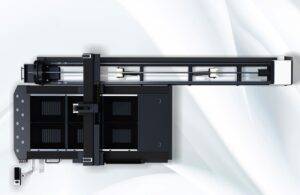
Unlike flat-sheet cutting, processing structural profiles like H-beams, I-beams, and channels requires a sophisticated multi-axis approach. A 30kW CNC Beam and Channel Laser Cutter utilizes a specialized 3D cutting head, often mounted on a robotic arm or a high-precision 5-axis gantry.
For an offshore platform, the complexity lies in the intersections. Jacket structures involve complex “tube-to-pipe” or “beam-to-column” junctions that require precise saddle cuts and variable-angle bevels for full-penetration welding. The CNC system must synchronize the rotation of the heavy profile (using a 3 or 4-chuck system) with the movement of the laser head. With 30kW of power, these machines can execute a 45-degree bevel on a thick-walled H-beam in a single pass, eliminating the need for secondary beveling machines. This precision ensures that when components arrive at the assembly yard in Vung Tau or Ho Chi Minh City’s ports, the fit-up is perfect, reducing “gap-bridging” welding issues.
The Critical Role of Automatic Unloading in Large-Scale Fabrication
One of the most significant bottlenecks in heavy-duty laser cutting is material handling. An H-beam used in offshore construction can weigh several tons. Manual unloading using overhead cranes is slow, dangerous, and prone to damaging the precision-cut edges.
The integration of an automatic unloading system is what transforms a high-speed laser into a high-throughput production line. In modern Ho Chi Minh City facilities, these systems utilize heavy-duty conveyor beds and hydraulic lifting arms that synchronize with the CNC controller. As the laser completes the final cut, the unloading system supports the piece, prevents it from dropping (which could warp the profile), and moves it to a designated stacking area. For offshore projects, which often require hundreds of identical structural braces, this automation reduces the “floor-to-floor” time by up to 40%. It also enhances workplace safety—a growing priority in Vietnam’s modernizing industrial sector.
Why Ho Chi Minh City? The Strategic Hub for Offshore Engineering
Ho Chi Minh City (HCMC) and its surrounding provinces like Ba Ria-Vung Tau have emerged as the premier hub for marine engineering in Southeast Asia. The proximity to the East Sea’s oil and gas fields makes it a logical site for a 30kW laser installation.
By housing such high-end technology in HCMC, fabrication yards can significantly reduce logistics costs. Instead of importing pre-cut structural steel from Singapore or China, local yards can buy raw mill-length profiles and process them “just-in-time” according to the specific requirements of the offshore project. Furthermore, HCMC offers a growing pool of highly skilled CNC operators and laser technicians who are proficient in the CAD/CAM software (such as Tekla or specialized laser nesting programs) required to run these complex machines. The local ecosystem of gas suppliers (providing the high-purity Oxygen and Nitrogen needed for laser cutting) and maintenance experts makes HCMC a low-risk, high-reward environment for such a capital-intensive investment.
Technical Superiority: 30kW vs. Traditional Plasma
When consulting for offshore fabricators, the question often arises: “Why invest in a 30kW laser when plasma is cheaper?” The answer lies in the Total Cost of Ownership (TCO) and the quality of the output.
1. **Weld Preparation:** Plasma cutting often leaves a layer of nitride or oxide that must be ground away before welding. A 30kW fiber laser, especially when using nitrogen or high-pressure air as an assist gas, leaves a clean, weld-ready surface.
2. **Precision:** A laser maintains a tolerance of ±0.1mm, whereas plasma may vary by 1.0mm or more. In the massive scale of an offshore platform, these small errors accumulate, leading to “stack-up” issues during final assembly.
3. **Speed:** In thicknesses up to 20mm, a 30kW laser is nearly three to four times faster than traditional plasma, and even in 40mm+ thicknesses, its ability to cut intricate bolt holes and notches with high verticality is unmatched.
Designing for the Marine Environment
Offshore platforms are subject to some of the harshest environments on Earth. The structural components must withstand constant salt spray, extreme pressure, and cyclic loading. The precision of a 30kW CNC laser ensures that the structural integrity of the beams is not compromised by micro-cracks or excessive thermal stress during the cutting process.
Moreover, the software integration of these machines allows for “smart marking.” The laser can etch part numbers, heat numbers, and weld symbols directly onto the beams and channels. This provides 100% traceability—a critical requirement for DNV or ABS certification. In the event of a structural failure years down the line, the operator can trace the exact batch of steel and the specific cutting parameters used for every single component.
The Future of Offshore Fabrication in Vietnam
The investment in 30kW fiber laser technology is a clear indicator that Vietnam is moving up the value chain. No longer just a center for low-cost manual assembly, Ho Chi Minh City is becoming a center for high-tech “Heavy Engineering 4.0.”
As offshore projects move into deeper waters and involve more complex subsea templates and floating production storage and offloading (FPSO) units, the demand for high-precision structural steel will only increase. The 30kW CNC Beam and Channel Laser Cutter, equipped with automatic unloading, represents the pinnacle of current fabrication technology. It allows Vietnamese yards to compete globally, offering the same precision and speed as European or American counterparts but with the logistical advantages of being located in the heart of the Asia-Pacific maritime corridor.
Expert Conclusion
As we look toward the next decade of offshore energy—including the burgeoning offshore wind sector—the 30kW fiber laser will be the tool that defines success. For a facility in Ho Chi Minh City, the combination of raw power, 3D geometric flexibility, and automated efficiency creates a formidable competitive advantage. By eliminating secondary processes, ensuring “first-time-right” fit-ups, and protecting workers through automation, this technology isn’t just cutting steel; it’s building the future of the maritime industry. Professionals in the field must recognize that the transition from 10kW or 20kW to 30kW is more than a power upgrade—it is a transition into a new era of structural engineering where the limits of thickness and complexity are virtually removed.