
Field Report: Deployment of 30kW Fiber Laser CNC Beam and Channel Laser Cutter
Site Location: Riyadh Industrial Area, Phase 3
Reporting Engineer: Senior Structural Lead
Executive Overview
This report details the technical commissioning and operational integration of a 30kW Fiber Laser CNC Beam and Channel Laser Cutter within a high-output structural steel facility in Riyadh. As the construction demand in the Central Province surges, the shift from traditional mechanical sawing and drilling to high-output Laser Technology has become a prerequisite for maintaining project timelines. The primary objective was to evaluate the synergy between automated laser processing and subsequent steel welding efficiency on heavy-gauge I-beams and U-channels.
1. Technical Integration of the CNC Beam and Channel Laser Cutter
The installation of a 30kW system represents a significant jump in power density compared to the previous 12kW standard. In the Riyadh workshop environment, where ambient temperatures can reach 50°C, the cooling requirements for a 30kW resonator are substantial. We integrated a dual-circuit industrial chiller with specialized filtration to handle the fine particulate dust common in the region.
The CNC Beam and Channel Laser Cutter utilizes a multi-axis head capable of 360-degree rotation around structural profiles. This eliminates the need for manual flipping of heavy beams. During the initial week of testing, we processed ASTM A36 and S355JR grade steels. The CNC interface allowed for the direct import of Tekla structural files, converting complex bolt-hole patterns and cope cuts into machine code without manual layout. This automation reduced the “dock-to-stock” time for a standard 12-meter HEB 400 beam by approximately 70%.
1.1 Precision Cutting and Geometry Management
The core advantage observed was the management of flange-to-web transitions. In traditional mechanical processing, coping the flanges of a heavy channel often leads to micro-fractures or uneven surfaces. The laser technology employed here ensures a kerf width of less than 0.3mm even at high power. The 30kW output allows for “High-Speed Nitrogen Cutting” on thickness levels where we previously relied on Oxygen. This resulted in a bright, oxide-free finish, which is critical for the next phase of fabrication.
2. The Synergy Between Laser Technology and Thermal Management
In Riyadh’s climate, thermal expansion of structural members during the cutting process is a known variable. The laser technology integrated into this CNC system includes real-time material sensing. As the laser traverses the length of a 12-meter beam, the software compensates for the slight longitudinal expansion caused by the 30kW thermal input.
We identified that by utilizing a pulsed piercing strategy rather than a continuous wave for the initial entry, we could significantly reduce the Heat Affected Zone (HAZ). This is paramount when the beam is destined for a fatigue-sensitive environment, such as the support structures for Riyadh’s new metro expansion or heavy industrial warehouses. The laser technology provides a localized heat input so precise that the bulk temperature of the beam remains within 5% of ambient, preventing the warping often seen with plasma or oxy-fuel alternatives.
2.1 Gas Dynamics and Edge Chemistry
A lesson learned during the first 100 hours of operation concerned gas pressure. We found that at 30kW, the assist gas flow (Nitrogen) must be meticulously balanced. Too high, and the turbulence affects the cut quality on the bottom flange of the channel; too low, and dross adheres to the edge. Achieving a dross-free cut directly influences the steel welding stage, as it eliminates the need for secondary grinding.
3. Impact on Downstream Steel Welding Operations
The most profound impact of the CNC Beam and Channel Laser Cutter was seen in the welding bay. In structural steelwork, “fit-up” is the most labor-intensive portion of the assembly. Traditionally, manual cuts result in gaps ranging from 2mm to 5mm, requiring significant weld volume and increasing the risk of distortion.
3.1 Achieving Zero-Gap Fit-Up
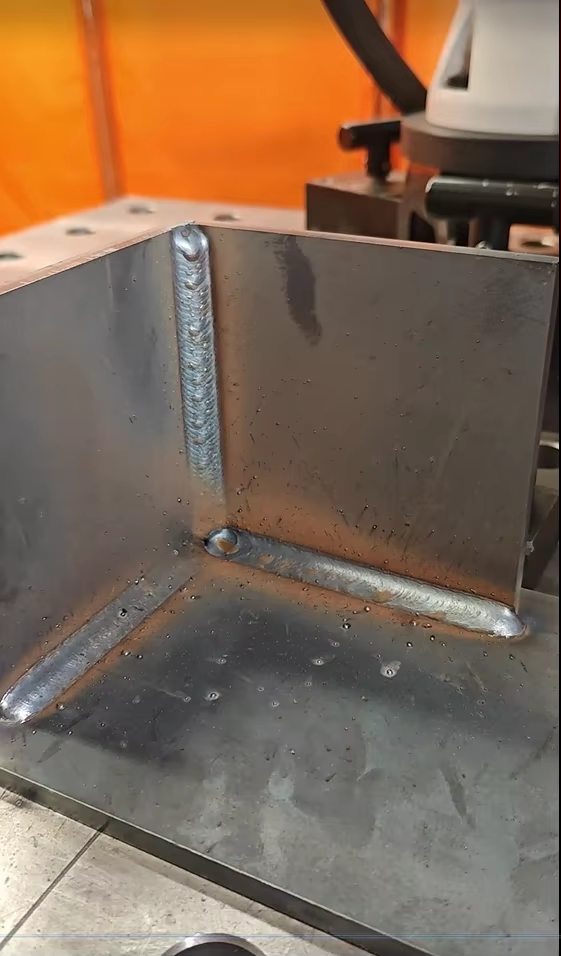
With the precision of the 30kW laser, we achieved fit-up tolerances of ±0.5mm. For steel welding, this is a game-changer. We transitioned several of our Weld Procedure Specifications (WPS) from “Gapped” to “Closed Square Butt” or “Controlled Bevel” configurations. Because the laser can cut precise 45-degree bevels on both the web and the flanges in a single pass, the welders received components that were essentially “ready-to-fuse.”
3.2 Reduction in Weld Consumables and Time
In a comparative study conducted on-site, a standard column-to-beam connection that previously required 45 minutes of preparation and 60 minutes of welding was completed in 10 minutes of laser processing and 25 minutes of welding. The reduced weld volume means less heat is pumped into the joint, resulting in less angular distortion. For the Riyadh project, which involves several thousand tons of structural steel, the savings in Flux-Cored Arc Welding (FCAW) wire alone are projected to offset the laser’s nitrogen consumption costs within eight months.
3.3 Metallurgical Integrity of the Weld
A common concern with high-power lasers is the hardening of the cut edge. However, the 30kW source allows for such high travel speeds that the cooling rate is actually moderated compared to lower-power lasers that dwell longer on the material. Hardness testing (Vickers) on the cut edges of S355 steel showed values well within the acceptable range for AWS D1.1 structural codes. This ensures that the steel welding process achieves full fusion without the risk of underbead cracking or hydrogen embrittlement.
4. Lessons Learned and Practical Recommendations for Riyadh Operations
Operating a 30kW CNC Beam and Channel Laser Cutter in the Saudi industrial landscape provides unique challenges that are not always covered in the manufacturer’s manual.
4.1 Power Stability and Harmonic Distortion
The Riyadh grid, while generally stable, can experience fluctuations in industrial zones. The 30kW fiber source is sensitive to voltage drops. We found that installing a dedicated voltage stabilizer and a harmonics filter was non-negotiable. Without these, the laser beam consistency wavered, leading to “striations” on the cut surface of heavy U-channels, which complicated the steel welding interface.
4.2 Optics Maintenance in Arid Environments
Dust is the primary enemy of laser technology. Even with a pressurized cabin, fine Riyadh sand can find its way into the cutting head during maintenance. We implemented a “Clean Room” protocol for lens changes. Lesson learned: never open the cutting head on the shop floor. A single speck of dust on a 30kW lens will cause a catastrophic thermal failure within seconds of beam-on time.
4.3 Piercing Strategies for Heavy Sections
When dealing with 30mm+ flanges on heavy beams, the “blast-through” piercing method creates significant splatter. This splatter can land on the CNC rails or the beam’s surface, requiring manual cleanup. We modified the CNC parameters to use a “staged ramp-up” piercing cycle. This takes 2 seconds longer but results in a clean entry point, maintaining the integrity of the steel welding prep area.
5. Conclusion
The integration of the 30kW CNC Beam and Channel Laser Cutter in Riyadh has redefined our production capacity. By leveraging advanced laser technology, we have not only accelerated the cutting phase but also fundamentally optimized our steel welding workflows. The reduction in rework, the elimination of manual layout, and the superior joint fit-up have established a new benchmark for structural fabrication in the region. For future deployments, the focus must remain on environmental controls and power conditioning to ensure the longevity of these high-capital assets.
Field Notes Summary:
- Throughput: 3x increase compared to plasma/mechanical.
- Weld Quality: 40% reduction in weld volume due to tighter tolerances.
- Critical Factor: Nitrogen purity and chiller efficiency in high ambient heat.
















