The Industrial Evolution of Katowice: From Coal to Wind
Katowice and the wider Upper Silesian region have long been the industrial engine of Central Europe. Historically defined by coal mining and heavy steel production, the region is currently undergoing a profound transformation. The introduction of a 30kW fiber laser 3D Structural Steel Processing Center is the flagship of this “Green Revolution.” By repurposing the region’s deep-rooted metallurgical expertise and combining it with high-power laser technology, Katowice is evolving into a critical node for the European Green Deal.
Wind turbine towers are colossal structures that demand uncompromising precision. As turbines grow in height and capacity—frequently exceeding 150 meters with 6MW+ nacelles—the structural demands on the steel sections become extreme. The Katowice facility serves as a response to this demand, providing the localized capacity to process massive S355 and S420 grade steel plates and tubular sections with a level of accuracy that traditional plasma or oxy-fuel systems simply cannot match.
The Physics of Power: Why 30kW Changes Everything
In the realm of fiber lasers, power is not merely about speed; it is about the “energy density” required to maintain a stable melt pool in thick-section materials. A 30kW laser source represents the current frontier of industrial viability. At this power level, the laser can penetrate steel thicknesses of up to 50mm to 80mm with ease, maintaining a narrow kerf and a minimal Heat Affected Zone (HAZ).
For wind turbine towers, which utilize thick-walled sections at the base to support thousands of tons of dynamic load, the 30kW source allows for high-speed cutting that was previously impossible. When compared to a 10kW or 20kW system, the 30kW laser increases cutting speeds on 25mm plate by nearly 300%. This throughput is essential for meeting the aggressive installation timelines of modern wind farm projects. Furthermore, the high power allows for the use of compressed air or nitrogen cutting on thicker sections, which leaves a clean, oxide-free surface ready for immediate welding without the need for secondary grinding.
The Precision of ±45° 3D Bevel Cutting
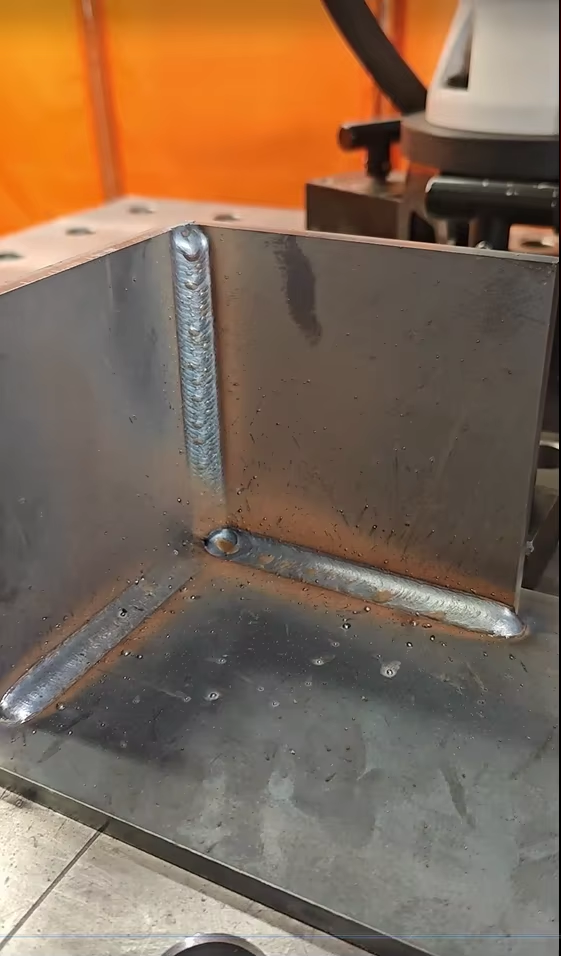
Perhaps the most significant technical feature of the Katowice processing center is its 3D beveling head. In structural steel fabrication, particularly for cylindrical wind towers, edges are rarely cut at a simple 90-degree angle. To achieve high-quality, full-penetration welds, the steel edges must be prepared with V, Y, X, or K-shaped grooves.
The ability to perform ±45° bevel cutting in a single pass is a game-changer. Traditionally, beveling thick steel required secondary machining or manual oxy-fuel torching, both of which are labor-intensive and prone to human error. The 3D laser head, governed by advanced five-axis kinematics, can adjust its angle dynamically as it traverses the steel. This allows for complex geometries, such as the elliptical cutouts for tower door frames and cable entries, to be beveled precisely in three dimensions.
This precision ensures that when the massive tower segments are rolled and brought together, the fit-up is perfect. A gap variance of even a few millimeters on a 5-meter diameter tower can lead to significant welding defects; the 30kW laser minimizes this risk, ensuring that the structural integrity of the tower is baked into the fabrication process from the first cut.
Engineering Challenges in Wind Turbine Tower Fabrication
Wind turbine towers are subjected to immense fatigue loads over their 25-to-30-year lifespans. Every cut, hole, and weld is a potential point of failure. The Katowice 30kW processing center addresses these engineering challenges through superior thermal management and mechanical stability.
One of the primary challenges in laser cutting thick structural steel is the accumulation of heat. Excessive heat can alter the grain structure of the steel, leading to brittleness. The high speed of the 30kW laser actually reduces the total heat input into the part compared to slower, lower-power methods. This preserves the mechanical properties of the high-tensile steel used in tower construction.
Furthermore, the 3D processing center is designed to handle the sheer scale of tower components. We are talking about longitudinal sections and circular flanges that can weigh several tons. The integration of heavy-duty material handling systems with the laser’s motion control ensures that even as the gantry moves at high speeds, the “photon-to-metal” interaction remains stable. This stability is vital for maintaining the ±0.1mm tolerance required for modern offshore wind specifications.
The Role of Software and Industry 4.0 Integration
A 30kW laser is only as effective as the software that drives it. The Katowice facility utilizes an integrated CAD/CAM ecosystem specifically designed for structural steel. This software takes 3D models of tower segments and automatically generates optimized cutting paths, including the complex calculations for bevel compensation.
Because the laser head is tilting up to 45 degrees, the software must account for the “effective thickness” of the material increasing as the angle sharpens. The system also incorporates real-time monitoring of the cutting process. Sensors in the cutting head monitor the back-reflection and the temperature of the protective lens, while optical sensors track the kerf to ensure the cut has fully penetrated.
This data-driven approach aligns with Industry 4.0 standards. Every component processed in Katowice can have a “digital twin,” where the exact cutting parameters, gas pressures, and time of fabrication are recorded. For wind farm operators, this traceability is invaluable for long-term maintenance and insurance purposes, providing a documented history of the tower’s structural origin.
Sustainability and Economic Impact
The move to 30kW fiber laser technology also brings a significant reduction in the environmental footprint of manufacturing. Fiber lasers are notoriously efficient, converting electrical energy into light with an efficiency of over 40%, far surpassing CO2 lasers or plasma systems.
Moreover, the precision of the laser reduces material waste. With “nesting” software optimized for large-scale structural parts, the Katowice center can maximize the utility of every steel plate. Because the laser creates such a clean cut, the need for chemical cleaning or intensive mechanical grinding is eliminated, reducing the use of consumables and lowering the overall energy consumption of the factory.
Economically, the facility boosts Poland’s standing in the renewable energy sector. By providing high-end processing capabilities locally, European tower manufacturers can reduce their reliance on imported pre-cut components from Asia. This shortens supply chains, reduces transport-related carbon emissions, and creates high-skilled jobs in the Silesian region.
Conclusion: Setting a New Standard
The 30kW Fiber Laser 3D Structural Steel Processing Center in Katowice is more than just a piece of machinery; it is a statement of intent. It signals that the heavy industry of the future will be defined by precision, power, and sustainability.
As wind turbines continue to scale up to meet the world’s energy needs, the infrastructure that builds them must also evolve. The combination of ultra-high-power fiber lasers and 3D beveling represents the pinnacle of current fabrication technology. In the heart of Katowice, the steel that once fueled the industrial revolution is now being shaped by light to power a cleaner, renewable future. For the wind energy sector, this facility is not just a processing center—it is the foundation upon which the next generation of giant turbines will stand.