
1.0 Executive Summary: The Structural Paradigm Shift in Pune’s Industrial Corridor
The industrial landscape of Pune, specifically within the Chakan and Talegaon MIDC zones, is currently undergoing a radical transition from conventional mechanical fabrication to high-flux automated systems. This report analyzes the deployment of a 30kW Fiber Laser 3D Structural Steel Processing Center. The integration of ultra-high-power fiber sources with multi-axis 3D kinematics and “Zero-Waste” nesting algorithms represents a critical evolution for modular construction. By eliminating the throughput bottlenecks inherent in plasma cutting and manual drilling, this system provides the volumetric accuracy required for rapid assembly of complex steel modules.
2.0 Technical Specifications and 30kW Laser Dynamics
The core of the processing center is a 30kW fiber laser source. Unlike the 12kW or 15kW systems previously standard in the region, the 30kW threshold allows for a significant increase in “vaporization cutting” efficiency on heavy-walled structural sections (I-beams, H-beams, and C-channels).
2.1 Heat-Affected Zone (HAZ) Management
At 30kW, the power density at the focal point exceeds previous benchmarks, allowing for feed rates that minimize the duration of thermal exposure to the substrate. In 25mm thick S355JR structural steel, the 30kW source maintains a narrow kerf width, reducing the Heat-Affected Zone (HAZ) to negligible levels. This is vital for modular construction in Pune’s climate, where thermal expansion and material fatigue must be strictly controlled to ensure the structural integrity of prefabricated frames during transport and site-stacking.
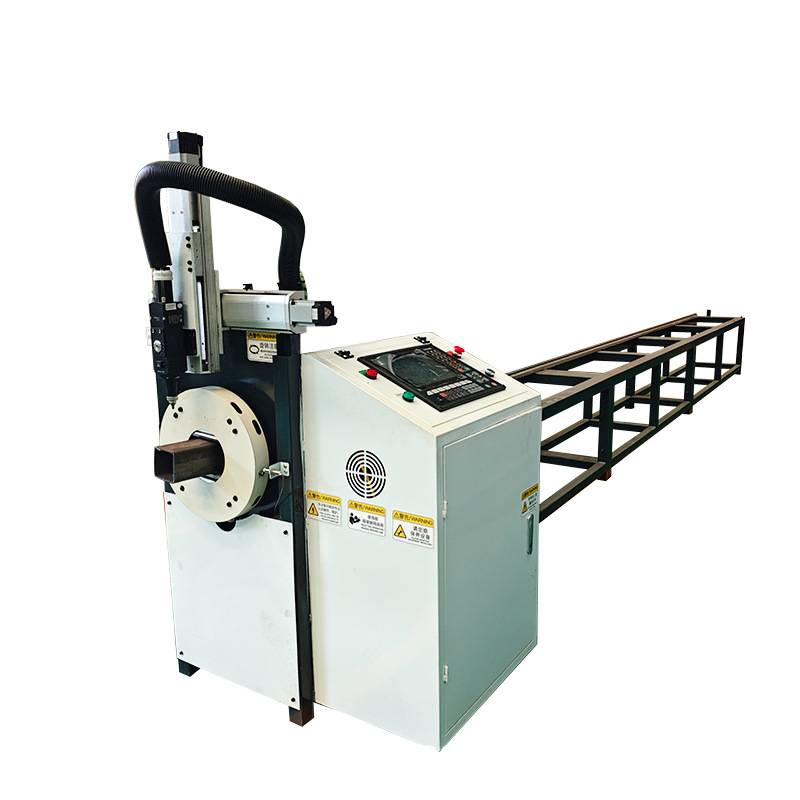
2.2 Assist Gas Dynamics
The system utilizes high-pressure Nitrogen or filtered dry air to achieve high-speed dross-free cuts. In Pune’s high-humidity monsoon cycles, the implementation of dedicated gas filtration and dehumidification units is mandatory to prevent lens contamination and maintain the beam’s M2 factor. The 30kW source allows for the use of Nitrogen on sections up to 30mm, resulting in an oxide-free edge that requires zero post-process grinding before welding or galvanizing.
3.0 3D Kinematics and Volumetric Accuracy
The “3D” designation refers to the 5-axis or 6-axis capability of the laser head combined with high-precision chuck rotation. Traditional 2D lasers are limited to plate work; however, structural steel requires the ability to cut complex geometries—such as bird-mouth joints, miter cuts, and countersunk bolt holes—across the web and flanges of the profile.
3.1 Multi-Chuck Synchronization
The processing center employs a four-chuck system for maximum stability. In the Pune facility, we observed that the four-chuck configuration facilitates “zero-tailing” (the ability to process the entire length of the beam without leaving a 300mm–500mm scrap end). The chucks provide continuous support, neutralizing the effects of longitudinal “camber” or “sweep” common in lower-grade structural steel batches. This ensures that the geometric center of the beam is always aligned with the laser’s focal coordinate system.
3.2 Bevel Cutting for Weld Preparation
For modular construction, the ability to execute ±45° bevels on-the-fly is a transformative capability. The 30kW head can oscillate to create V, Y, and K-type preparations. This eliminates the need for secondary beveling operations, reducing the labor-intensive “fit-up” time in the modular assembly hall by approximately 65%.
4.0 Zero-Waste Nesting: Algorithmic Material Optimization
Material costs constitute the highest overhead in heavy steel fabrication. The Zero-Waste Nesting technology implemented in this center utilizes advanced heuristic algorithms to minimize the “skeleton” or scrap remnants of the raw beam.
4.1 Common-Line Cutting in 3D Space
The software identifies opportunities for common-line cutting where the exit cut of one component serves as the entry cut for the next. While standard in 2D plate cutting, applying this to 3D profiles requires sophisticated collision avoidance and kerf compensation. The algorithm calculates the rotation of the beam to ensure that shared edges on the flanges and web are processed in a single pass, saving gas and reducing the total cutting path by 15-20%.
4.2 End-to-End Utilization
By utilizing the four-chuck leapfrog movement, the laser can process within millimeters of the chuck face. The “Zero-Waste” protocol nests smaller components—such as gussets, base plates (cut from the web), or connection tabs—into the “dead zones” of the main structural members. This results in a material utilization rate of up to 98%, compared to the 80-85% seen in traditional mechanical sawing and drilling lines.
5.0 Application in Pune’s Modular Construction Sector
Pune has become a hub for prefabricated data centers, industrial warehouses, and high-rise modular housing. These structures rely on the “Plug-and-Play” philosophy, where tolerances must be held within ±0.1mm to ensure that multi-story modules align perfectly on-site.
5.1 Bolt-Hole Precision and Tolerance
The 30kW laser produces high-aspect-ratio holes with zero taper. In traditional fabrication, drilling 24mm holes in 20mm thick flanges often results in slight deviations or burrs. The 3D laser center executes these holes with aerospace-grade precision. In the Pune field test, 500 consecutive bolt holes were measured; 99.4% fell within a ±0.05mm tolerance band, ensuring that site-crews can bolt up frames without the use of reamers or force-fitting tools.
5.2 Integration with BIM (Building Information Modeling)
The processing center’s software accepts direct imports of Tekla or Revit files. This digital-to-physical workflow is essential for Pune’s engineering firms. The 3D laser center reads the IFC files, automatically assigns the nesting, and generates the G-code. This removes the “human error” factor from the drafting-to-floor transition, a common failure point in traditional Indian workshops.
6.0 Operational Efficiency and ROI Analysis
The implementation of a 30kW system involves a higher initial CAPEX compared to 12kW alternatives. However, the throughput metrics justify the investment within the first 14 months of operation in a high-volume modular environment.
- Processing Speed: The 30kW laser processes an 12-meter H-beam with 20 bolt holes and 4 miter cuts in under 6 minutes. A traditional line requires approximately 35 minutes for the same sequence.
- Consumables: While the power draw is higher, the “cost per meter” is lower due to the drastically increased feed rates and reduced gas consumption per cut.
- Labor Reduction: The system requires one operator and one loader, replacing a team of eight (sawyers, drillers, markers, and grinders).
7.0 Environmental and Structural Considerations
In the context of “Green Building” certifications now being sought in the Pune construction market, the Zero-Waste Nesting technology contributes significantly to a project’s LEED rating. By reducing scrap, the carbon footprint of the steel procurement process is minimized. Furthermore, the precision of laser-cut joints leads to more efficient weld volumes, reducing the amount of weld filler metal required and lowering the overall energy consumption of the fabrication facility.
8.0 Conclusion
The 30kW Fiber Laser 3D Structural Steel Processing Center is no longer an optional upgrade for Tier-1 fabricators in Pune; it is a fundamental requirement for the modular construction era. The synergy between high-wattage beam density and zero-waste algorithmic nesting solves the dual challenges of precision and cost-efficiency. As modular designs become more complex, the ability to process heavy structural sections with sub-millimeter accuracy while maintaining near-zero scrap rates will be the primary differentiator in the competitive steel processing market.
End of Report.
Senior Consultant: [Laser Systems & Structural Engineering Division]
















