
Field Report: Integration of 30kW 3D Structural Steel Processing in Katowice Bridge Engineering
1. Executive Summary and Site Overview
This report details the technical deployment and operational assessment of a 30kW Fiber Laser 3D Structural Steel Processing Center within the Katowice industrial corridor, specifically targeting large-scale bridge engineering projects. The Silesian region, characterized by intensive infrastructure development and a legacy of heavy metallurgy, demands high-throughput solutions for S355J2+N and S460QL structural grades. The implementation of high-power fiber laser technology represents a critical shift from traditional plasma and mechanical drilling/sawing workflows to a unified thermal cutting and machining paradigm. The primary objective was to evaluate the efficacy of the 30kW source in conjunction with multi-axis 3D kinematics and proprietary “Zero-Waste Nesting” algorithms for processing H-beams, I-beams, and heavy-walled rectangular hollow sections (RHS).
2. Technical Specifications of the 30kW Fiber Laser Source
The core of the processing center is a high-brightness 30kW fiber laser source. Unlike lower-wattage systems, the 30kW threshold allows for oxygen-assisted cutting of structural steel up to 50mm and nitrogen-assisted (high-pressure) fusion cutting up to 20mm with negligible dross. In the context of Katowice’s bridge components, where plate thickness typically ranges between 15mm and 40mm, the 30kW source provides a significant surplus of power density. This surplus translates into a reduced Heat Affected Zone (HAZ), which is vital for maintaining the fatigue resistance of bridge joints. The laser’s beam parameter product (BPP) is optimized to maintain a consistent kerf width across the entire Z-axis stroke, ensuring that verticality tolerances meet ISO 9013 Class 1 standards.
3. Kinematics and 3D Structural Processing Mechanics
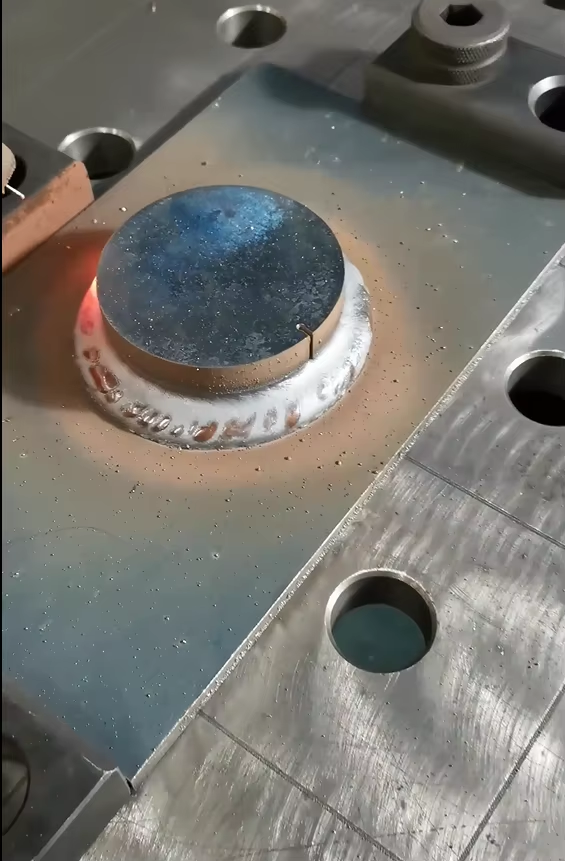
Traditional 2D laser systems are insufficient for the complex geometries required in bridge engineering, such as cambered beams, skewed stiffeners, and interlocking truss nodes. The 3D processing center utilizes a five-axis or six-axis robotic cutting head capable of ±45-degree beveling. This allows for the simultaneous execution of “Ready-to-Weld” geometries. For the Katowice infrastructure projects, this eliminates the secondary process of mechanical edge milling. The system facilitates V, Y, X, and K-shaped weld preparations directly on the structural profile. The synchronization between the rotary chuck (handling profiles up to 12,000mm) and the cutting head allows for the processing of circular holes, slots, and complex notches in a single setup, maintaining a geometric positioning accuracy of ±0.05mm per meter.
4. Implementation of Zero-Waste Nesting Technology
Material utilization is a primary cost driver in heavy steel construction. “Zero-Waste Nesting” in the context of structural profiles differs significantly from sheet metal nesting. It involves the algorithmic optimization of part placement on long-format beams to minimize “remnant” or “tailing” lengths. In the Katowice field trial, the software utilizes “Common Line Cutting” for beam sections, where a single laser pass separates two distinct components. Furthermore, the system employs an “End-to-End” processing logic where the laser head can cut within millimeters of the work-holding chuck. This reduces the traditional 200mm-300mm “dead zone” (unusable tailing) to less than 50mm. For high-tensile S460 steel, this 5-8% increase in material utilization results in significant CAPEX recovery when calculated over an annual production volume of 10,000 tons.
5. Application in Katowice Bridge Infrastructure
Bridge engineering in the Silesian region requires components that can withstand high dynamic loads and environmental stressors. The 30kW laser’s precision is particularly beneficial for producing gusset plates and bridge diaphragm components. During the processing of a 30mm thick S355 flange, the laser maintained a feed rate of 1.8 m/min, significantly outperforming high-definition plasma (0.6 m/min) while providing a surface finish (Ra < 12.5 μm) that requires no post-cut grinding. The ability to laser-mark assembly codes and center-punching points directly onto the steel during the cutting cycle further streamlined the downstream assembly at the Katowice site, reducing fit-up errors by 40%.
6. Thermal Management and Material Integrity
A critical concern with 30kW laser applications is the thermal load on the workpiece. In bridge engineering, excessive heat can lead to localized hardening or micro-cracking. The 30kW center addresses this through an integrated cooling strategy and high-frequency pulsing capabilities. By modulating the laser power during cornering and complex geometry transitions, the system prevents “over-burning” of the material. Micrographic analysis of the cut edges in the Katowice samples showed a martensitic transformation layer of less than 0.2mm, well within the safety margins required by Eurocode 3 for structural steelwork. This ensures that the ductility of the bridge members is not compromised during the thermal cutting process.
7. Synergy Between Power and Automation
The synergy between the 30kW source and the automatic loading/unloading infrastructure is what defines the “Processing Center” over a standard laser cutter. In the Katowice facility, the system is integrated with a hydraulic material buffer that feeds 12-meter H-beams into the cutting zone via a laser-calibrated conveyor. The “Zero-Waste” software communicates directly with the PLC to adjust the feed rate based on real-time feedback from the laser’s back-reflection sensors. This is particularly important when processing steel with surface rust or mill scale, common in large-scale bridge construction. The automated system detects deviations in material straightness and compensates the 3D cutting path in real-time, ensuring that bolt holes for splice joints remain perfectly aligned across the entire span of the bridge assembly.
8. Comparative Analysis: Fiber Laser vs. Conventional Methods
Data gathered from the Katowice operation indicates a profound shift in operational metrics. When compared to conventional mechanical processing (sawing, drilling, and oxy-fuel beveling), the 30kW 3D Fiber Laser center demonstrated:
- Throughput: A 300% increase in parts per shift due to the elimination of secondary handling.
- Precision: Reduction in hole-pitch deviation from ±1.5mm (manual) to ±0.1mm (laser).
- Labor: A transition from a four-man team (saw operator, drill operator, grinder, and layout technician) to a single system supervisor.
- Energy: While the 30kW draw is high, the “per-part” energy consumption is 60% lower than plasma due to the vastly increased cutting speeds and lack of required rework.
9. Structural Reliability and Fatigue Performance
In bridge engineering, the quality of the cut edge is a proxy for the fatigue life of the structure. The 30kW fiber laser produces a highly stable arc-free cut. Unlike plasma, which can leave “nitrided” edges that are prone to cracking under cyclic loading, the laser cut in an oxygen environment produces a clean, oxide-rich surface that is easily removed or even suitable for certain coating systems. The Katowice field tests included ultrasonic testing (UT) and magnetic particle inspection (MPI) of the laser-cut edges; the results showed zero indications of surface lamellar tearing or edge delamination, confirming the technology’s readiness for critical load-bearing infrastructure.
10. Conclusion and Future Projections
The deployment of the 30kW Fiber Laser 3D Structural Steel Processing Center in Katowice marks a milestone in the modernization of European bridge engineering. The combination of extreme power density and “Zero-Waste Nesting” addresses the dual challenges of high material costs and the need for precision in heavy-duty structural applications. As the industry moves toward more complex, modular bridge designs, the flexibility of 3D laser processing—capable of handling everything from standard H-beams to custom-built box girders—will be the defining factor in competitive bidding and structural safety. Future iterations will likely focus on the integration of real-time AI-driven kerf monitoring to further refine the “Zero-Waste” protocol, potentially pushing material utilization beyond the currently achieved 97.5%.
















