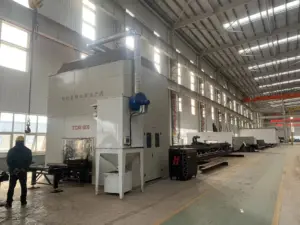
The Dawn of Ultra-High Power in Structural Fabrication
For decades, the structural steel industry relied on a segmented workflow: mechanical sawing for length, CNC drilling for bolt holes, and manual plasma cutting for complex notches or bevels. The arrival of fiber laser technology began to disrupt this flow, but it was the move beyond the 10kW barrier that truly revolutionized the sector. In Hamburg, a city synonymous with global logistics and heavy industry, the deployment of 30kW fiber laser systems has redefined what is possible in the fabrication of storage racking and structural frames.
At 30kW, the physics of laser-material interaction changes. We are no longer merely “melting and blowing” through thin sheets; we are executing high-speed sublimation and fusion cutting through structural steel up to 50mm thick with surgical precision. The power density of a 30kW source allows for a significantly reduced Heat Affected Zone (HAZ), ensuring that the metallurgical integrity of the structural steel remains uncompromised—a critical factor for the load-bearing requirements of high-bay racking systems.
Engineering the Infinite Rotation 3D Head
The “Infinite Rotation” capability is the crown jewel of this processing center. Traditional 3D laser heads are often limited by internal cabling, requiring “unwinding” movements that interrupt the cutting cycle and increase the risk of mechanical wear. The infinite rotation head utilizes advanced slip-ring technology and specialized optical pathways to allow the cutting torch to rotate N x 360° without restriction.
For storage racking manufacturers, this means the ability to perform complex bevel cuts (A-axis and B-axis) on all four sides of a structural member in a single continuous motion. Whether it is a 45-degree miter cut on a heavy-duty beam or a complex countersink for a specialized fastening system, the infinite rotation head maintains the optimal angle of incidence. This eliminates the need to flip or reposition the workpiece, which in the world of 12-meter structural beams, represents a massive saving in cycle time and overhead crane usage.

Optimization for the Storage Racking Industry
Storage racking is the backbone of the global supply chain, and the demands placed on these structures have increased exponentially with the rise of Automated Storage and Retrieval Systems (ASRS). These systems require tolerances that traditional mechanical fabrication simply cannot meet. In a racking system that stands 40 meters tall, a deviation of even one millimeter in hole placement at the base can lead to significant alignment issues at the summit.
The 30kW 3D processing center addresses this through laser-precision hole cutting and slotting. Unlike mechanical punches that can deform the surrounding metal or drills that wear down, the laser provides perfectly perpendicular edges and consistent diameters. This ensures that every bolt, connector, and interlocking beam fits with high-tolerance accuracy, facilitating faster on-site assembly and superior structural stability. Furthermore, the ability to cut complex “puzzle” joints allows for innovative racking designs that distribute weight more efficiently, potentially reducing the total amount of steel required for a project.
Hamburg: A Strategic Hub for Logistics Infrastructure
The selection of Hamburg as a site for such an advanced processing center is no coincidence. As one of Europe’s largest ports and a primary gateway for international trade, Hamburg is the epicenter of the warehouse construction boom. The proximity to major logistics hubs means that the demand for high-quality, rapidly produced storage solutions is constant.
By localizing 30kW laser processing in Hamburg, the supply chain for Central European warehouse projects is significantly shortened. Instead of importing pre-fabricated components from distant markets, developers can source precision-engineered structural steel locally. This not only reduces the carbon footprint associated with transport but also allows for “Just-In-Time” manufacturing, where racking components can be produced and delivered in sync with the construction phases of a new distribution center.
Overcoming the Challenges of Thick-Walled Steel
Cutting structural steel (such as S235 or S355) at 30kW presents unique challenges, particularly regarding thermal management. At such high power levels, the laser beam can generate immense heat. The 30kW processing centers in Hamburg utilize sophisticated “Cooling-Edge” technology and high-pressure nitrogen or oxygen assist gases to manage the thermal profile of the cut.
A key advantage of the 30kW source is the “Fly-Cutting” capability on structural profiles. By moving the head at high speeds with a highly focused beam, the energy is concentrated so precisely that the material is vaporized before the heat can conduct into the bulk of the steel. This prevents warping and ensures that the long-span beams used in cantilever racking remain perfectly straight over their entire length. Additionally, integrated sensors in the 3D head monitor the reflected light and plasma state in real-time, automatically adjusting the focal position and power to compensate for variations in material grade or surface rust.
Software Integration and the Digital Twin
The hardware of a 30kW fiber laser is only as effective as the software driving it. These centers are fully integrated into the Industry 4.0 ecosystem. Before a single spark is struck, the entire cutting process is simulated via a “Digital Twin.” This allows engineers in Hamburg to nest parts across multiple beams, optimize the cutting path for the infinite rotation head, and predict exactly how the material will behave.
The integration with Building Information Modeling (BIM) software is particularly vital for the racking industry. The laser center can ingest data directly from the warehouse architectural plans, ensuring that every notch, hole, and bevel corresponds exactly to the global project coordinates. This end-to-end digital workflow eliminates manual data entry errors and allows for the rapid prototyping of custom racking components for unique warehouse layouts.
The Economic and Environmental ROI
From an expert perspective, the Return on Investment (ROI) for a 30kW 3D laser system is measured in more than just speed. While the cutting speed is 3 to 5 times faster than a 10kW system, the true value lies in process consolidation. One 30kW laser processing center can replace a band saw, a drill line, and a manual grinding station. This reduces the footprint of the factory floor and significantly lowers labor costs.
Environmentally, the fiber laser is the cleanest method of steel fabrication. It uses no cutting fluids, produces minimal scrap thanks to advanced nesting algorithms, and has a much higher wall-plug efficiency than older CO2 lasers or plasma cutters. In an era where “Green Logistics” is a corporate mandate, the ability to manufacture the “bones” of a warehouse using energy-efficient, low-waste technology is a significant competitive advantage for Hamburg-based fabricators.
Future Horizons: Beyond Racking
While storage racking is the immediate application, the capabilities of the 30kW 3D processing center extend into broader structural engineering. We are seeing the beginning of its use in bridge components, maritime infrastructure for the Port of Hamburg, and even the frames for large-scale renewable energy projects like offshore wind turbine internal structures.
The infinite rotation 3D head is the key to this flexibility. As we move toward more complex architectural shapes and higher-strength steel alloys, the ability to manipulate a 30kW beam in three-dimensional space with no mechanical limits will be the baseline requirement for any serious structural fabricator. The Hamburg facility stands as a blueprint for the future of the industry: a marriage of extreme power, infinite maneuverability, and digital precision.