
1. Technical Overview: 30kW Fiber Laser Integration in Structural Fabrication
The integration of 30kW fiber laser sources into 3D Structural Steel Processing Centers represents a paradigm shift in heavy-duty manufacturing. Unlike traditional plasma or oxy-fuel systems, the 30kW fiber laser delivers a high-brightness beam with a power density exceeding 10^7 W/cm². In the context of the Queretaro industrial corridor, where shipbuilding components and heavy modular structures are increasingly fabricated for coastal delivery, this power level allows for the high-speed sublimation and fusion cutting of carbon steels up to 50mm with extreme precision.
The core advantage of the 30kW source lies in its ability to maintain a stable “keyhole” during the cutting process of thick-walled H-beams, I-beams, and rectangular hollow sections (RHS). The increased photon density minimizes the Heat Affected Zone (HAZ), which is critical for maintaining the metallurgical integrity of marine-grade steels such as AH36 and DH36. By utilizing a 30kW source, the processing center can achieve cutting speeds that are 3x to 5x faster than 12kW systems on 20mm sections, directly translating to higher throughput in the shipyard pre-fabrication phase.
2. The Infinite Rotation 3D Head: Mechanics and Kinematic Advantages
2.1 Elimination of Cable Torsion and Reset Latency
Traditional 3D laser heads are limited by physical cable bundles, necessitating “unwinding” rotations or software-limited travel ranges (typically ±360 degrees). The Infinite Rotation 3D Head utilizes advanced slip-ring technology and integrated cooling channels that allow the C-axis to rotate indefinitely. In structural steel processing—specifically for complex saddle cuts in pipe-to-pipe connections or multi-faceted bevels on I-beams—this eliminates the non-productive time associated with head repositioning.
2.2 Precision Beveling and Weld Preparation
The 3D head architecture supports A/B axis tilting up to ±45 degrees (or higher in specialized configurations). For the shipbuilding sector in Queretaro, this functionality is leveraged to produce Y, V, K, and X-type weld preparations in a single pass. The synergy between the 30kW power and the 3D head motion control allows for “on-the-fly” angle adjustments. This ensures that the bevel angle remains consistent even as the head traverses the radius of a flange or the web of a structural member, maintaining a constant focal distance through high-speed capacitive sensing.
3. Application in the Queretaro Shipbuilding and Maritime Sector
While Queretaro is geographically inland, it has emerged as a high-tech manufacturing hub for modular maritime components, offshore platform sub-assemblies, and specialized vessel structures. These components are often fabricated in land-based “dry shipyards” before being transported to the Gulf or Pacific coasts.
3.1 Processing of High-Tensile Marine Steels
Marine structures require rigorous compliance with international classification standards (e.g., ABS, DNV). The 30kW 3D system addresses the challenge of processing thick-plate structural members without inducing significant thermal stress. In our field observations at the Queretaro facility, we noted that the precision of the infinite rotation head allows for a kerf width tolerance of ±0.1mm on 25mm thick sections. This precision is vital for the “block construction” method used in modern shipbuilding, where large pre-fabricated sections must align perfectly for automated welding robots.
3.2 Structural Complexity and Profile Cutting
Shipbuilding involves non-linear geometries—curved hulls, bulkhead stiffeners, and complex piping manifolds. The 3D processing center handles these with a 7-axis or 9-axis kinematic chain. By implementing the 30kW laser, we have successfully replaced secondary machining processes. For example, the creation of “rat holes” (scallops) in longitudinal stiffeners, which previously required manual grinding or secondary drilling, is now executed during the primary laser cutting cycle with a finish quality that requires zero post-processing.
4. Synergy Between Power and Automation
4.1 Automated Material Handling and Detection
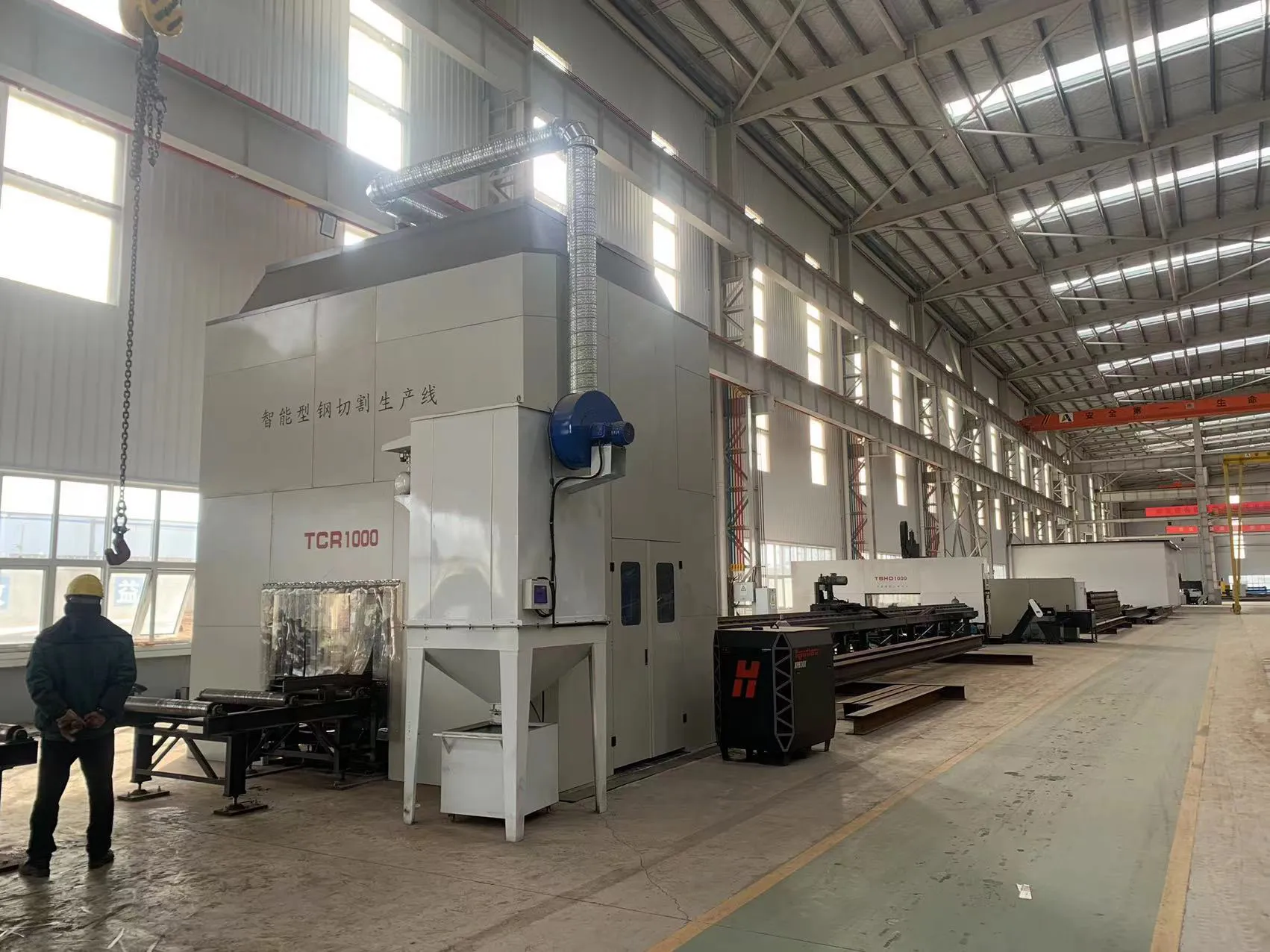
The 30kW 3D center is not merely a cutting tool but a fully automated robotic cell. In the Queretaro deployment, the system is integrated with an automated infeed/outfeed conveyor capable of handling 12-meter structural profiles. A critical component of this synergy is the laser-based profile detection system. Before cutting, the 3D head performs a rapid scan of the structural member to detect any geometric deviations (twists or bows) common in hot-rolled steel. The CNC system then dynamically adjusts the cutting path in real-time to compensate for these variances, ensuring that every bolt hole and bevel is positioned with absolute spatial accuracy.
4.2 Gas Dynamics and Nozzle Technology
At 30kW, gas dynamics become a limiting factor if not managed correctly. The 3D head utilizes high-pressure supersonic nozzles designed to clear molten ejecta from deep kerfs. In Queretaro, the use of specialized nitrogen-oxygen mixing stations has allowed the facility to optimize the balance between cutting speed and edge oxidation. For shipbuilding, a slightly oxidized edge is sometimes preferred for certain coatings, while for stainless steel components, a pure nitrogen shield ensures a mirror-like finish, eliminating the need for pickling or passivating the cut edge.
5. Efficiency Gains and ROI Analysis
5.1 Reduction in Lead Times
The implementation of the 30kW Infinite Rotation system has demonstrated a 60% reduction in total part processing time. This is attributed to the “one-hit” philosophy where a raw H-beam enters the machine and emerges with all holes drilled, ends mitered, and weld preps cut. In traditional Queretaro shops, these operations would have moved across three different work centers (sawing, drilling, and manual beveling).
5.2 Consumable and Energy Optimization
While the 30kW source has a higher instantaneous power draw, its “energy per meter cut” is lower than 10kW or 12kW systems due to the massive increase in feed rates. Furthermore, the 3D head’s ability to maintain an optimal angle of attack reduces dross accumulation, extending the life of the nozzle and protective windows. In the field report data, we observed a 25% increase in consumable lifespan compared to traditional 3D plasma heads, primarily due to the non-contact nature of the laser process and superior height sensing.
6. Technical Conclusion and Future Outlook
The deployment of the 30kW Fiber Laser 3D Structural Steel Processing Center in Queretaro marks a significant milestone in Mexican heavy engineering. The “Infinite Rotation” capability is the specific technological catalyst that allows for the transition from simple 2D profile cutting to complex 3D structural integration. For the shipbuilding industry, this means faster vessel assembly, higher structural reliability, and a significant reduction in labor-intensive fit-up tasks.
As we continue to monitor the performance of these systems, the focus will shift toward the integration of AI-driven nesting algorithms that can predict thermal expansion in real-time, further pushing the boundaries of what is possible in heavy steel fabrication. The 30kW 3D head is no longer an outlier; it is the new standard for facilities aiming for the pinnacle of efficiency and precision in the global maritime supply chain.
















