
1. Technical Scope and Strategic Deployment in Casablanca Maritime Infrastructure
The modernization of the Casablanca shipbuilding sector necessitates a transition from traditional plasma and oxy-fuel thermal cutting to high-density 30kW fiber laser processing. This technical report evaluates the field performance of the 3D Structural Steel Processing Center, specifically focused on the fabrication of bulkheads, hull stiffeners, and transverse frames. The integration of 30kW power levels into a 3D kinematic environment allows for the processing of high-tensile maritime steels (Grade AH36/DH36) at speeds previously unattainable in heavy-gauge profiles. The Casablanca deployment is characterized by high-volume throughput requirements and the need for weld-ready beveling to minimize post-processing labor in shipyard assembly lanes.
2. The Physics of 30kW Fiber Laser Sources in Heavy-Section Steel
The 30kW fiber laser source represents a critical threshold in power density. At this magnitude, the beam quality (expressed as M²) remains stable enough to maintain a narrow kerf even when penetrating 20mm to 50mm structural sections. In the 3D processing of H-beams and bulb flats, the energy distribution within the focal spot enables “vaporization-dominated” cutting as opposed to “melt-and-blow” dynamics seen in lower power ranges. This results in a significantly reduced Heat Affected Zone (HAZ), which is vital for maintaining the metallurgical integrity of the structural steel used in ocean-going vessels.
Furthermore, the 30kW source allows for high-pressure nitrogen cutting on thicker sections, eliminating the oxide layer typically left by oxygen-assisted cutting. For shipyards in Casablanca, where saltwater corrosion is an ever-present variable, the ability to produce an oxide-free edge ensures superior paint adhesion and coating longevity without the need for secondary mechanical grinding.
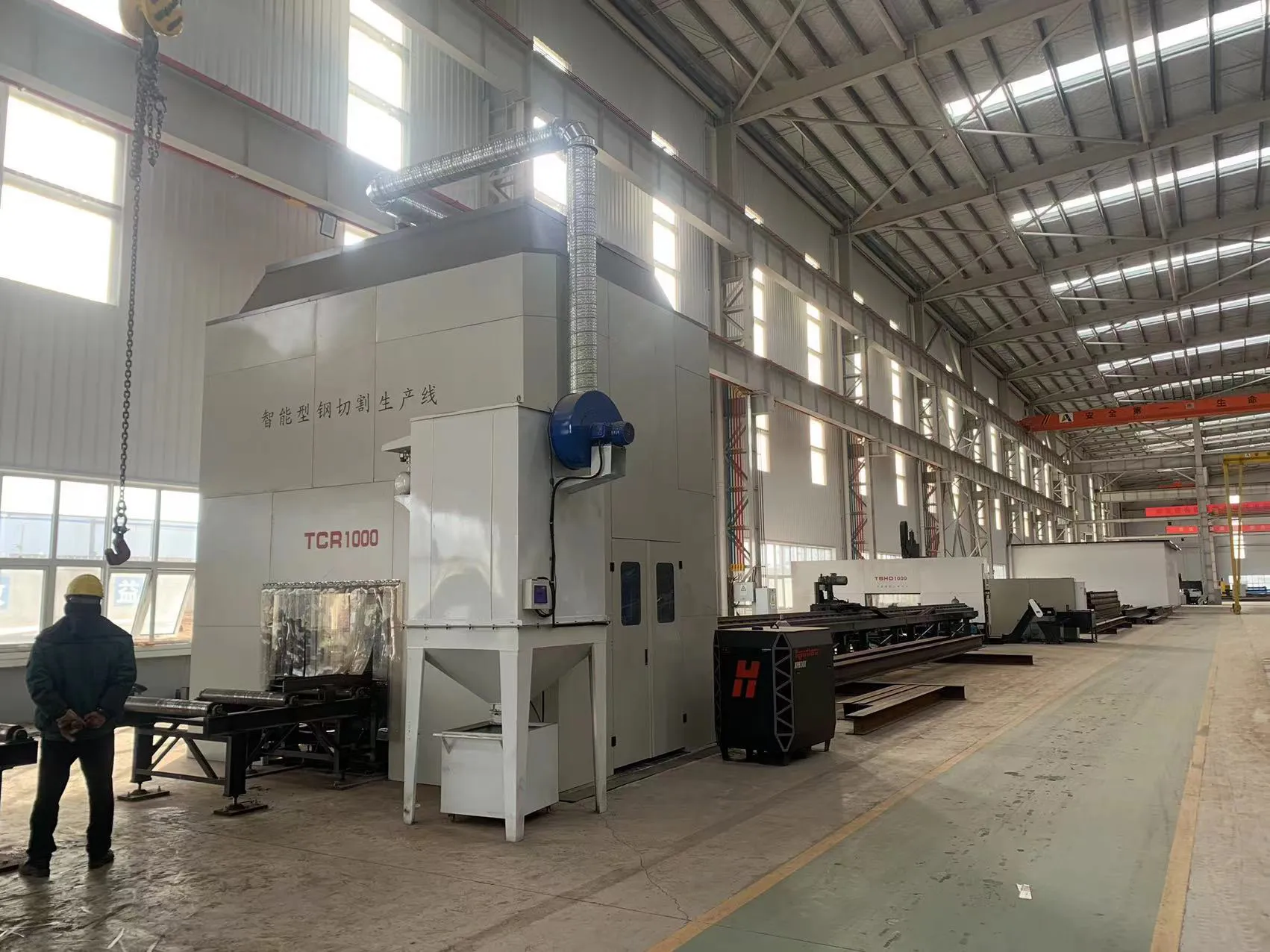
3. 3D Kinematics and Multi-Axis Beveling Precision
The 3D Structural Steel Processing Center utilizes a 5-axis or 6-axis head configuration. Unlike traditional 2D flatbed cutting, the 3D head must navigate the complex geometries of structural profiles—specifically the transitions between the web and the flange of an I-beam. In the Casablanca shipyard context, the requirement for complex bevel cuts (A, V, X, and K-joints) is paramount for automated welding robotic cells.
The kinematic accuracy of the 3D head is maintained through high-resolution absolute encoders and real-time capacitive sensing. This sensing technology is critical when dealing with “as-rolled” steel from the mill, which often exhibits dimensional deviations or longitudinal bowing. The 30kW laser head compensates for these irregularities by dynamically adjusting the standoff distance, ensuring that the focal point remains optimal relative to the material surface, regardless of structural deformation.
4. Integration of Automatic Unloading Technology
In heavy steel processing, the bottleneck is rarely the cutting speed itself but the material handling and logistics cycle. Manual unloading of 12-meter beams weighing several tons introduces significant downtime and safety risks. The Automatic Unloading system integrated into the 30kW center utilizes a synchronized hydraulic/pneumatic gripper system and a motorized conveyor bed designed to move finished parts to a designated staging area while the next profile is loaded into the cutting zone.
4.1 Solving Precision Issues via Automated Handling
Precision in structural steel is often lost during the transition from the cutting bed to the sorting floor. Manual handling with overhead cranes frequently results in micro-deformations or surface scoring. The automated unloading unit uses programmed “soft-drop” or “lateral-transfer” mechanisms that preserve the dimensional accuracy of the processed parts. This is particularly critical for the assembly of interlocking ship structures where tolerances are capped at ±0.5mm over a 10-meter span.
4.2 Throughput Optimization
The synergy between the 30kW source and automatic unloading creates a “continuous-flow” environment. In the Casablanca facility, field data suggests a 40% increase in duty cycle efficiency compared to manual unloading systems. By decoupling the operator from the unloading process, the machine maintains a consistent “Beam-On” time, maximizing the ROI of the high-capital laser source.
5. Synergy Between High-Power Density and Structural Automation
The technical synergy between the 30kW source and the 3D processing hardware manifests in the “One-Pass” philosophy. Traditional methods require separate machines for length cutting, hole drilling, and beveling. The 30kW 3D Center consolidates these operations. The high power allows for the “pierce-on-the-fly” technique, where the 30kW beam penetrates the steel with minimal dwell time, reducing the total heat input into the profile.
In Casablanca’s shipbuilding applications, this synergy allows for the fabrication of complex “lightening holes” and “manholes” in structural webs with zero mechanical stress. The automated unloading system then sorts these parts based on their nesting ID, which is often laser-etched onto the part surface by the same 30kW head at a lower power setting. This creates a fully traceable digital-to-physical workflow.
6. Material Specifics: Managing Thermal Expansion and Surface Refraction
A 30kW laser generates substantial thermal energy. In 3D processing, where the laser may be directed at various angles, managing back-reflections and thermal expansion of the workpiece is a critical engineering challenge. The processing center employs a specialized chilled-bed design and localized fume extraction to mitigate thermal buildup.
For the maritime steels used in Casablanca, the carbon content and surface finish (mill scale) can affect the absorption rate of the 1.06µm wavelength. The 30kW system utilizes an advanced beam-shaping technology (Adjustable Ring Mode or similar) to optimize the energy distribution between the core and the ring of the beam. This allows for a cleaner cut in “dirty” or scaled steel, which is common in shipyard storage yards. The automatic unloading system must also be designed with heat-resistant contact points to handle parts that may still hold residual thermal energy immediately after processing.
7. Software Integration: The Digital Twin in Casablanca Shipyards
The hardware is governed by a sophisticated CNC suite that integrates CAD/CAM data directly from naval architecture software. This “Digital Twin” approach allows for the simulation of the 3D cutting path to prevent collisions between the 30kW head and the structural profile. The software also controls the automatic unloading sequence, predicting the center of gravity for each cut piece to ensure stable extraction from the machine bed. This level of software-to-hardware integration is what allows the Casablanca facility to maintain high precision in complex, one-off vessel components.
8. Field Observation: Efficiency and Structural Integrity
Field observations at the Casablanca site indicate that the transition to 30kW 3D processing has virtually eliminated the “fit-up” issues previously encountered during hull assembly. Because the laser-cut edges are perfectly perpendicular or beveled to exact specifications, the gap volume for welding is minimized. This reduction in weld volume directly correlates to less thermal distortion in the ship’s hull, leading to a more hydrodynamically efficient vessel.
The automatic unloading technology further contributes to this by ensuring that parts are not stressed or bent during the removal phase. The result is a streamlined production line where the 30kW laser acts as the high-speed engine, and the automated unloading acts as the critical transmission, ensuring that the power is translated into usable, high-precision output.
9. Conclusion: The New Benchmark for Heavy Industry
The implementation of a 30kW Fiber Laser 3D Structural Steel Processing Center with Automatic Unloading in Casablanca sets a new technical benchmark for the African maritime sector. By solving the dual challenges of heavy-section cutting speed and logistical handling, this technology provides a high-precision, high-throughput solution for the most demanding structural applications. The data confirms that the synergy of 30kW power and automated kinematics is the only viable path for shipyards seeking to compete in the modern era of naval engineering.
















