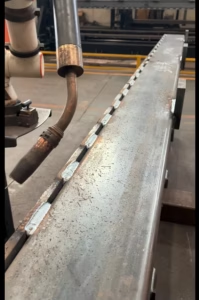
The Dawn of Ultra-High Power in Structural Fabrication
In the realm of industrial laser technology, the leap from 10kW to 30kW is not merely an incremental upgrade; it is a fundamental shift in the capabilities of light-based manufacturing. As a fiber laser expert, I have witnessed the evolution of these systems from delicate laboratory tools to the ruggedized workhorses of heavy industry. The installation of a 30kW Fiber Laser 3D Structural Steel Processing Center in Mexico City is a response to the city’s unique architectural challenges and its ambitious infrastructure goals, particularly concerning the expansion and modernization of its aviation hubs.
Airport construction requires massive amounts of structural steel—I-beams, H-beams, square tubing, and thick plates—that must be fabricated to exacting tolerances to ensure structural integrity and ease of assembly on-site. The 30kW fiber laser source provides the photon density required to “vaporize” thick-walled steel with a precision that plasma or oxygen-fuel cutting cannot match. In the context of Mexico City’s high-altitude environment and specific logistical needs, this technology offers a localized manufacturing powerhouse capable of handling the heaviest sections used in modern hangar and terminal design.
The Technical Superiority of the 30kW Fiber Engine
The heart of this system is the 30kW fiber laser oscillator. At this power level, the laser can maintain a stable “keyhole” welding and cutting state through steel thicknesses exceeding 50mm. For the structural steel typical of airport frameworks, which often ranges from 12mm to 40mm, the 30kW laser operates in its “sweet spot,” achieving cutting speeds that are five to ten times faster than legacy systems.
One of the primary advantages of this high power is the reduction of the Heat Affected Zone (HAZ). In structural engineering, particularly in seismic zones like Mexico City, maintaining the metallurgical integrity of the steel is paramount. Excessive heat from traditional cutting methods can embrittle the edges of a beam, creating micro-fractures that could fail under the stress of an earthquake. The 30kW fiber laser moves so quickly that the heat does not have time to dissipate into the surrounding material, preserving the steel’s ductility and structural characteristics.
3D Processing: Beyond Flat Sheets
The “3D” aspect of this processing center refers to its ability to manipulate the cutting head or the workpiece across multiple axes. In airport construction, steel is rarely just a flat plate. We are dealing with complex geometries: trusses, vaulted ceiling supports, and interlocking columns.
This system utilizes a specialized 5-axis or 6-axis robotic cutting head or a rotating chuck system that allows the laser to perform complex bevels, miter cuts, and hole-punching on three-dimensional profiles. For instance, creating a complex saddle cut on a large-diameter pipe or a precise 45-degree bevel on a heavy H-beam for weld preparation used to take hours of manual grinding and layout. With the 30kW 3D system, these tasks are completed in minutes. The accuracy is so high—often within fractions of a millimeter—that the components fit together perfectly on the construction site, eliminating the need for expensive “field fixes.”
Automatic Unloading: Solving the Logistical Bottleneck
A common pitfall in high-power laser facilities is the “throughput paradox”: the laser cuts so fast that the human operators cannot clear the machine quickly enough to keep it running. In a high-stakes project like an airport in a metropolitan area as dense as Mexico City, downtime is not an option.
The inclusion of an Automatic Unloading System is the critical link in the production chain. As the laser finishes a section of a 12-meter I-beam, automated grippers and conveyor systems move the finished part to a sorting area while simultaneously loading the next raw profile. This ensures a “spindle-on” time of over 90%. In the context of Mexico City’s labor market, this automation does not replace workers but rather elevates them; the role of the laborer shifts from heavy lifting and dangerous manual cutting to being a systems operator and quality control specialist, significantly reducing workplace injuries associated with handling massive steel members.
Meeting Mexico City’s Seismic and Engineering Standards
Mexico City is built on a high-seismic zone characterized by soft lakebed sediments that amplify ground motion. The engineering codes for any airport infrastructure are among the strictest in the world. The structural steel used must be able to dissipate energy through controlled deformation.
The precision of the 30kW laser contributes directly to seismic safety. When bolt holes are laser-cut rather than punched or thermally gouged, the hole walls are smoother and more consistent. This leads to better bolt tensioning and more predictable behavior of the joints during a seismic event. Furthermore, the ability to create complex “dog-bone” cuts—standard in seismic design to ensure beams yield before columns fail—is made effortless by the CNC-controlled laser, ensuring every structural fuse in the airport’s skeleton is identical to the engineer’s specification.
Environmental and Economic Impact on Local Infrastructure
Sustainability is a core pillar of modern airport design. Traditional steel processing is a heavy consumer of industrial gases (like acetylene and oxygen) and produces significant slag and particulate matter. The 30kW fiber laser is remarkably efficient. It uses nitrogen as an assist gas for clean cuts and has a wall-plug efficiency (the conversion of electricity to laser light) of nearly 40%, far higher than older CO2 lasers.
For the project in Mexico City, this means a lower localized carbon footprint. Additionally, the speed of the 30kW system allows for “just-in-time” manufacturing. Instead of storing massive inventories of pre-cut steel at the construction site—where space is at a premium in the Valley of Mexico—the processing center can produce parts as they are needed by the assembly teams. This reduces the logistical burden on the city’s already congested transport arteries.
The Expert’s Perspective on Implementation
From my perspective as an expert, the implementation of such a system requires more than just plugging it in. It requires a robust power grid and specialized training. Mexico City’s industrial corridors have seen significant investment in electrical infrastructure to support such high-draw machinery.
Furthermore, the software integration is where the magic happens. We utilize advanced nesting algorithms that take the architectural BIM (Building Information Modeling) data from the airport designers and convert it directly into laser paths. This “digital-to-physical” workflow ensures that the vision of the architect is translated perfectly into the steel skeleton of the terminal. It eliminates the transcription errors that have plagued large-scale construction for decades.
Conclusion: A Legacy for Mexican Engineering
The 30kW Fiber Laser 3D Structural Steel Processing Center is more than a piece of machinery; it is a statement of intent for the future of Mexican infrastructure. By applying the pinnacle of laser technology to the construction of a major airport, Mexico City is positioning itself as a hub of advanced manufacturing.
The benefits—unprecedented speed, microscopic precision, enhanced seismic safety, and automated efficiency—will be felt long after the airport is completed. This facility will serve as a blueprint for how heavy industry can evolve in the 21st century, proving that even the most massive steel structures can be crafted with the delicacy of a surgeon’s scalpel and the power of a thousand suns. As the cranes rise over the new terminal, the invisible work of the 30kW laser stands as the silent, unbreakable foundation of a nation’s gateway to the world.