The Dawn of Ultra-High Power: The 30kW Advantage
For decades, the structural steel industry relied on plasma cutting and mechanical sawing for thick-walled profiles. While reliable, these methods often fell short in terms of edge quality and thermal distortion. The advent of the 30kW fiber laser has fundamentally rewritten the rules of engagement. As an expert in fiber optics and laser kinetics, I’ve observed that the jump from 12kW to 30kW isn’t merely incremental; it is transformative.
At 30,000 watts, the laser’s power density is sufficient to vaporize carbon steel and stainless steel with extreme velocity. In the context of power tower fabrication—where materials often range from 10mm to 30mm in thickness—the 30kW source allows for “high-speed nitrogen cutting” or “oxygen-assisted high-pressure cutting” that leaves an oxide-free or perfectly clean edge. This power level ensures that the laser can maintain a stable “keyhole” during the cutting process, resulting in a narrower kerf and a significantly reduced Heat Affected Zone (HAZ). For structural components that must withstand the cyclic loading of wind and high-tension cables, maintaining the metallurgical integrity of the steel is paramount.
3D Kinematics and Structural Geometry
Traditional flatbed lasers are limited to two dimensions. However, power towers are comprised of complex geometries: H-beams, I-beams, C-channels, and large-diameter hollow sections. The 30kW 3D Structural Steel Processing Center utilizes a sophisticated multi-axis robotic or gantry-based delivery system.
The “3D” aspect refers to the machine’s ability to process the profile on all sides in a single pass. The workpiece is often held by a series of synchronized chucks that rotate the heavy steel profiles while the 30kW laser head moves along the X, Y, and Z axes. This synchronicity allows for the cutting of “fish-mouth” joints, intricate copes, and bolt holes with a tolerance of ±0.1mm. In power tower assembly, where thousands of components must bolt together perfectly in remote field locations, this level of precision eliminates the need for “reaming” holes on-site, drastically reducing installation costs.
The Critical Role of ±45° Bevel Cutting
Perhaps the most significant advancement in this system is the ±45° bevel cutting capability. In heavy structural fabrication, parts are rarely joined at simple 90-degree angles. To ensure deep-penetration welds that meet AWS (American Welding Society) standards, edges must be prepped with V, Y, X, or K-shaped bevels.
Traditionally, this beveling was a secondary process performed by manual grinding or specialized milling machines. A 30kW fiber laser equipped with a 5-axis interpolating head can cut these bevels simultaneously with the part profile. The ±45° range allows the laser to create the necessary chamfers for complex intersections in lattice towers.
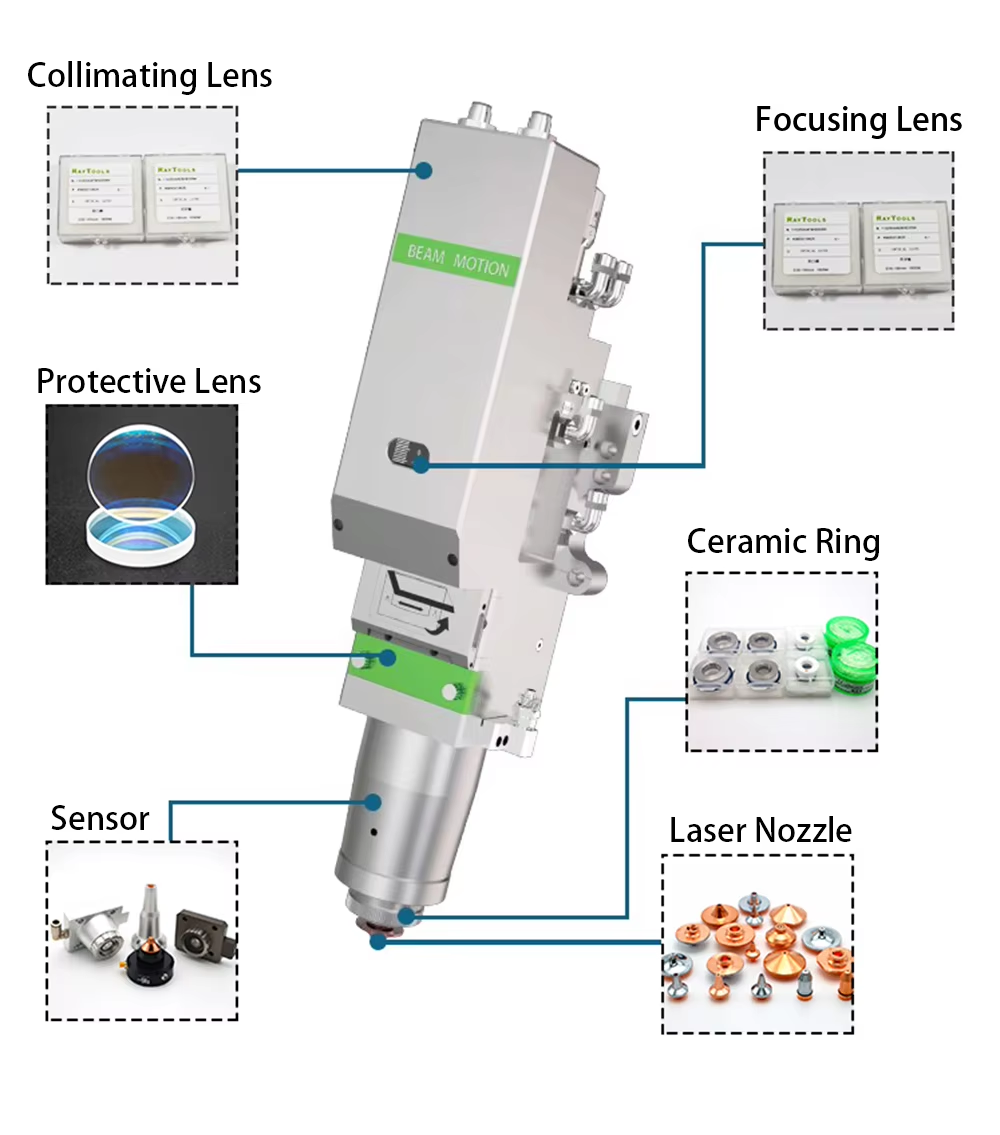
From a laser physics perspective, bevel cutting at 30kW requires sophisticated beam shaping. As the head tilts, the “apparent thickness” of the material increases (e.g., a 20mm plate cut at 45° presents nearly 28mm of material to the beam). The 30kW reservoir provides the “headroom” needed to maintain speed even when the beam is inclined, ensuring that the dross remains minimal and the surface finish remains smooth enough for immediate welding without further treatment.
Queretaro: A Strategic Industrial Hub for Power Infrastructure
The location of this technology in Queretaro, Mexico, is no coincidence. Queretaro has evolved into one of the most sophisticated manufacturing ecosystems in the world, home to aerospace giants and Tier-1 automotive suppliers. The transition into high-power structural steel is a natural evolution of the region’s technical capability.
By housing a 30kW 3D processing center in Queretaro, manufacturers are strategically positioned to serve both the Mexican national grid (CFE) and the massive infrastructure demands of the United States and Canada. Under the USMCA framework, Queretaro-based fabricators provide a “nearshoring” advantage, offering lower logistical costs than overseas competitors while maintaining a level of technological sophistication that rivals European or Japanese facilities. The local workforce in Queretaro is already accustomed to high-tech CNC operations, making the adoption of 30kW laser systems smoother than in less industrialized regions.
Fabricating the Backbone of the Energy Grid: Power Towers
Power towers (transmission towers) are the silent sentinels of our modern economy. Whether they are lattice structures for high-voltage lines or monopoles for telecommunications and wind energy, their fabrication requirements are grueling.
1. **Material Variety:** Power towers use high-strength, low-alloy (HSLA) steels. The 30kW laser handles these alloys with ease, preventing the micro-cracking often associated with older plasma technologies.
2. **Massive Scale:** These structures can stand over 50 meters tall. The processing center must handle profiles up to 12 meters in length. The automation involved in loading, measuring, and unloading these massive “sticks” of steel is as important as the laser itself.
3. **Hole Quality:** A single lattice tower may have over 1,000 bolt holes. Traditional punching can cause stress fractures around the hole. The fiber laser’s “non-contact” cutting ensures that the area around the hole remains structurally sound, which is vital for the long-term fatigue life of the tower.
4. **Galvanization Readiness:** Most power towers are hot-dip galvanized. The clean, burr-free edges produced by the 30kW laser ensure that the zinc coating adheres uniformly, preventing premature corrosion in harsh environments.
Integration of AI and CAD/CAM Software
A 30kW 3D laser is only as good as the software driving it. Modern processing centers utilize “Digital Twin” technology. Before the laser even touches the steel in Queretaro, the entire cutting sequence is simulated in a virtual environment.
Advanced CAD/CAM software (such as Lantek or Tekla integration) allows for “nesting” on 3D profiles. This optimizes the layout of parts on a beam to minimize scrap—a critical factor when dealing with the high price of structural steel. Furthermore, the software compensates for “beam spring-back” or slight deviations in the raw material’s straightness. Using touch probes or laser sensors, the system measures the actual position of the beam in the chucks and adjusts the 3D cutting path in real-time to ensure every hole and bevel is perfectly positioned relative to the actual geometry of the steel.
The Economic Impact: ROI and Efficiency
From an investment standpoint, a 30kW 3D structural laser is a significant capital expenditure. However, the Return on Investment (ROI) is driven by the “One-Pass” philosophy.
In a traditional shop, a beam might be moved from a saw to a drill line, then to a manual beveling station. Each move requires a crane, a rigger, and time. The 30kW 3D laser center replaces three to four separate machines and eliminates 70% of the material handling. For a fabricator in Queretaro, this means the ability to bid on larger contracts with shorter lead times. The speed of the 30kW source specifically reduces the “cost per part” by increasing the number of tons processed per shift, effectively outperforming two or three lower-power laser systems combined.
Conclusion: The Future of Heavy Fabrication
The deployment of a 30kW Fiber Laser 3D Structural Steel Processing Center with ±45° Bevel Cutting in Queretaro marks a new era for North American infrastructure. We are moving away from the “hammer and flame” era of steel construction and into an age of photonic precision.
As we push toward a greener, more electrified future, the demand for power towers and renewable energy support structures will only grow. The ability to produce these components faster, more accurately, and with higher structural integrity is no longer a luxury—it is a necessity. For the engineers and fabricators in Queretaro, this technology is the key to building the backbone of the 21st-century energy grid, one perfectly beveled beam at a time.