
Comprehensive Guide to 2kW Tube laser cutting for Carbon Steel in Queretaro
The industrial landscape of Queretaro has undergone a radical transformation over the last decade, evolving into one of Mexico’s premier hubs for aerospace, automotive, and heavy machinery manufacturing. Central to this growth is the adoption of advanced fabrication technologies, specifically the 2kW tube laser cutter. This specific power rating—2,000 watts—represents a critical “sweet spot” for regional manufacturers working with carbon steel. It provides the necessary energy density to maintain high throughput while ensuring the structural integrity of the components remains uncompromised.
In the Bajío region, where precision and lead times are dictated by international supply chain standards, understanding the nuances of laser cutting for tubular profiles is essential. Whether processing square, rectangular, or round carbon steel sections, a 2kW fiber laser offers a level of versatility that traditional mechanical sawing or plasma cutting cannot match. This guide explores the technical parameters, material considerations, and regional advantages of deploying 2kW tube laser technology in the Queretaro industrial corridor.
 laser cutting machine MAK160″ style=”width: 100%; max-width: 800px; height: auto; margin: 20px 0;”>
The 2kW Fiber Advantage for Carbon Steel
Carbon steel is the backbone of structural engineering in Queretaro’s construction and automotive sectors. When utilizing a 2kW fiber laser, the wavelength of the beam (typically around 1.06 microns) is highly absorbed by carbon steel. This absorption efficiency allows for rapid heating and vaporization of the metal, resulting in a narrow kerf width and a minimal heat-affected zone (HAZ).
A 2kW system is optimized for wall thicknesses ranging from 1mm up to 8mm or 10mm, depending on the specific alloy and assist gas used. For the majority of automotive chassis components, furniture frames, and architectural supports found in Queretaro’s industrial parks, this power range handles the workload with maximum electrical efficiency. Unlike higher-wattage machines that may be overkill for thin-walled tubing, the 2kW unit balances capital investment with operational costs, making it a favorite for Tier 2 and Tier 3 suppliers.
Technical Specifications and Material Interaction
When laser cutting carbon steel, the interaction between the beam and the material is governed by the carbon content and the surface finish of the tube. In Queretaro, many fabricators source A36 or 1018 carbon steel. These materials are ideal for fiber laser processing because their chemical composition allows for stable melt dynamics.
The 2kW laser source, often paired with a high-precision cutting head, utilizes autofocus technology to maintain the focal point relative to the tube’s surface, even if the material has slight structural deviations. In tube processing, this is particularly vital because tubes are rarely perfectly straight. The machine’s ability to compensate for “bow” or “twist” ensures that every notch, hole, or miter cut is executed with a tolerance often exceeding +/- 0.1mm.
Assist Gas Selection: Oxygen vs. Nitrogen
One of the most critical decisions for engineers in Queretaro is the choice of assist gas. For carbon steel, the two primary options are Oxygen (O2) and Nitrogen (N2). Each has a distinct impact on the laser cutting process:
- Oxygen Cutting: This is the most common method for carbon steel. Oxygen acts as an exothermic reactant, adding thermal energy to the cut. This allows a 2kW laser to cut thicker walls (up to 9-10mm) at lower power settings. However, it leaves a thin oxide layer on the cut edge, which may need to be removed if the part is to be powder-coated or painted.
- Nitrogen Cutting: Often referred to as “high-pressure” or “clean” cutting. Nitrogen is inert and simply flushes the molten metal out of the kerf. While it requires more laser power and higher gas pressure, it results in a shiny, oxide-free edge. For Queretaro’s high-end furniture or visible architectural components, Nitrogen is often preferred to eliminate post-processing steps.
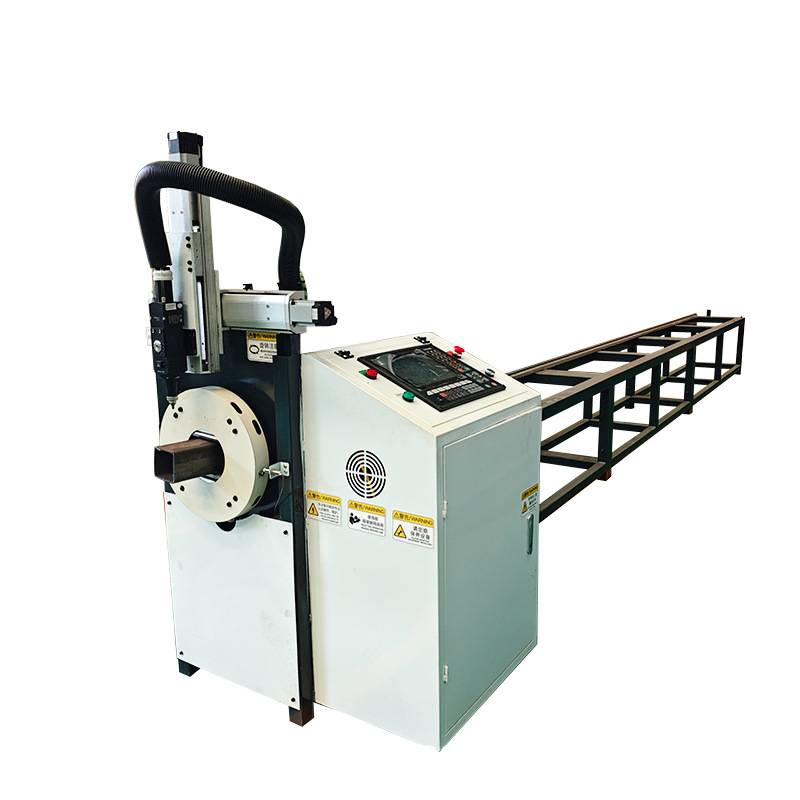
Precision Motion Control and Chucking Systems
A 2kW tube laser cutting machine is only as good as its mechanical handling system. For carbon steel tubes, which can be heavy and cumbersome, the chucking system must provide both rigidity and speed. Most modern machines in the Queretaro market feature pneumatic or hydraulic dual-chuck systems. These chucks rotate the tube with high synchronized precision, allowing the laser head to move along the X and Z axes while the tube provides the Y-axis rotation.
This “4-axis” or “5-axis” movement capability allows for complex geometries, such as saddle cuts for tube-to-tube joining, which are essential for the manufacturing of roll cages, bicycle frames, and industrial racking. The 2kW fiber source ensures that even during high-speed rotations, the beam remains stable, providing a consistent cut quality across the entire circumference of the workpiece.
Optimizing Production in Queretaro’s Industrial Parks
Queretaro’s strategic location means that local shops are often under pressure to deliver “Just-In-Time” (JIT) components. Integrating a 2kW tube laser into the workflow significantly reduces the number of operations. Traditionally, a carbon steel tube would be sawed to length, moved to a drill press for holes, and then to a milling machine for slotting. A laser cutting system performs all these tasks in a single setup.
Furthermore, the nesting software associated with these machines allows Queretaro engineers to maximize material utilization. Carbon steel prices fluctuate, and reducing scrap by nesting multiple parts on a single 6-meter tube can lead to significant cost savings. The software calculates the most efficient path and part placement, often reducing waste by 15-20% compared to manual methods.
Maintenance and Environmental Considerations
The semi-arid climate of Queretaro presents specific challenges for high-tech machinery. Dust and temperature fluctuations can affect the performance of a fiber laser. Therefore, 2kW systems are typically equipped with refrigerated chillers and dust extraction units. The chiller maintains the laser source and the cutting head at a constant temperature, preventing thermal drift which could affect the precision of the laser cutting.
Maintenance for a 2kW fiber laser is notably lower than that of older CO2 technology. There are no mirrors to align and no blower turbines to service. The primary maintenance tasks involve checking the protective windows in the cutting head, ensuring the gas filters are clean, and lubricating the rack-and-pinion motion systems. For businesses in Queretaro, this high uptime is vital for maintaining competitiveness in the global market.
Safety Standards and Training
Operating a 2kW fiber laser requires adherence to Class 4 laser safety standards. In Mexico, NOM (Normas Oficiales Mexicanas) standards dictate the safety requirements for industrial equipment. These machines are fully enclosed with laser-safe glass (OD6+ or higher) to protect operators from stray reflections, which are particularly dangerous with the 1.06-micron wavelength of fiber lasers.
Training for local operators in Queretaro focuses on both the software (CAD/CAM integration) and the physical parameters of the machine. Understanding how to adjust the “nozzle standoff” or the “pulse frequency” allows operators to fine-tune the laser cutting process for different batches of carbon steel, which may have slight variations in surface scale or oil content.
Conclusion: The Future of Fabrication in Queretaro
As Queretaro continues to attract international investment, the demand for high-precision, efficient metal fabrication will only increase. The 2kW tube laser cutter stands as a cornerstone technology for this evolution. By offering the perfect balance of power for carbon steel processing, it enables local manufacturers to move away from labor-intensive traditional methods and toward a fully automated, high-precision future.
Investing in 2kW laser cutting technology is not just about purchasing a machine; it is about adopting a philosophy of precision and efficiency. For the engineers and business owners in Queretaro, this technology provides the tools necessary to compete on a global stage, ensuring that the “Made in Mexico” label remains synonymous with quality and technical excellence in the world of carbon steel fabrication.
















