
Engineering Guide: 2kW Precision Fiber Laser Systems for Stainless Steel Fabrication in the Tijuana Automotive Cluster
The industrial landscape of Tijuana, Baja California, has evolved into one of the most sophisticated manufacturing hubs in North America. As a primary node for the “Maquiladora” industry, the region demands high-efficiency, high-precision tools that can meet the rigorous quality standards of the global automotive supply chain. For factory owners and lead engineers, the transition to 2kW precision fiber laser systems represents a critical upgrade in processing stainless steel components. This guide examines the technical architecture of these systems, focusing specifically on the structural advantages of the tube-welded standard bed and the metallurgical precision required for automotive-grade stainless steel.
The Industrial Context: Why 2kW is the Strategic Choice for Tijuana
In the context of the USMCA (United States-Mexico-Canada Agreement), Tijuana-based manufacturers are under increasing pressure to provide Tier 1 and Tier 2 automotive components with tighter tolerances and faster turnaround times. While higher wattage lasers (6kW to 12kW) exist, the 2kW fiber laser serves as the optimal “workhorse” for the majority of automotive applications involving stainless steel.
Stainless steel, particularly grades 304 and 316, is ubiquitous in automotive exhaust systems, decorative trim, and structural brackets. A 2kW system provides the ideal balance between capital expenditure (CAPEX) and operational efficiency for material thicknesses ranging from 0.5mm to 8mm. In this range, the 2kW beam offers a high power density that ensures clean vaporization of the metal with a minimal Heat Affected Zone (HAZ), which is critical for maintaining the corrosion resistance and structural integrity of the stainless steel.
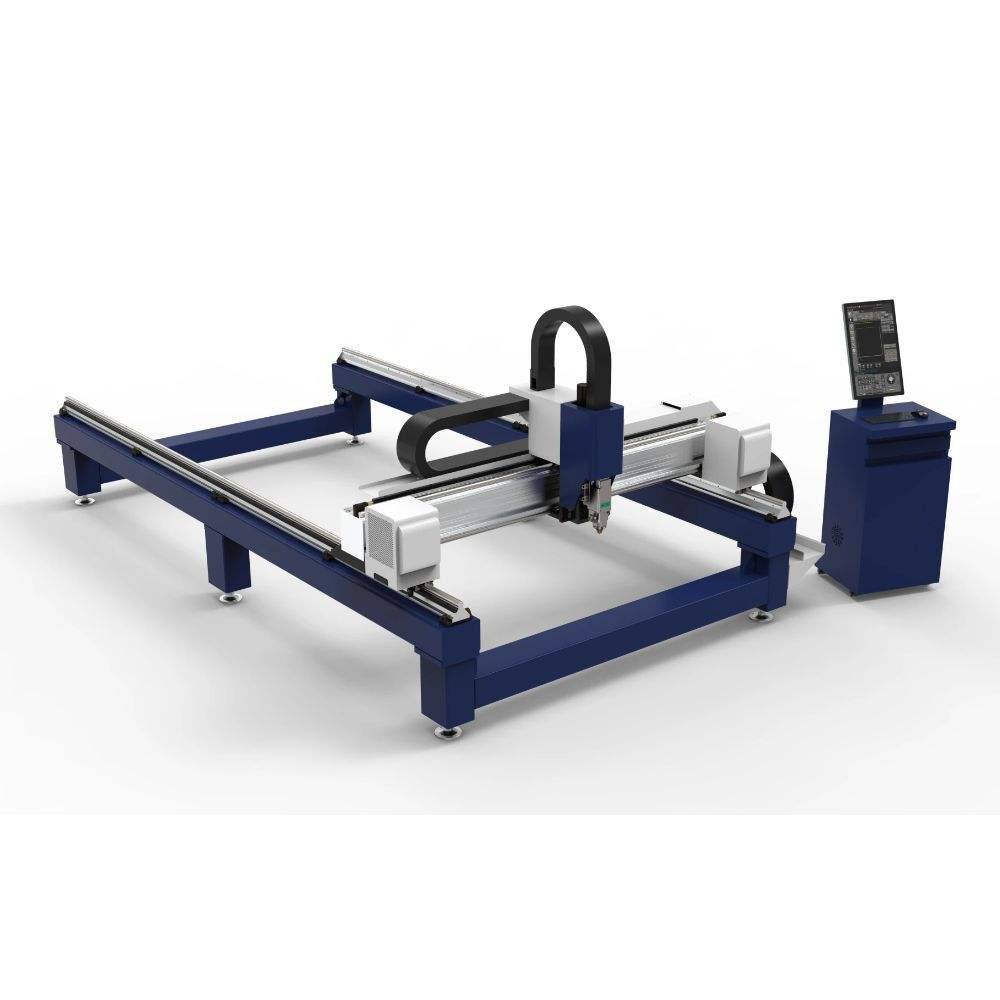
Structural Engineering: The Tube-welded Standard Bed Advantage
The foundation of any precision laser system is its bed. In high-speed laser cutting, the machine is subjected to intense acceleration and deceleration forces (often exceeding 1.2G). For the Tijuana market, where production environments can be demanding, the Tube-welded Standard Bed offers a specific set of engineering advantages over traditional cast-iron or plate-welded frames.
The tube-welded bed is constructed using high-strength structural steel tubes. These tubes are strategically arranged and welded to create a lattice-like internal structure. This design provides an exceptional strength-to-weight ratio. From an engineering perspective, the hollow sections of the tubes allow for superior vibration damping compared to solid plate frames. In a 2kW system, where the cutting head moves at high frequencies to achieve precision on intricate automotive parts, the ability to dissipate kinetic energy quickly is paramount.
Furthermore, these beds undergo rigorous stress-relief processes. After welding, the frame is subjected to high-temperature annealing. This process reorganizes the molecular structure of the steel, removing internal stresses created during the welding process. For an automotive factory in Tijuana, this means the machine maintains its geometric alignment over years of multi-shift operation, preventing the “frame creep” that can lead to accuracy drift in lower-quality equipment.
Precision Cutting of Stainless Steel: Metallurgy and Gas Dynamics
Cutting stainless steel requires a sophisticated understanding of thermodynamics. Unlike carbon steel, which often utilizes an exothermic reaction with oxygen to assist the cut, high-precision stainless steel cutting typically utilizes high-pressure Nitrogen (N2) as an assist gas.
The 2kW laser source provides enough energy to melt the stainless steel instantly, while the Nitrogen gas expels the molten material from the kerf. Because Nitrogen is an inert gas, it prevents oxidation of the cut edge. For automotive engineers, this is a non-negotiable requirement; an oxidized edge on a stainless steel part is a point of failure for both aesthetics and corrosion resistance. The resulting “silver” edge requires no post-processing, allowing parts to move directly from the laser bed to the welding or assembly station.
The precision of a 2kW system is also defined by its kerf width—the amount of material removed by the laser. In a well-calibrated system, the kerf can be as narrow as 0.1mm. This allows for the nesting of complex automotive brackets with minimal bridge distance, significantly increasing material utilization and reducing scrap costs—a vital metric for high-volume Maquiladora operations.

Kinematics and Motion Control in Automotive Fabrication
The performance of the 2kW laser is only as good as the motion system that carries it. For precision stainless steel work, the integration of high-torque AC servo motors and precision rack-and-pinion systems is essential. In the Tijuana automotive cluster, where parts often feature complex geometries and small-diameter holes, the dynamic response of the gantry is the deciding factor in part quality.
A tube-welded standard bed facilitates a lighter gantry design without sacrificing rigidity. A lighter gantry has lower inertia, allowing the motion control system to execute direction changes with higher fidelity. This is particularly important when cutting 300-series stainless steel, which has a higher coefficient of thermal expansion than carbon steel. Rapid, precise movements ensure that the heat input is localized and fleeting, preventing the warping or “bowing” of thin-gauge stainless steel sheets.
Data-Driven Efficiency: Power Consumption and ROI
For factory owners, the engineering specs must translate into financial performance. Fiber laser technology is inherently more efficient than older CO2 technology, boasting a wall-plug efficiency of approximately 30-35%. A 2kW fiber laser system consumes significantly less electricity while delivering faster cutting speeds on stainless steel up to 5mm.
In the Tijuana market, where utility costs and labor rates are key variables in the “cost-per-part” equation, the 2kW system offers a compelling ROI. The lack of consumable mirrors (as found in CO2 lasers) and the long lifespan of the fiber diodes (often rated for 100,000 hours) minimize maintenance downtime. When integrated with a tube-welded bed that requires less frequent leveling and calibration, the total cost of ownership (TCO) is optimized for the high-uptime requirements of automotive manufacturing.
Technical Specification Breakdown for Engineering Evaluation
When evaluating a 2kW system for a Tijuana-based facility, engineers should look for the following technical benchmarks:
1. Beam Quality (M2): For stainless steel, an M2 < 1.1 is preferred, ensuring a tight focal spot for high power density. 2. Positioning Accuracy: +/- 0.03mm per meter. This ensures that large-format sheets used for automotive chassis components remain within tolerance across the entire bed. 3. Repetition Accuracy: +/- 0.02mm. Essential for multi-part runs where consistency is required for robotic assembly downstream. 4. Acceleration: 1.0G to 1.5G. This allows the machine to reach its commanded cutting speed quickly, even on short segments and small radii.
Thermal Management and Environmental Stability
Tijuana’s climate, while generally mild, can present challenges in a factory environment regarding dust and temperature fluctuations. A professional-grade 2kW laser system must include a dual-circuit industrial chiller. One circuit cools the fiber laser source, while the other cools the cutting head optics.
The tube-welded bed also plays a role in thermal stability. The geometry of the structural tubing allows for better airflow around the frame, preventing localized heat buildup during long production shifts. Additionally, the high-quality dust extraction systems integrated into the bed design are crucial when cutting stainless steel. The fine metallic dust produced during the fiber laser process is abrasive; efficient extraction protects the precision linear guides and rack systems from premature wear.
Integration into the Tijuana Maquiladora Workflow
Successful implementation of a 2kW precision laser goes beyond the hardware. It requires integration with CAD/CAM software that can handle the specific nesting requirements of the automotive industry. Modern systems allow for direct import of STEP or DXF files, with automated nesting algorithms that optimize grain direction—a critical factor when the mechanical properties of the stainless steel part are paramount.
Furthermore, the proximity of Tijuana to San Diego and the wider California tech corridor allows for a unique synergy in technical support and parts availability. However, the machine’s local reliability is enhanced by the robust nature of the tube-welded bed, which is designed to withstand the rigors of 24/7 operation common in the region’s top-tier factories.
Conclusion: The Strategic Advantage of Precision
For the automotive factory owner or engineer in Tijuana, the 2kW precision laser system is more than just a cutting tool; it is a strategic asset. By combining the structural stability of a tube-welded standard bed with the refined power of a 2kW fiber source, manufacturers can achieve the precision, speed, and reliability required to compete on a global scale.
As the automotive industry moves toward lighter, more corrosion-resistant materials, the ability to process stainless steel with high efficiency will remain a competitive moat. Investing in a system that prioritizes structural integrity and metallurgical precision ensures that your facility is not just meeting today’s standards, but is prepared for the engineering challenges of the next decade in the heart of Mexico’s manufacturing powerhouse.
















