
Engineering Overview: The 2kW Fiber Laser in Queretaro’s Aerospace Ecosystem
The industrial landscape of Queretaro, Mexico, has evolved into one of the most sophisticated aerospace hubs globally. For factory owners and lead engineers operating within the Queretaro Aerocluster, the demand for high-precision components manufactured from carbon steel is increasing. The 2kW fiber laser cutting machine represents a critical technological pivot for local facilities, offering a balance of power, precision, and operational cost-efficiency that traditional CO2 lasers or plasma cutters cannot match.
In an environment where AS9100 standards are the baseline, the adoption of 2kW fiber technology provides the necessary thermal control and mechanical stability required for aerospace-grade carbon steel processing. This guide examines the engineering fundamentals of these machines, focusing specifically on the structural integrity of the tube-welded standard bed and the nuances of high-precision carbon steel fabrication.
Structural Integrity: The Tube-welded Standard Bed
The foundation of any high-precision CNC machine is its bed. In the 2kW fiber laser category, the tube-welded standard bed is engineered to provide a high strength-to-weight ratio, which is essential for the rapid acceleration and deceleration cycles (often exceeding 1.0G) characteristic of modern laser paths.
Unlike lighter sheet-metal frames, the tube-welded structure utilizes high-quality industrial carbon steel rectangular tubes. These tubes are welded into a reinforced lattice that undergoes a rigorous stress-relief process. In Queretaro’s manufacturing environment, where ambient temperatures can fluctuate, thermal stability is paramount. The tube-welded bed is subjected to high-temperature annealing and natural aging to eliminate internal stresses. This ensures that the machine bed remains dimensionally stable over years of multi-shift operations, preventing the “frame twist” that compromises cutting accuracy.
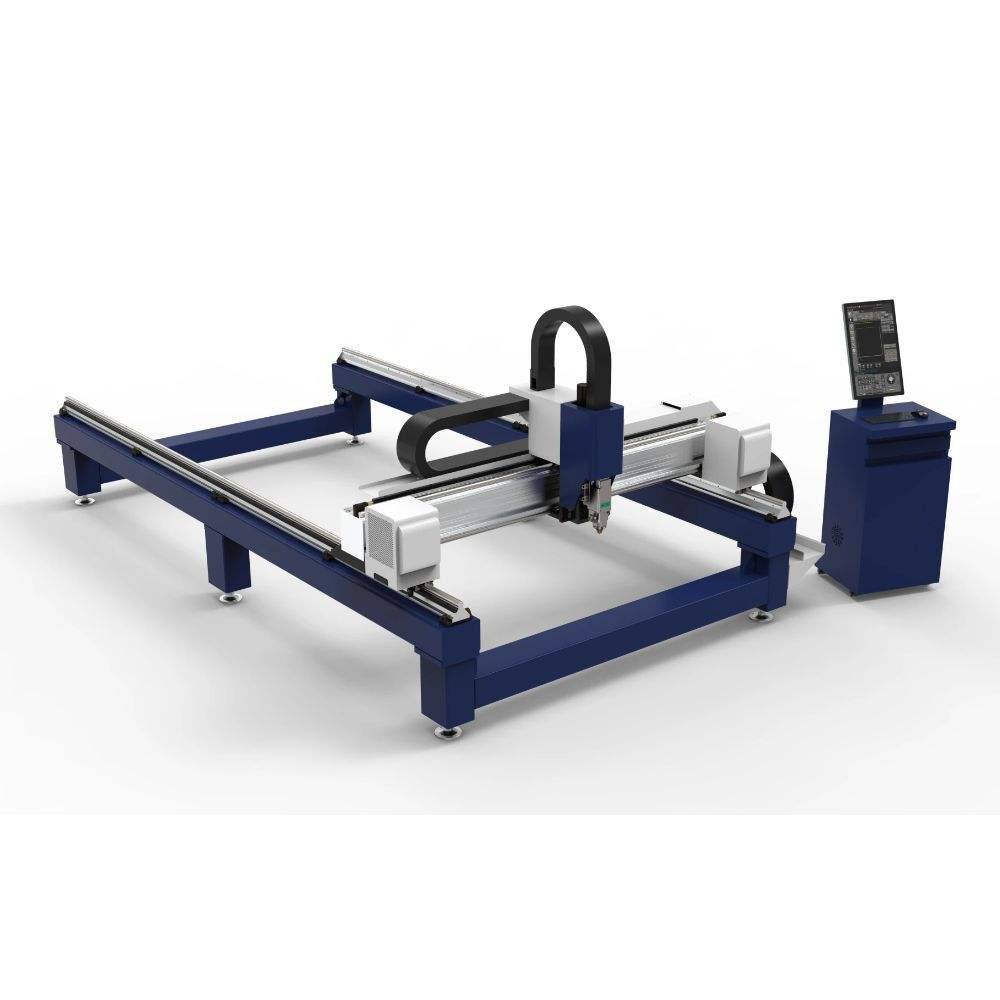
From an engineering perspective, the hollow structure of the tube-welded bed allows for superior vibration damping. When the gantry moves at speeds of up to 100m/min, the kinetic energy must be dissipated effectively. The inherent geometry of the welded tubes absorbs these micro-vibrations, ensuring that the laser focal point remains consistent within a +/- 0.03mm tolerance. This structural rigidity is the primary reason why tube-welded beds are preferred for 2kW systems targeting the aerospace and automotive supply chains in Central Mexico.
Laser Dynamics and Carbon Steel Interaction
Carbon steel is a staple in aerospace ground support equipment, structural brackets, and tooling. A 2kW fiber laser source, typically operating at a wavelength of 1.064 microns, is highly absorbed by carbon steel, making the cutting process significantly more efficient than CO2 alternatives.
The 2kW power rating is specifically optimized for carbon steel thicknesses ranging from 0.5mm to 16mm. While 20mm is achievable, the “sweet spot” for high-precision, aerospace-grade edges lies between 1mm and 12mm. At these thicknesses, the 2kW beam maintains a narrow kerf width, minimizing material waste and allowing for the nesting of complex geometries.
The precision of the cut is dictated by the interaction between the laser beam, the auxiliary gas (typically Oxygen for carbon steel), and the material’s carbon content. In 2kW systems, the use of high-pressure Oxygen facilitates an exothermic reaction that increases cutting speed while maintaining a clean, dross-free lower edge. For engineers, this means a reduction in secondary finishing processes, such as grinding or deburring, which directly impacts the throughput of the Queretaro production line.
High-Precision Components: Gantry and Motion Control
To complement the stability of the tube-welded bed, 2kW fiber lasers utilize aerospace-grade aluminum gantries. These gantries are manufactured using high-pressure casting or extrusion processes to minimize weight without sacrificing stiffness. A lighter gantry allows the servo motors (typically Yaskawa or Delta) to achieve higher dynamic responses.
The motion control system usually employs a high-precision rack and pinion drive combined with linear guide rails from manufacturers like HIWIN or PMI. For a 2kW machine specialized in carbon steel, the positioning accuracy is generally rated at ±0.03mm per meter, with a repeatability of ±0.02mm. In the context of Queretaro’s aerospace manufacturing, these specifications are vital for ensuring that every part in a 1,000-unit run is identical, meeting the stringent quality control requirements of Tier 1 and Tier 2 suppliers.

Optimizing the Cutting Head for Carbon Steel
The cutting head is the “business end” of the 2kW fiber laser. Specialized heads, such as those from Raytools or Precitec, feature automated focusing capabilities. In carbon steel processing, the focal point must be adjusted precisely relative to the material surface to control the kerf shape and the Heat Affected Zone (HAZ).
For thinner carbon steel sheets, the focus is typically placed on or slightly above the surface. As the thickness increases toward 12mm-16mm, the focus is moved deeper into the material. The 2kW system’s ability to maintain a stable BPP (Beam Parameter Product) ensures that the laser intensity remains consistent throughout the depth of the cut. This results in a perpendicularity tolerance that meets international standards, preventing the “tapered” edge often seen in lower-quality machines or plasma systems.
Data-Driven Performance: Speed and Efficiency
For Queretaro factory owners, the decision to invest in 2kW fiber technology is often driven by the Return on Investment (ROI) calculated through cutting speeds and operational costs. On average, a 2kW fiber laser will cut 2mm carbon steel at speeds exceeding 8-10 meters per minute. Even at the upper limit of 12mm carbon steel, the machine maintains a steady 1.2 to 1.5 meters per minute.
Furthermore, the wall-plug efficiency of a fiber laser is approximately 30-35%, compared to the 8-10% seen in CO2 lasers. In the Mexican industrial sector, where energy costs are a significant overhead, this 70% reduction in power consumption for the laser source alone provides a competitive advantage. Additionally, the fiber laser requires no laser gas (like Helium or CO2) and has no mirrors to align, reducing maintenance downtime by an estimated 50% over a five-year lifecycle.
Environmental and Safety Considerations in Queretaro
Operating a 2kW fiber laser in Queretaro requires adherence to both local (NOM) and international safety standards. Fiber lasers operate at a wavelength that is extremely hazardous to the human eye. Therefore, machines are equipped with full enclosures featuring certified laser-protective glass (OD4+ or higher).
The cutting of carbon steel produces significant particulate matter and fumes. A professional 2kW setup includes a high-capacity dust extraction and filtration system. For aerospace facilities, maintaining a clean air environment is not just a safety requirement but a necessity for protecting other sensitive metrology and CNC equipment on the factory floor. The tube-welded bed design often incorporates segmented dust collection zones that open and close based on the current position of the cutting head, maximizing suction efficiency.
Engineering Conclusion: Selecting the Right Tool for the Region
For the Queretaro market, the 2kW fiber laser cutting machine with a tube-welded standard bed is more than just a tool; it is a strategic asset. It addresses the specific needs of the aerospace and automotive sectors by providing high-precision carbon steel processing with a machine structure designed for longevity and stability.
Engineers must prioritize the synergy between the bed’s structural damping, the motion control’s precision, and the laser source’s efficiency. By focusing on these technical advantages, Queretaro-based manufacturers can ensure they remain at the forefront of the global supply chain, delivering components that meet the highest standards of accuracy and reliability. The transition to 2kW fiber technology represents the modern standard for carbon steel fabrication, offering a future-proof solution for the region’s evolving industrial demands.
















