
Engineering Optimization: 2kW Fiber Laser Integration in the Queretaro Aerospace Cluster
The aerospace manufacturing sector in Queretaro has evolved into one of the most sophisticated industrial ecosystems in North America. For factory owners and lead engineers operating within the Bajío region, the demand for high-precision components—particularly those fabricated from aluminum alloys—requires a shift from traditional mechanical milling to advanced thermal cutting solutions. The 2kW fiber laser cutting machine represents the optimal intersection of power efficiency and structural stability for the production of aerospace-grade brackets, shims, and interior housing components.
As Queretaro continues to attract Tier 1 and Tier 2 suppliers for global OEMs like Bombardier, Airbus, and GE Aviation, the technical requirements for edge quality and dimensional tolerance have become non-negotiable. This guide examines the engineering advantages of the 2kW fiber laser system, focusing specifically on the structural integrity of the tube-welded standard bed and the nuances of high-precision aluminum processing.
Structural Integrity: The Engineering Behind the Tube-Welded Standard Bed
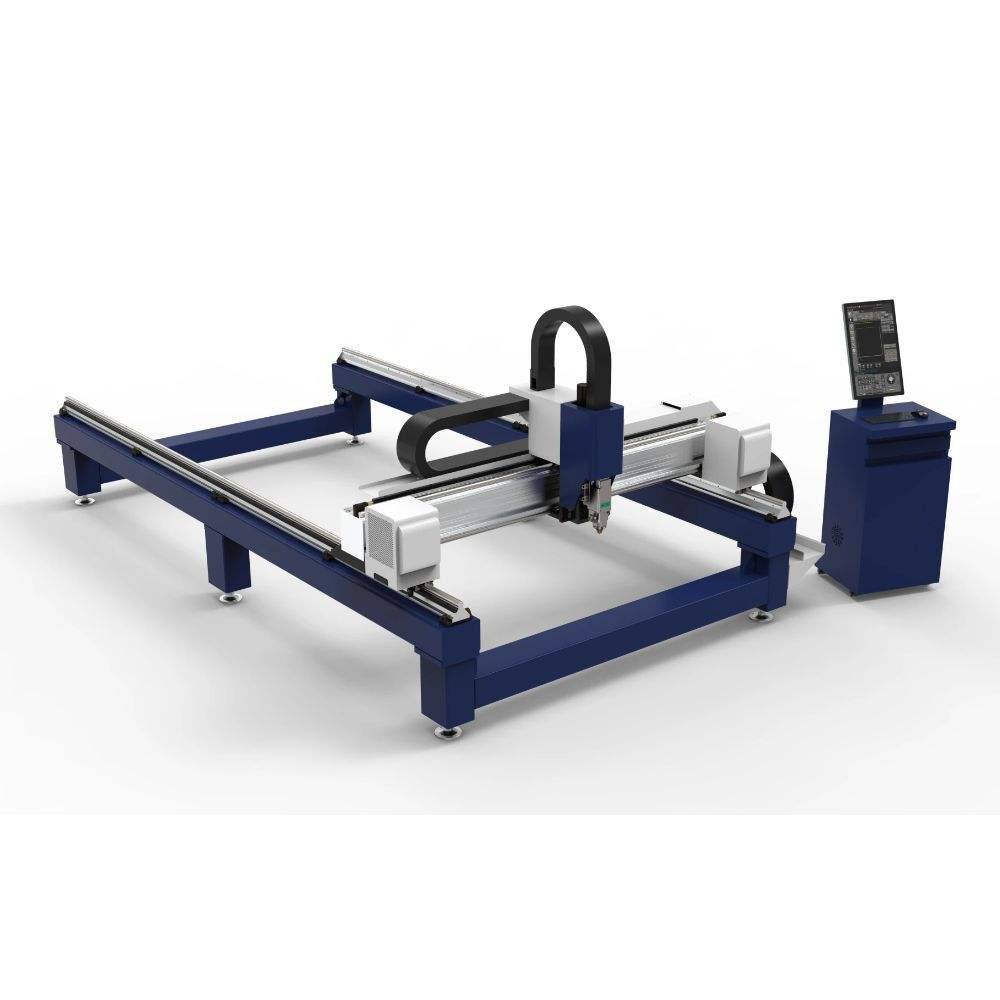
In high-speed laser cutting, the mechanical foundation of the machine dictates the long-term accuracy of the output. While cast iron beds offer high mass, the modern tube-welded standard bed has emerged as the preferred architectural choice for 2kW systems due to its superior strength-to-weight ratio and dynamic response.
The bed is constructed using high-quality industrial rectangular steel tubes. Through a process of internal reinforcement and strategic ribbing, the frame achieves a structural rigidity that resists the inertial forces generated by the gantry’s high acceleration (typically 1.0G to 1.2G). For an aerospace engineer, this translates to reduced vibration during high-speed directional changes, ensuring that the laser focal point remains consistent within microns.
To ensure long-term stability, these beds undergo a rigorous stress-relief process. After welding, the frame is subjected to high-temperature annealing in a controlled furnace. This thermal treatment eliminates the internal stresses created during the welding process, preventing the bed from warping or deforming over years of operation in the fluctuating temperatures of a Queretaro industrial park. The result is a machine tool that maintains a positioning accuracy of ±0.03mm and a repeatability of ±0.02mm throughout its lifecycle.

Optimizing the 2kW Beam for Aluminum Alloy Processing
Aluminum alloys, such as 2024, 6061, and 7075, are staples of aerospace engineering due to their high strength-to-weight ratios. However, they present unique challenges for laser cutting: high thermal conductivity and high reflectivity. A 2kW fiber laser is uniquely suited to overcome these hurdles through its specific wavelength (approximately 1.064 micrometers) and high power density.
At 2kW, the laser beam provides sufficient energy to instantly vaporize the material surface, creating a “keyhole” effect that minimizes the reflection of the laser back into the optics. This is a critical safety and maintenance consideration; older CO2 lasers often suffered from back-reflection damage when cutting aluminum. Modern 2kW fiber systems utilize advanced optical isolators and protective windows to ensure the resonator remains shielded from reflected light.
Furthermore, the 2kW power level allows for the use of high-pressure nitrogen as an assist gas. Nitrogen cutting is essential for aerospace applications because it prevents oxidation of the cut edge. This results in a “bright” finish that requires little to no post-processing before welding or coating, significantly reducing the Total Cost of Ownership (TCO) for Queretaro-based workshops.
Precision Metrics: Kerf Width and Heat-Affected Zone (HAZ)
In aerospace engineering, the Heat-Affected Zone (HAZ) is a critical parameter. Excessive heat can alter the grain structure of aluminum alloys, potentially leading to stress corrosion cracking or fatigue failure in flight-critical components. The 2kW fiber laser minimizes the HAZ by concentrating energy into an extremely small spot size (typically 100-150 microns).
Data-driven analysis of 2kW laser performance on 3mm 6061-T6 aluminum shows:
1. Kerf Width: 0.15mm to 0.25mm, allowing for extremely tight nesting and complex geometries.
2. HAZ Depth: Less than 0.1mm, preserving the mechanical properties of the parent material.
3. Edge Roughness (Ra): 6.3 to 12.5 μm, meeting the stringent requirements for non-structural aerospace components.
By utilizing a high-precision CNC controller with real-time power modulation, the machine can automatically reduce power during cornering. This prevents “over-burning” at the vertices of a part, a common issue in lower-tier machines that compromises dimensional accuracy.
Technical Advantages for the Queretaro Market
The Queretaro industrial market is characterized by a high demand for “just-in-time” (JIT) production and a need for versatility. The 2kW fiber laser machine with a tube-welded bed offers several localized advantages:
1. Energy Efficiency: Compared to traditional milling or plasma cutting, the 2kW fiber laser consumes significantly less electricity. Given the rising energy costs in Central Mexico, the wall-plug efficiency (WPE) of over 30% provides a direct competitive advantage in contract bidding.
2. Footprint Optimization: The standard bed design is compact, allowing aerospace shops to maximize their floor space. In specialized industrial parks like the Queretaro Aerospace Park (PAQ), where square footage is at a premium, this efficiency is vital.
3. Low Maintenance Requirements: Unlike CO2 lasers that require gas mixtures for the resonator and frequent mirror alignments, the fiber laser delivers the beam via a flexible fiber optic cable. This solid-state design is ideal for the dusty or high-vibration environments sometimes found in large-scale fabrication facilities.
Implementation Strategy: From CAD to Component
For engineers integrating a 2kW fiber laser into their workflow, the software-hardware synergy is paramount. Most modern systems utilize advanced CAD/CAM integration (such as CypCut or similar platforms) that allows for direct import of DXF or STEP files.
For aluminum processing, the software must manage:
– Lead-in/Lead-out Optimization: To prevent dross accumulation at the start of the cut.
– Micro-jointing: To keep small aerospace parts from falling through the slats or tilting and causing a collision with the laser head.
– Leapfrog Tracking: To minimize the non-cutting movement time of the gantry, maximizing parts-per-hour.
In the context of Queretaro’s aerospace supply chain, traceability is also a factor. Many 2kW systems now include laser marking capabilities, allowing for the etching of part numbers and heat lot codes directly onto the aluminum component during the cutting cycle, ensuring 100% compliance with AS9100 standards.
Conclusion: Future-Proofing Aerospace Production
The selection of a 2kW fiber laser cutting machine with a tube-welded standard bed is a strategic investment in precision and reliability. For the aerospace sector in Queretaro, where the margin for error is non-existent, the technical advantages of this configuration—specifically its vibration damping, thermal stability, and superior aluminum processing capabilities—provide a clear path to operational excellence.
By focusing on the data-driven performance of the fiber laser, engineers can ensure that their facilities remain at the forefront of the Bajío region’s industrial evolution. As aluminum continues to be the backbone of aerospace design, the ability to cut it with high precision, minimal waste, and zero oxidation will define the market leaders of the next decade.
















