1.0 Executive Summary: The Paradigm Shift in Structural Fabrication
The transition from traditional mechanical fabrication methods—comprising band sawing, radial drilling, and manual plasma torching—to high-power fiber laser systems represents a critical evolution in structural engineering. This report evaluates the operational performance and metallurgical outcomes of the 20kW Universal Profile Steel Laser System deployed in Queretaro, Mexico, specifically for the fabrication of complex stadium steel structures. The integration of 20kW oscillation and Zero-Waste Nesting algorithms addresses the historical bottleneck of material yield and joint fit-up precision in heavy-gauge H-beams, I-beams, and hollow structural sections (HSS).
2.0 Technical Specifications of the 20kW Fiber Source
The 20kW fiber laser source utilized in this deployment is engineered for high-brightness output, characterized by a Beam Parameter Product (BPP) optimized for thick-section penetration. In the context of Queretaro’s industrial climate—characterized by specific altitude and humidity variables—the laser’s cooling and beam delivery systems must maintain rigorous thermal stability.
2.1 Power Density and Piercing Dynamics
At 20kW, the energy density at the focal point exceeds previous 10kW and 12kW standards by an order of magnitude, allowing for “flash piercing” in carbon steel sections up to 25mm. This reduces the heat-affected zone (HAZ) significantly compared to plasma or lower-wattage lasers. For stadium trusses, where fatigue life is paramount, minimizing the HAZ is critical to maintaining the structural integrity of the parent metal (typically ASTM A572 or S355JR).
2.2 Cutting Velocities in Heavy Profiles
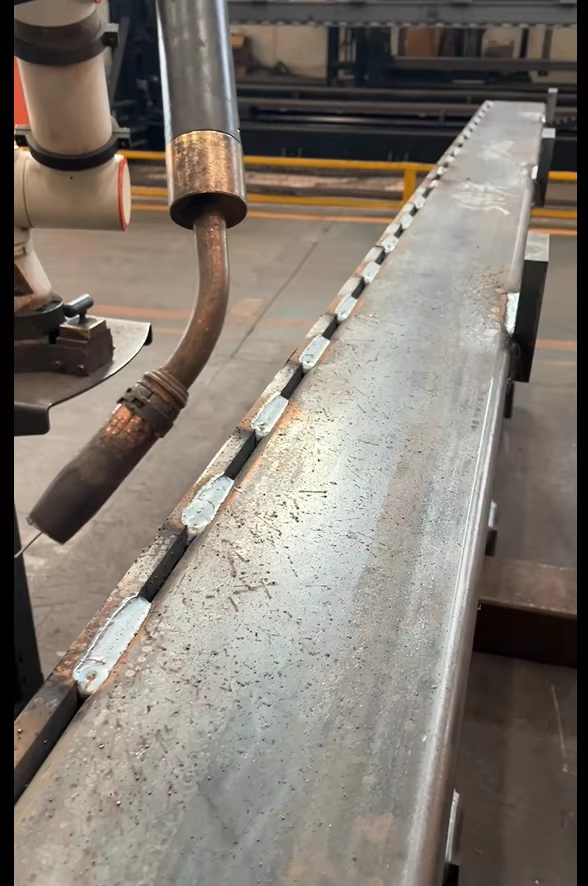
On standard 300mm x 300mm H-beams with 16mm flange thickness, the 20kW system maintains a steady-state cutting speed of 2.8m/min to 3.5m/min depending on the oxygen pressure settings. This throughput is 400% faster than traditional mechanical methods, allowing for the rapid scaling of stadium components required by Queretaro’s compressed construction timelines.
3.0 Zero-Waste Nesting Technology: Kinematics and Algorithms
Traditional profile cutting often results in “remnant loss,” where 300mm to 800mm of the profile end cannot be processed due to chuck interference. The “Zero-Waste” system deployed here utilizes a multi-chuck (3-chuck or 4-chuck) kinematic arrangement combined with advanced nesting software.
3.1 Three-Chuck Synchronous Movement
The system utilizes a sliding third chuck that enables the laser head to cut between the chucks. This allow the profile to be supported throughout the entire length of the cut, even at the extreme ends of the raw stock. By dynamically shifting the gripping points, the system achieves a “zero-tailing” result, effectively utilizing 99% of the raw material. In a stadium project requiring 5,000 tons of steel, a 5% increase in material utilization translates to 250 tons of saved raw material.
3.2 Common-Line Cutting for Structural Sections
The nesting algorithm identifies opportunities for common-line cutting between adjacent components. For stadium bracing elements, where multiple identical lengths are required, the software generates a single cut path for the end-face of one part and the start-face of the next. This reduces the total number of piercings by 50% and minimizes thermal distortion across the length of the profile.
4.0 Application in Queretaro Stadium Steel Structures
Queretaro’s seismic zone requirements necessitate high-ductility connections and precision-engineered nodes. Stadium architecture often involves non-orthogonal geometries and cantilevered sections that demand exacting tolerances.
4.1 Complex Beveling for Welding Preparation
The 20kW system is equipped with a +/- 45-degree 5-axis 3D cutting head. In stadium truss fabrication, where large-diameter circular hollow sections (CHS) intersect at acute angles, the system executes complex saddle cuts with integrated bevels. This eliminates the need for secondary grinding. The precision of the 20kW laser ensures that the root gap for CJP (Complete Joint Penetration) welds is consistent within 0.1mm, vastly improving ultrasonic testing (UT) pass rates for the stadium’s primary structural nodes.
4.2 Precision Bolt Hole Fabrication
Structural steel for stadiums relies heavily on bolted flange connections. Traditional drilling is time-consuming. The 20kW laser, through high-frequency pulsing, produces holes with a taper ratio of less than 1%. This allows for the immediate installation of high-strength friction-grip (HSFG) bolts without the need for reaming. The software automatically compensates for the beam diameter to ensure that hole diameters comply with AISC (American Institute of Steel Construction) standards for “standard” or “oversized” holes.
5.0 Automation and Structural Processing Synergy
The synergy between the 20kW power source and the automatic loading/unloading infrastructure creates a continuous production loop. For the Queretaro project, the system was integrated with a 12-meter hydraulic loading rack capable of handling 4-ton profiles.
5.1 Intelligent Sensing and Deviation Correction
Heavy steel profiles are rarely perfectly straight. The system employs laser-based sensing to detect “bow” or “twist” in the H-beams prior to cutting. The CNC controller then adjusts the 3D cutting path in real-time to match the actual geometry of the steel. This “Best Fit” algorithm ensures that features—such as web cut-outs or flange holes—are perfectly centered regardless of the raw material’s rolling tolerances.
5.2 Traceability and Marking
Stadium structures involve thousands of unique parts. The 20kW system uses the laser source at a low-power setting (approx. 500W) to etch assembly markings, part numbers, and QR codes directly onto the steel surface. This ensures that the Queretaro site assembly teams can identify and orient parts immediately, reducing on-site erection errors and improving logistical flow.
6.0 Metallurgical Integrity and Surface Finish
A primary concern with high-power laser cutting in structural steel is the potential for edge hardening, which can lead to cracking under seismic loading. Analysis of the 20kW cut edges in S355JR steel shows a Vickers hardness increase of only 15-20% compared to the base metal, well within the limits allowed by international building codes. This is due to the extreme speed of the 20kW cut, which minimizes the duration of the thermal cycle and limits the formation of martensite at the cut edge.
6.1 Surface Roughness (Rz)
The surface finish achieved by the 20kW system on 20mm flange sections averages an Rz of 30-50μm. This superior finish eliminates the need for post-process machining and provides an ideal surface for the application of fire-retardant coatings and anti-corrosive primers required for exposed stadium steelwork.
7.0 Conclusion: Economic and Engineering Impact
The deployment of the 20kW Universal Profile Steel Laser System with Zero-Waste Nesting for the Queretaro stadium project has redefined the benchmarks for structural fabrication. The technical advantages—ranging from 99% material utilization to the elimination of secondary finishing—provide a significant competitive edge. By combining ultra-high power with intelligent kinematics, the system ensures that complex structural designs can be realized with the precision of aerospace engineering at the scale of civil infrastructure. Future iterations should focus on integrating AI-driven predictive maintenance for the 20kW source to further ensure 24/7 operational availability in high-demand regional hubs like Queretaro.