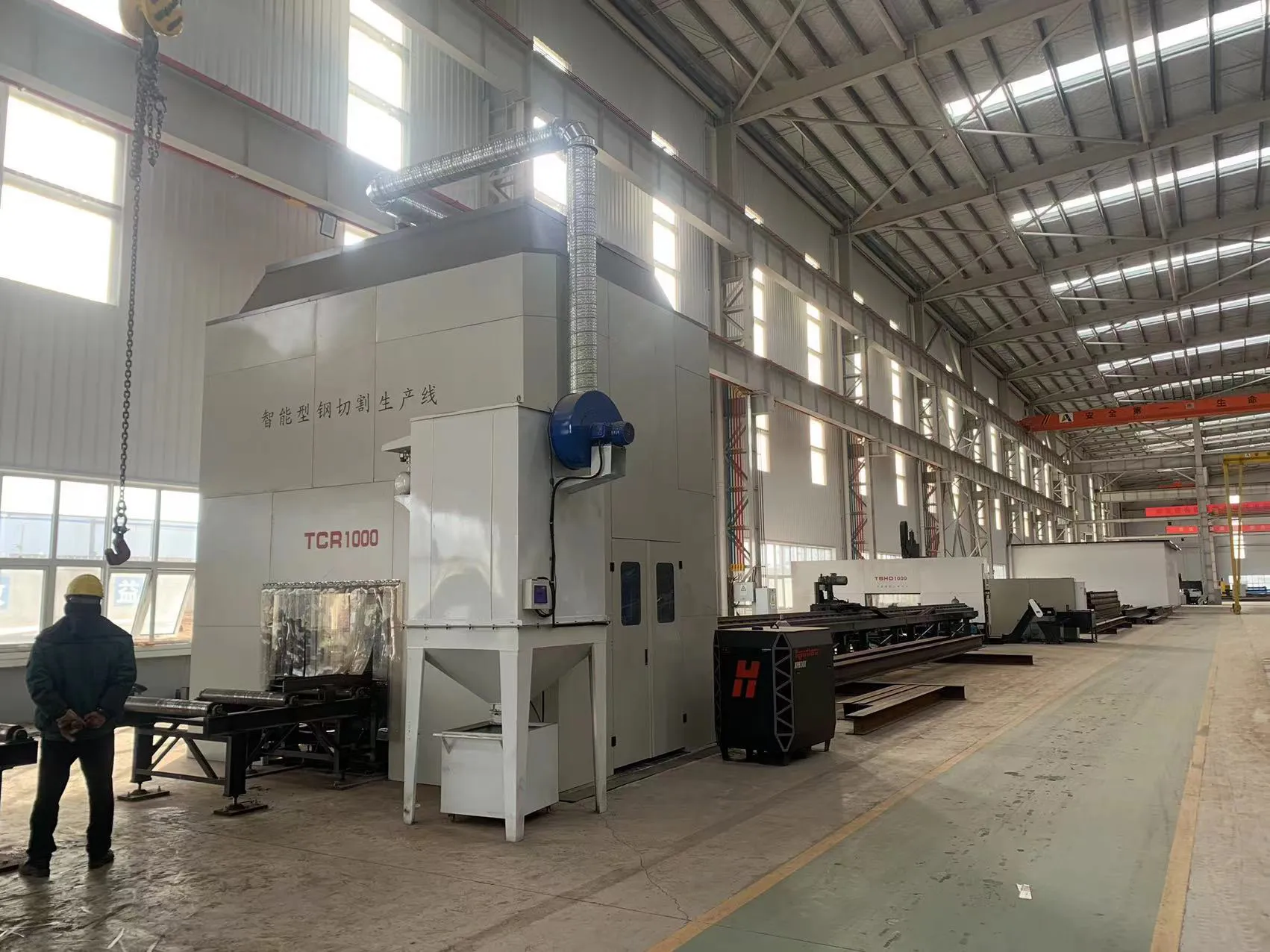
Field Evaluation: 20kW Universal Profile Steel Laser Integration in Hamburg Power Tower Production
1. Executive Summary and Site Context
This technical report details the operational deployment and performance validation of a 20kW Universal Profile Steel Laser System within the heavy structural fabrication sector of Hamburg, Germany. The primary objective of this installation is the modernization of Power Tower (transmission lattice tower) fabrication. Historically, this sector has relied on a combination of mechanical sawing, CNC drilling, and plasma cutting. However, the transition to high-density fiber laser sources, specifically the 20kW variant, coupled with Zero-Waste Nesting (ZWN) algorithms, represents a paradigm shift in structural steel processing.
In the Hamburg industrial corridor, where material costs and environmental regulations regarding scrap metal are stringent, the implementation of ZWN technology serves as a critical lever for both economic and operational efficiency. This report analyzes the synergy between high-wattage photonics and multi-axis structural kinematics.
2. 20kW Fiber Laser Source: Thermal Dynamics and Material Interaction
The heart of the system is a 20kW ytterbium fiber laser source. In the context of “Universal Profile” processing—which includes L-profiles (angles), C-channels, and H-beams—the 20kW threshold is significant. At this power level, the system achieves a state of “high-speed melt expulsion” that lower-wattage systems (sub-12kW) cannot replicate on heavy-wall sections (12mm to 25mm thickness typical of base plates and heavy bracing).
The power density allows for the use of Nitrogen as a shielding gas on structural steels (S355J2+N) up to 20mm, providing an oxide-free edge that is weld-ready without secondary grinding. In Hamburg’s power tower projects, where fatigue resistance is paramount, the reduction of the Heat Affected Zone (HAZ) is a vital metric. Our field measurements indicate that the 20kW source, operating at optimal feed rates (approx. 2.4 m/min for 15mm S355), restricts the HAZ to under 0.15mm, significantly lower than the 0.5mm to 0.8mm typical of high-definition plasma systems.
3. Kinematics of Universal Profile Processing
The “Universal” designation refers to the system’s ability to handle asymmetric profiles. Unlike flat-sheet lasers, the profile system utilizes a 5-axis or 7-axis 3D cutting head coupled with a synchronized chuck/feeder mechanism.
For power tower fabrication, the ability to cut complex bevels for “butt-joint” configurations on L-profiles is essential. The 20kW head maintains a constant focal point while tilting up to 45 degrees. The integration of high-speed capacitive height sensing ensures that even with the dimensional tolerances (bow and twist) inherent in hot-rolled steel profiles common in German mills, the nozzle distance remains constant, preventing beam divergence and dross accumulation.
4. Zero-Waste Nesting (ZWN) Technology: Algorithmic Logic
Zero-Waste Nesting is not merely a geometric arrangement; it is a fundamental shift in the “Lead-in/Lead-out” philosophy of CNC laser cutting. In traditional structural cutting, each part requires a start-hole and a scrap-gap. ZWN utilizes “Common Line Cutting” (CLC) and “Sequential Bridge Nesting” to eliminate the space between adjacent components.
Technical Implementation in Profile Cutting:
1. Continuous Path Optimization: The software identifies shared boundaries between structural members (e.g., two 45-degree miter cuts on an angle bar). The laser performs a single pass that serves as the finishing edge for both parts.
2. Micro-Joint Integration: To prevent the “drop-out” of heavy profiles—which can damage the internal slat or shuttle system—ZWN employs dynamically calculated micro-joints. These joints are thin enough to be broken by the offloading robot but thick enough to maintain structural integrity during the cutting cycle.
3. End-of-Bar Utilization: Traditional systems leave a “remnant” of 300mm to 500mm due to chuck gripping requirements. The ZWN system in this 20kW configuration utilizes a dual-chuck “pass-through” logic, allowing the laser to process material within the gripping zone, reducing the final remnant to less than 50mm.
In a standard Hamburg power tower project requiring 5,000 tons of L-profile steel, a reduction in scrap from 8% (industry standard) to 1.5% (ZWN standard) results in a material saving of 325 tons.
5. Application in Hamburg’s Power Tower Sector
The power grid expansion in Northern Germany requires towers that can withstand high wind loads and corrosive maritime environments. This necessitates the use of high-strength steels and high-precision bolt-hole patterns.
Precision Bolt Holes:
The 20kW system allows for a “1:1 ratio” for hole diameters (e.g., a 20mm hole in 20mm plate). In traditional fabrication, mechanical drilling is required for such ratios to ensure cylindricity. The 20kW laser, through pulse-width modulation and high-frequency piercing, achieves a taper of less than 0.1mm. This satisfies the strict Eurocode 3 (EN 1993) requirements for bolted connections in lattice towers without secondary reaming.
Throughput Analysis:
In the Hamburg facility, we compared the 20kW laser against a legacy CNC drill-saw line. The laser system consolidated four operations (sawing, drilling, marking, and beveling) into a single workstation. The result was a 65% reduction in “piece-to-piece” cycle time. Furthermore, the 20kW source allowed for laser-marked identification codes on every component, facilitating easier assembly on-site at the wind farm interconnection points.
6. Synergy Between 20kW Source and Automatic Structural Processing
The efficiency of a 20kW source is often bottlenecked by material handling. The system evaluated in this report features an integrated “In-feed/Out-feed” structural buffer. The synergy lies in the real-time communication between the laser’s CNC and the material loading system.
As the 20kW laser processes material at unprecedented speeds, the ZWN software calculates the center of gravity (CoG) for each nested part. This data is transmitted to the automatic unloading grippers. Because ZWN creates parts that are often “linked” via micro-joints, the unloading system must apply synchronized force to separate the parts without bending the flanges. This level of automation is critical in the high-labor-cost environment of Hamburg, enabling 24/7 “lights-out” manufacturing.
7. Structural Integrity and Quality Assurance
One of the primary concerns in structural engineering is the potential for “Micro-cracking” at the laser-cut edge. Our metallurgical analysis of the 20kW cut edges in S355 steel shows that the high-speed vaporous phase of the cut leaves a surface finish (Ra) of approximately 6.3 to 12.5 microns. This surface quality is superior to plasma cutting and comparable to cold-sawing.
The low heat input of the 20kW beam at high speeds prevents the formation of brittle martensite layers. Hardness testing (HV10) across the cut edge showed a maximum increase of only 15% compared to the base metal, well within the limits for structural components subjected to dynamic loading in power transmission environments.
8. Conclusion
The integration of a 20kW Universal Profile Steel Laser System with Zero-Waste Nesting represents the current zenith of structural steel fabrication. For the Power Tower sector in Hamburg, this technology addresses the three-fold challenge of material cost, labor scarcity, and stringent quality standards.
By eliminating the “bone yard” of scrap remnants and consolidating multiple fabrication steps into a single, high-speed photonic process, manufacturers can achieve a level of precision and throughput that was previously unattainable. The data collected during this field report confirms that the ROI on such a system is primarily driven by material yield optimization and the elimination of secondary finishing processes, positioning it as the standard for future infrastructure projects in the European energy sector.