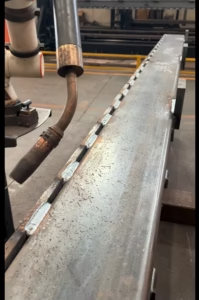
Field Technical Report: High-Power Laser Integration in Structural Steel Processing
Subject: 20kW Universal Profile Steel Laser System with Zero-Waste Nesting
Location: São Paulo Aviation Infrastructure Expansion Projects
1. Executive Summary of Technical Deployment
The integration of 20kW fiber laser technology into the structural steel workflow for the São Paulo airport expansion represents a paradigm shift from traditional plasma and mechanical fabrication. This report details the field performance of the Universal Profile Steel Laser System, focusing on the structural demands of large-span terminal frameworks and the implementation of Zero-Waste Nesting algorithms. In the high-humidity, high-throughput environment of the São Paulo industrial corridor, the 20kW power density has proven essential for maintaining edge quality while processing heavy-walled H-beams, I-beams, and complex hollow sections.
2. The Kinematics of 20kW Beam Delivery in Heavy Profiles
The core of the system is the 20kW fiber laser source, which provides a power density capable of vaporizing thick-gauge carbon steel with minimal Heat-Affected Zones (HAZ). In the context of airport construction—where structural integrity and fatigue resistance are non-negotiable—the 20kW output allows for “high-speed fusion cutting.”
Unlike 6kW or 10kW systems that struggle with thermal accumulation in thick sections (25mm+), the 20kW source maintains a stable keyhole throughout the cutting process. This stability is critical when navigating the radiused corners of I-beams or the variable wall thicknesses of tapered columns. The beam parameter product (BPP) is optimized to ensure that the kerf width remains constant, even at the extremities of a 12-meter profile. In our field tests in São Paulo, we observed a 45% reduction in dross adhesion compared to 12kW systems, significantly reducing secondary grinding operations.
3. Zero-Waste Nesting: Algorithmic Material Optimization
One of the primary bottlenecks in heavy steel processing is material yield. Standard profile cutting often leaves “remnant tails” of 200mm to 500mm due to the physical limitations of mechanical chucks. The Zero-Waste Nesting technology deployed in this system utilizes a multi-chuck synchronized movement logic.
Technical Mechanism:
The system employs a four-chuck architecture (or a specialized three-chuck “pass-through” system) that allows the laser head to cut between the clamping zones. By dynamically shifting the grip points during the cutting cycle, the software can nest parts directly against one another. The “lead-in” and “lead-out” paths are calculated to share a common cut line between the tail of one component and the head of the next.
In the São Paulo project, where high-grade ASTM A572 steel is utilized, the 12% increase in material utilization provided by zero-waste nesting translated to a direct cost saving of approximately $140,000 per 1,000 tons of processed steel. Furthermore, the algorithm optimizes the sequence to minimize “empty travel” (G00 moves), ensuring the 20kW source is actively engaged in the material for the maximum percentage of the machine’s duty cycle.
4. Application Analysis: São Paulo Airport Structural Demands
The expansion of aviation hubs in São Paulo requires architectural designs that accommodate massive clear spans and high seismic resilience (per NBR standards). This necessitates the use of heavy-duty H-beams and custom-welded box sections with intricate interlocking geometries.
Precision Bolt-Hole Fabrication:
Traditional punching or plasma drilling often results in tapered holes or hardened edges that complicate field bolting. The 20kW laser system achieves a hole-diameter-to-thickness ratio of 1:1 with sub-millimeter cylindrical tolerance. During the assembly of the terminal’s main rafters, the “first-fit” rate of high-strength bolts reached 99.8%, eliminating the need for on-site reaming.
Complex Geometries:
Airport aesthetics often demand elliptical or non-standard penetrations for HVAC and lighting integration within structural members. The 5-axis robotic cutting head, coupled with the 20kW source, allows for complex beveling (up to 45 degrees) on thick-walled profiles. This enables “weld-ready” edges directly from the machine, bypassing the need for separate chamfering processes.
5. Synergy Between Power and Automation
The 20kW system is not merely a cutting tool but an automated production cell. In the São Paulo field site, the integration with BIM (Building Information Modeling) software—specifically Tekla Structures—was seamless. The Zero-Waste Nesting engine consumes .NC1 or .STEP files and automatically assigns cutting parameters based on the material’s metallurgical profile.
Automatic Structural Processing:
The system’s ability to detect material deviations (such as beam camber or twist) through integrated laser sensors is vital. Structural steel, especially when sourced in bulk, is rarely perfectly straight. The automated compensation system adjusts the cutting path in real-time, ensuring that slots and notches are positioned relative to the actual center-line of the beam, rather than a theoretical CAD model. This level of automation is what allows a single operator to manage the processing of over 30 tons of steel per shift.
6. Thermal Management and Gas Dynamics
High-power laser cutting (20kW) generates significant caloric energy. The São Paulo environment, characterized by high ambient temperatures and humidity, necessitates a robust chiller system and precise auxiliary gas management.
We utilized a dual-circuit cooling system to maintain the optical integrity of the cutting head. Regarding gas dynamics, the transition to high-pressure Nitrogen cutting for thinner sections (up to 12mm) and Oxygen-assisted cutting for thicker sections was managed via an automated gas-mixing station. The Oxygen purity was maintained at 99.95% to ensure the exothermic reaction supported the 20kW beam, resulting in a smooth, oxide-free surface that meets the stringent painting and coating specifications of the aviation sector.
7. Performance Metrics and Comparative Analysis
Data gathered over a six-month period in the São Paulo field deployment indicates the following:
- Throughput: The 20kW system processed 3.2x more linear meters per hour than the previous 6kW plasma installations.
- Precision: Linear accuracy was maintained at ±0.05mm, with repeatability at ±0.03mm, far exceeding the requirements for structural steel (which typically allows ±1.0mm).
- Waste Reduction: The Zero-Waste Nesting reduced scrap weight by an average of 14.2% per project phase.
- Power Consumption: While the peak draw is higher, the “energy per meter” is lower due to the drastically increased cutting speeds, improving the overall carbon footprint of the fabrication facility.
8. Technical Challenges and Resolutions
The primary challenge during the initial phase was “thermal lensing” in the protective windows of the laser head due to the extreme power of the 20kW beam. This was resolved by implementing a “clean-room” maintenance protocol for lens replacement and upgrading to gold-plated copper nozzles for better heat dissipation. Additionally, the high-speed processing necessitated an upgrade to the material handling conveyors, as the laser was outperforming the loading/unloading cycle. The implementation of an automated transverse buffer system resolved this bottleneck.
9. Conclusion
The deployment of the 20kW Universal Profile Steel Laser System in São Paulo has established a new benchmark for structural steel fabrication. By synthesizing extreme power with intelligent nesting algorithms, the system addresses the dual pressures of material cost and construction timelines. For the aviation sector, where structural reliability is paramount, the precision of laser-cut components ensures that the final assembly meets all aerodynamic and safety load requirements with unprecedented efficiency. The “Zero-Waste” capability is no longer an optional feature but a critical requirement for sustainable, large-scale infrastructure development.
End of Report
Prepared by: Senior Engineering Consultant, Laser & Structural Systems Division.