The Dawn of High-Power Fiber Lasers in Wind Energy
The global transition toward sustainable energy has placed immense pressure on the supply chain for wind turbine towers. These structures, often exceeding 100 meters in height, require massive amounts of high-grade carbon steel, traditionally processed via oxy-fuel or plasma cutting. However, as an expert in fiber laser systems, I have witnessed a significant migration toward 20kW fiber laser technology.
A 20kW system is not merely “faster” than its 6kW or 10kW predecessors; it changes the physics of the cut. At 20,000 watts, the energy density at the focal point allows for the sublimation and expulsion of molten metal in thick plates (up to 50mm or more) with unprecedented efficiency. For wind turbine towers, which utilize thick-gauge S355 or S420 structural steel, the 20kW power threshold is the “sweet spot” where productivity meets metallurgical integrity. The speed of processing 20mm to 30mm plates—common in tower sections—is tripled compared to traditional methods, all while maintaining a narrow Heat Affected Zone (HAZ).
The Engineering Marvel of the Infinite Rotation 3D Head
The most critical component of a universal profile system designed for wind energy is the 3D cutting head, specifically one capable of infinite rotation. In traditional 5-axis laser systems, the cutting head is often limited by cable management; after a certain number of degrees of rotation, the head must “unwind” to prevent internal lines from snapping.
The “Infinite Rotation” technology utilized in Istanbul’s latest installations employs high-end slip-ring connectors and advanced fiber-optic coupling. This allows the head to rotate 360 degrees (and beyond) continuously. In the context of wind turbine towers, this is revolutionary. Towers are not simple cylinders; they require complex bevels (V, Y, K, and X-type joints) to ensure deep-penetration welds. When cutting holes for door frames, internal platforms, or flange bolt patterns, the 3D head can transition from a straight cut to a 45-degree bevel seamlessly without stopping to reset its orientation. This continuity results in a smoother finish and significantly reduces the cycle time per component.
Istanbul: A Strategic Hub for Wind Tower Fabrication
Istanbul has strategically positioned itself as a primary manufacturing junction between Europe and Asia. The city’s industrial zones have become fertile ground for the adoption of 20kW laser systems. The local expertise in steel fabrication, combined with the proximity to major shipping ports on the Marmara and Black Seas, makes Istanbul an ideal location for producing the massive components required for offshore and onshore wind farms.
Turkish engineers have mastered the integration of these high-power lasers into “Universal Profile” machines. These systems are not limited to flat sheets. They are designed to handle “universal” shapes—I-beams, H-beams, channels, and large-diameter tubes. For a wind turbine tower, this means the same machine can cut the massive base plates, the curved door reinforcements, and the internal structural ladders or mezzanine supports. The versatility of an Istanbul-based 20kW system reduces the need for multiple specialized machines, lowering the capital expenditure for manufacturers.
Precision Weld Preparation and Metallurgical Superiority
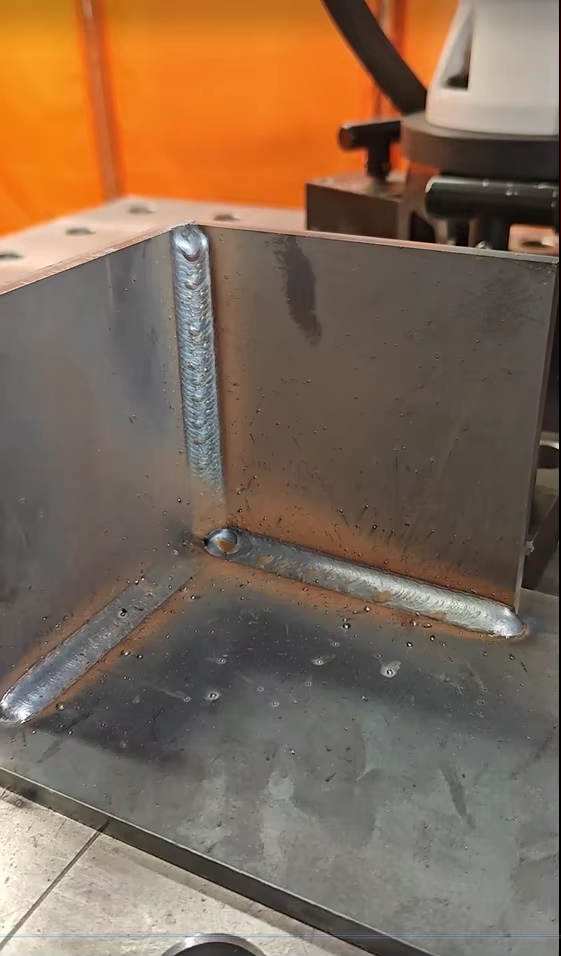
In wind turbine construction, the quality of the weld is non-negotiable. Fatigue failure in a tower can be catastrophic. Traditional plasma cutting often leaves a layer of nitrides or oxides on the cut edge, which must be mechanically ground off before welding can begin. This is a labor-intensive process that introduces human error.
The 20kW fiber laser, using high-pressure nitrogen or oxygen assist gases, produces a surface finish that is often weld-ready immediately after the cut. The precision of the infinite rotation 3D head ensures that the bevel angles are consistent within fractions of a degree. Because the laser is a non-contact process with a highly concentrated heat source, the structural integrity of the steel is preserved. There is minimal warping, even in long-span profiles, which is essential when fitting two massive tower sections together for a circumferential weld.
Solving the Complexity of Universal Profiles
Wind turbine towers are increasingly incorporating complex geometries to improve aerodynamics and structural efficiency. The “Universal Profile” aspect of these laser systems refers to their ability to adapt to these non-standard shapes. Using advanced CAD/CAM software integrated with the laser’s CNC, operators in Istanbul can import complex 3D models and automatically generate toolpaths for the 3D head.
Whether it is a conical section of the tower or the intricate flange profiles that connect the tower to the nacelle, the 20kW laser handles the variability with ease. The “Universal” nature also implies a large-format working area. Many of these systems feature beds that are 12 to 24 meters in length, allowing for the processing of full-scale structural members in a single setup. This eliminates the errors associated with repositioning large, heavy workpieces.
Efficiency, Sustainability, and the Bottom Line
Beyond the technical specifications, the shift to 20kW fiber lasers in Istanbul is driven by economics. Fiber lasers boast an electrical-to-optical conversion efficiency of approximately 35-40%, which is significantly higher than CO2 lasers or plasma systems. For a facility running 24/7 to meet wind farm deadlines, the energy savings are substantial.
Furthermore, the speed of the 20kW system allows one laser to do the work of three plasma tables. This reduction in the industrial footprint is vital in Istanbul’s dense industrial corridors where space is at a premium. By reducing the “Man-Hour per Tower” metric through automated beveling and high-speed cutting, Turkish manufacturers are becoming more competitive on the global stage, offering shorter lead times for European renewable projects.
Future Outlook: Beyond 20kW
While 20kW is currently the industrial standard for high-performance tower fabrication, the trajectory is moving toward 30kW and even 40kW systems. However, as an expert, I emphasize that the 20kW system with an infinite rotation 3D head represents the current “peak” of reliable, repeatable technology. It offers a balance of power and control that prevents excessive dross and ensures the longevity of the optical components.
In Istanbul, the focus is now on integrating Artificial Intelligence with these 20kW systems. AI-driven sensors can monitor the “spark stream” in real-time, adjusting the 3D head’s orientation or the laser’s frequency to compensate for variations in the steel’s composition. This level of “Smart Manufacturing” ensures that every tower section produced meets the stringent international standards (such as ISO and ASME) required for the next generation of mega-turbines.
Conclusion
The deployment of the 20kW Universal Profile Steel Laser System with Infinite Rotation 3D Head in Istanbul is more than a technological upgrade; it is a strategic industrial evolution. By mastering the complexities of 3D beveling at ultra-high powers, Istanbul-based fabricators are not just cutting steel—they are carving out a central role in the global green energy revolution. The precision, speed, and versatility of these systems ensure that the wind towers of tomorrow are stronger, more efficient, and produced with a level of technological sophistication that was unimaginable a decade ago.