The Industrial Evolution of Monterrey: A Hub for Mining Excellence
Monterrey, Nuevo León, has long been recognized as the industrial heart of Mexico. Its proximity to the United States and its robust domestic steel production infrastructure make it the ideal epicenter for heavy equipment manufacturing. In recent years, the mining industry—both within Mexico and globally—has demanded larger, more durable, and more complex machinery. To meet these demands, the local fabrication shops that supply companies like Caterpillar, Komatsu, and various specialized mining conglomerates have had to move beyond traditional plasma cutting and manual oxy-fuel processes.
The introduction of the 20kW Universal Profile Steel Laser System with an Infinite Rotation 3D Head is not just an incremental upgrade; it is a total transformation of how mining components are engineered. Mining machinery, such as underground loaders, massive crushers, and vibrating screens, requires high-strength steel (often AR400 or AR500 wear plates) that is notoriously difficult to process. The 20kW fiber laser provides the thermal energy required to pierce and cut these materials at speeds that leave conventional methods in the dust.
Unleashing the Power of 20kW Fiber Technology
In the realm of fiber lasers, “power is king,” but only if it is controlled. A 20kW source allows for the efficient cutting of carbon steel up to 50mm or even 60mm in thickness. For the mining sector, where structural frames are built from heavy-gauge plate, this capability is essential.
The advantage of a 20kW system over a 10kW or 12kW unit isn’t just the maximum thickness it can cut; it is the “sweet spot” of productivity. In the 16mm to 25mm range—common for mining equipment chassis—a 20kW laser operates with significantly higher feed rates and utilizes high-pressure air or nitrogen cutting to produce a dross-free edge. This eliminates the need for secondary grinding, which is a massive labor sink in Monterrey’s fabrication shops. Furthermore, the beam quality of modern 20kW resonators ensures a narrow kerf and a minimal heat-affected zone (HAZ), preserving the metallurgical integrity of high-strength alloys used in extreme mining environments.
The Infinite Rotation 3D Head: Precision Without Boundaries
While 20kW provides the “muscle,” the Infinite Rotation 3D Head provides the “finesse.” Traditional 3D laser heads are often limited by cable management systems that prevent them from rotating more than 360 or 720 degrees before needing to “unwind.” In a complex profile cutting environment—such as cutting a spiral hole into a large diameter tube or a complex bevel on an I-beam—this unwinding causes downtime and creates start-stop marks on the cut surface.
The “Infinite Rotation” capability utilizes advanced slip-ring technology or specialized fiber delivery systems that allow the cutting head to spin indefinitely. This is a game-changer for the universal profile processing required in mining. When fabricating the structural “bones” of a mining conveyor or the ROPS (Roll-Over Protective Structure) of a vehicle, the laser must navigate around flanges, webs, and corners.
Furthermore, the 3D aspect allows for +/- 45-degree beveling. For mining machinery, weld preparation is the most time-consuming part of the assembly. A 20kW laser with a 3D head can cut the part and apply the V, X, or K-style weld bevel in the same operation. This ensures that the parts arriving at the welding station fit perfectly, with consistent root gaps, leading to superior weld penetration and structural longevity.
Universal Profile Processing: Beyond the Flat Sheet
In the mining industry, heavy-duty structures are rarely built from flat plates alone. They rely on “Universal Profiles”—H-beams, I-beams, C-channels, and large-diameter square tubing. Historically, processing these required multiple machines: a saw for length, a drill for holes, and a manual torch for notches and cope cuts.
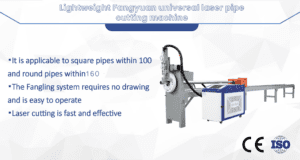
A 20kW Universal Profile system integrates all these functions. In Monterrey’s modern facilities, a 12-meter H-beam can be loaded onto the system, and the 3D head can move around the profile to cut bolt holes, wiring pass-throughs, and complex interlocking notches. Because the system is powered by a 20kW source, it can blast through the thickest flanges of a structural beam as if they were sheet metal. This consolidation of the workflow reduces material handling, which is one of the leading causes of workplace injuries and logistical delays in heavy manufacturing.
Meeting the Demands of Mining Environments
Mining machinery operates in some of the harshest conditions on Earth—abrasive dust, extreme vibrations, and massive mechanical loads. Consequently, the precision of the components is non-negotiable. A 20kW laser offers a level of repeatability (often within +/- 0.05mm) that plasma cutting cannot match.
When building a rock crusher’s main housing, the alignment of bearing seats and structural supports must be perfect. The 3D laser head ensures that every aperture is perfectly perpendicular or beveled exactly to specification. Moreover, the high power of the 20kW laser allows for “fine-feature” cutting in thick plate—meaning smaller holes can be cut into thicker material without the risk of thermal deformation or “slug” welding. This allows engineers to design more efficient, lighter, yet stronger mining components.
Economic Impact and Nearshoring in Monterrey
The deployment of these high-end systems in Monterrey is deeply tied to the “nearshoring” trend. As North American companies move their supply chains closer to home, they require Mexican partners who can match or exceed the technical capabilities of Asian or European fabricators.
Investing in a 20kW 3D system allows Monterrey-based firms to compete on a global scale. The reduction in gas consumption (when using high-pressure air cutting) and the massive increase in parts-per-hour dramatically lower the Total Cost of Ownership (TCO). For a mining equipment manufacturer, the ability to turn a design into a finished, beveled, and ready-to-weld kit in hours rather than days is a massive competitive advantage. It allows for “Just-In-Time” manufacturing, reducing the capital tied up in inventory.
Technical Challenges: Thermal Management and Software
Operating a 20kW system is not without its challenges. The sheer amount of energy involved requires a sophisticated cooling infrastructure. In the warm climate of Monterrey, industrial-grade chillers with high-precision temperature control (dual-circuit cooling for the laser source and the cutting head) are vital to prevent thermal drift.
Additionally, the software side of “Infinite Rotation” and “Universal Profile” cutting is complex. It requires advanced 5-axis CAM software that can take a 3D CAD model of a mining chassis and automatically generate the toolpaths for bevels and profile intersections. The integration of “collision avoidance” algorithms is critical because a 3D head moving around a structural beam is at high risk of hitting the material if the pathing isn’t perfect. Leading Monterrey shops are now employing specialized laser engineers who focus solely on optimizing these nesting and pathing strategies to maximize material yield.
The Future of Heavy Fabrication
As we look toward the future, the 20kW Universal Profile Steel Laser System is the precursor to even higher power levels and more automation. However, for the current needs of the mining machinery sector, 20kW represents the “peak” of efficiency. It provides the perfect balance of cutting speed, thickness capability, and edge quality.
For Monterrey, being the epicenter of this technology adoption reinforces its status as a world-class manufacturing hub. The synergy between high-power fiber lasers and 3D motion control is not just about cutting steel; it is about redefining the limits of what can be built. As mining operations become more automated and move into deeper, more challenging environments, the machinery supporting them will be built on the foundations laid by these incredible laser systems—precise, powerful, and infinitely capable.