Technical Field Report: Implementation of 20kW Universal Profile Laser Systems in HCMC Bridge Infrastructure
1. Executive Summary: The Transition to High-Brightness Fiber Sources
The structural steel landscape in Ho Chi Minh City (HCMC) is currently undergoing a significant technological shift. As urban infrastructure projects—specifically complex bridge spans and elevated transit corridors—demand tighter tolerances and higher throughput, traditional plasma and mechanical processing methods are reaching their physical limits. This report evaluates the deployment of the 20kW Universal Profile Steel Laser System equipped with an Infinite Rotation 3D Head. The integration of 20kW high-density fiber laser energy into automated profile processing allows for the precision cutting of thick-walled H-beams, I-beams, and box girders with a drastic reduction in secondary processing requirements.
2. The Kinematics of the Infinite Rotation 3D Head
The core technological differentiator in this system is the Infinite Rotation 3D Head. In bridge engineering, structural members rarely require simple 90-degree cuts. Complex intersections, weld preparation (V, X, Y, and K-type bevels), and bolt-hole alignment across curved surfaces necessitate a multi-axis approach.
2.1. Eliminating Torsional Constraints
Traditional 3D laser heads are often limited by internal cabling, requiring a “rewind” cycle after a certain degree of rotation (typically +/- 360 degrees). The Infinite Rotation Head utilizes slip-ring technology or advanced fiber-coupling paths that allow for continuous C-axis rotation. In the context of HCMC’s large-scale bridge joints, this eliminates the “start-stop” marks on the cut surface, ensuring a continuous thermomechanical footprint and superior edge finish.
2.2. Precision Beveling and Weld Preparation
For heavy-duty bridge girders (S355JR or SM490 grade steel), weld integrity is paramount. The 3D head enables real-time beveling during the primary cutting cycle. By maintaining a constant standoff distance via high-speed capacitive sensors, the system can execute complex geometries on flanges and webs simultaneously. This precision ensures that the root gap and bevel angle are consistent within ±0.1mm, a requirement for automated robotic welding systems used later in the assembly line.
3. Thermal Dynamics of 20kW Fiber Laser Processing
The jump from 12kW to 20kW is not merely a linear increase in speed; it represents a fundamental change in the material-laser interaction.
3.1. Penetration and Kerf Morphology
At 20kW, the energy density at the focal point allows for “high-speed melt-shearing.” In thick-walled bridge profiles (up to 40mm), the 20kW source maintains a narrow kerf width while minimizing the Heat Affected Zone (HAZ). This is critical for HCMC’s tropical environment, where micro-cracks induced by excessive heat can lead to accelerated stress-corrosion cracking over the bridge’s lifecycle.
3.2. Gas Dynamics and Dross Suppression
The system utilizes high-pressure nitrogen or oxygen-assisted cutting. The 20kW source allows for faster feed rates, which reduces the time the molten pool is exposed to the assist gas. This results in a dross-free lower edge, eliminating the need for manual grinding. For a bridge project requiring thousands of tons of steel, the removal of the grinding phase represents a 30-40% increase in total production efficiency.
4. Application Specifics: Bridge Engineering in Ho Chi Minh City
HCMC’s infrastructure projects, such as the expansion of the Thu Thiem bridges or the Metro Line elevated sections, involve highly customized structural components.
4.1. Dealing with Variable Material Quality
Steel sourced for regional projects can exhibit variations in surface oxidation or carbon distribution. The 20kW system’s “Active Beam Parameter Product” (BPP) management allows the laser to adjust the beam profile dynamically. This ensures consistent penetration even when encountering the mill scale common in heavy structural sections stored in high-humidity environments.
4.2. Geometric Complexity in Urban Spans
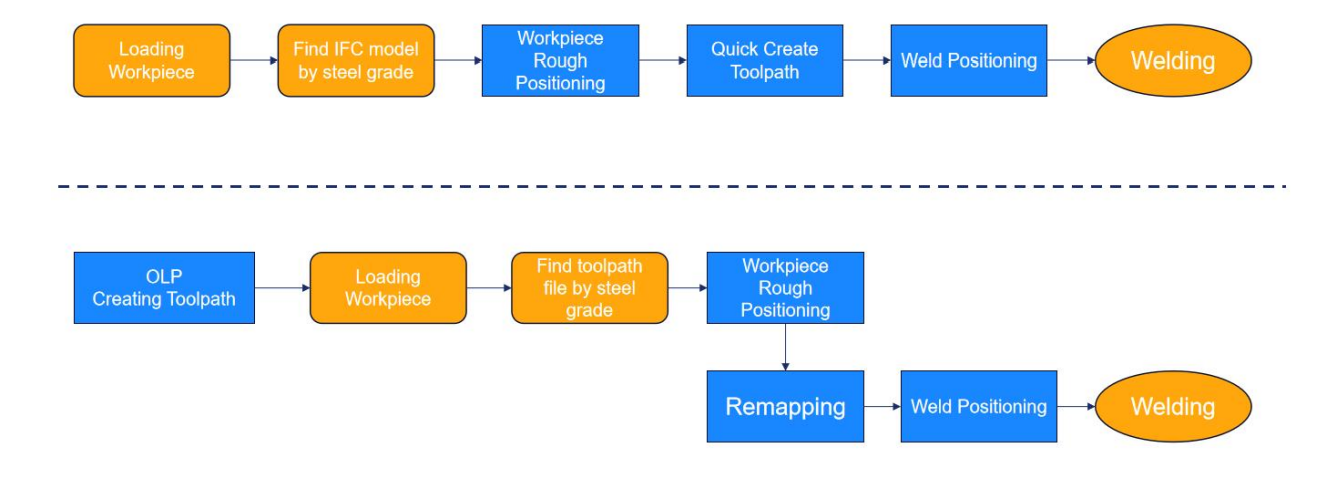
Modern urban bridges in HCMC often feature aesthetic curves and non-linear load paths. The Universal Profile Laser System processes these through sophisticated CAD/CAM integration (typically via Tekla or Steel Projects files). The software translates 3D models directly into G-code for the Infinite Rotation Head, allowing for the precise execution of “fish-mouth” cuts and complex intersections in tubular and profile sections that would be mathematically impossible to execute manually.
5. Synergy with Automatic Structural Processing
The 20kW laser does not operate in isolation. Its efficiency is maximized through a synchronized material handling and sensing ecosystem.
5.1. Automated Measuring and Compensation
Structural profiles, particularly those over 12 meters, often suffer from “bow and twist” deviations. The system utilizes laser line scanners to map the actual geometry of the profile once it is loaded onto the conveyor. The 3D head’s control software then applies a real-time transformation matrix to the cutting path, compensating for any structural deformations. This ensures that every bolt hole and connection point aligns perfectly during site erection, a critical factor in reducing the “fit-up” time in the field.
5.2. Digital Twin and IoT Monitoring
In the HCMC deployment, the system is linked to a centralized monitoring station. Real-time data regarding gas consumption, nozzle condition, and laser power stability are logged. This “Digital Twin” of the fabrication process provides an immutable record of the cutting parameters for every structural member, enhancing the Quality Assurance (QA) protocols required by international bridge building standards.
6. Comparative Analysis: Laser vs. Plasma in Heavy Steel
Historically, bridge components were processed using CNC plasma cutters. While plasma is capable of cutting thick sections, its limitations are highlighted when compared to the 20kW 3D laser:
- Precision: Plasma typically offers a tolerance of ±1.0mm to ±2.0mm. The 20kW laser maintains ±0.1mm.
- Heat Input: The laser’s HAZ is approximately 80% smaller than that of plasma, preserving the metallurgical properties of high-strength bridge steels.
- Operational Cost: While the initial capital expenditure (CAPEX) for a 20kW laser is higher, the operational expenditure (OPEX) is lower due to the elimination of secondary cleaning and the higher speed of the fiber source.
7. Technical Challenges and Mitigation Strategies
Despite its advantages, the deployment of 20kW systems in HCMC presents specific challenges:
7.1. Power Grid Stability
A 20kW fiber laser, including the chiller and motion system, requires significant and stable electrical input. Fluctuations in the HCMC industrial power grid can affect beam stability. The implementation of high-capacity Voltage Regulation Systems and dedicated transformers is mandatory to ensure the longevity of the diode modules.
7.2. Optical Contamination
The high humidity and particulate matter in HCMC’s industrial zones necessitate a pressurized, HEPA-filtered environment for the laser source and a “clean air” curtain for the cutting head’s protective windows. Failure to maintain optical cleanliness at 20kW can lead to catastrophic thermal runaway in the focusing lens.
8. Conclusion: The Future of Structural Steel Fabrication
The integration of a 20kW Universal Profile Steel Laser System with Infinite Rotation 3D Head technology represents the current pinnacle of structural steel processing. For bridge engineering in Ho Chi Minh City, this technology provides the dual benefit of extreme precision and industrial-scale throughput. By solving the inherent inefficiencies of traditional beveling and profile cutting, the system not only accelerates project timelines but also ensures a level of structural integrity that meets the most stringent global engineering standards. As HCMC continues its rapid vertical and horizontal expansion, high-power 3D laser processing will be the foundational technology upon which its future infrastructure is built.