
The New Frontier of High-Power Fiber Lasers in Heavy Construction
In the world of structural steel fabrication, the move toward higher wattage is not merely about speed; it is about the fundamental transformation of what is possible. For the construction sector in Rosario, a city historically rooted in industrial excellence and strategic logistics, the introduction of a 20kW fiber laser system is a landmark event. While 6kW or 10kW systems have become common for sheet metal, the 20kW threshold is where the laser begins to dominate the world of heavy profiles and thick-walled structural members.
At 20,000 watts, the fiber laser source delivers an energy density capable of vaporizing carbon steel at thicknesses that previously required plasma cutting or mechanical sawing. However, unlike plasma, the laser provides a “surgical” finish. In the context of the Rosario airport expansion, where structural integrity must meet aesthetic architectural standards, this power level allows for the processing of steel up to 50mm thick with a heat-affected zone (HAZ) so minimal that it preserves the metallurgical properties of the high-strength alloys used in modern aviation hangers.
The Engineering Marvel of the Infinite Rotation 3D Head
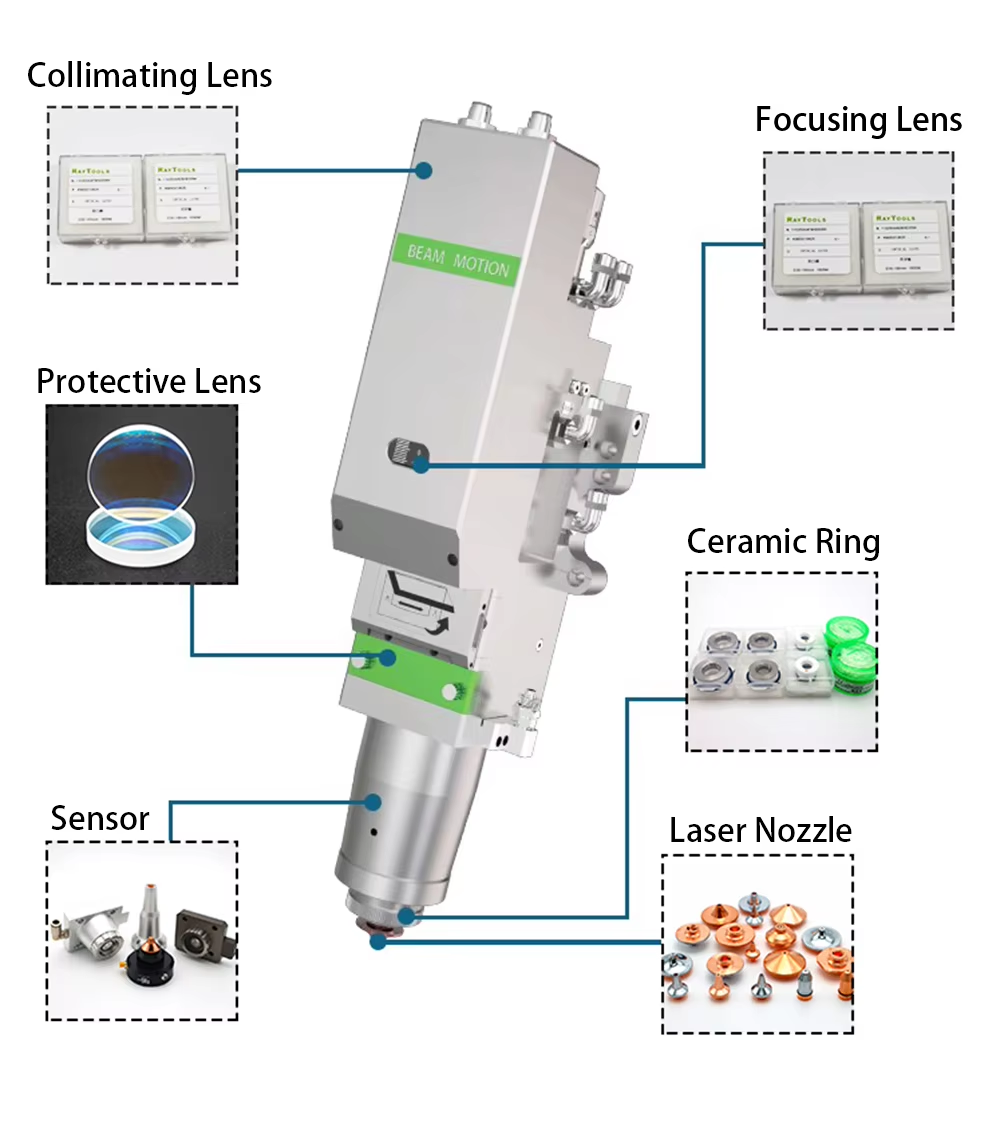
The true “intelligence” of this system lies in its Infinite Rotation 3D Head. Traditional 3D laser heads are often limited by internal cabling, requiring a “rewind” after a certain degree of rotation. In a high-stakes environment like airport construction, where large-diameter pipes and complex structural beams require continuous beveling and intersecting cuts, these pauses are costly. The Infinite Rotation head utilizes advanced slip-ring technology and specialized optical pathways to rotate without limit.
This capability is crucial for creating complex “fish-mouth” cuts on tubes or 45-degree bevels on I-beams. In airport terminal design, trusses are often composed of intersecting tubular sections that must bear immense loads. The 3D head allows for the cutting of “weld-ready” profiles directly on the machine. By integrating the beveling process into the initial cut, the system eliminates the need for secondary grinding or manual edge preparation, which are the most labor-intensive stages of steel fabrication.
Meeting the Demands of the Rosario Airport Expansion
The Islas Malvinas International Airport in Rosario is a vital node for both passenger travel and the Mercosur trade corridor. Modernizing such a facility requires structural steel that can support wide-span roofs without excessive internal columns. This is achieved through complex space frames and heavy-duty universal profiles. Using a 20kW Universal Profile system means that the massive H-beams and U-channels required for these structures can be processed in a single pass.
Consider the logistics of building a new terminal. Traditionally, beams are cut to length with a saw, moved to a drill line for bolt holes, and then moved to a manual station for beveling. The 20kW Universal Laser performs all these functions—cutting, hole-making, and beveling—on a single platform. In Rosario’s competitive construction landscape, this consolidation reduces the lead time for structural frames by as much as 70%, ensuring that the airport expansion remains on schedule and within budget.
Precision Beveling and the Science of Weld Preparation
For large-scale infrastructure, the weld is the most critical point of failure. Airport structures are subject to dynamic loads, wind shear, and thermal expansion. Therefore, the precision of the weld preparation is non-negotiable. The 20kW laser, guided by the 5-axis 3D head, can execute K, V, X, and Y-shaped bevels with absolute consistency.
Because the laser is a non-contact process, there is no tool wear. A hole cut in the first beam of the project will be identical to the hole cut in the thousandth beam. This level of repeatability is essential for the modular construction techniques favored in modern airports. When the steel arrives at the Rosario construction site, the pieces fit together like a precision-engineered puzzle, reducing the need for “on-site adjustments” with torches—a practice that often compromises the integrity of the steel.
Material Versatility: Beyond Simple Sheets
The “Universal” designation of this system refers to its ability to handle a diverse range of geometries. Beyond standard flat plates, the machine is equipped with sophisticated chuck systems and support beds designed for:
- I and H Beams: Essential for the primary skeletons of hangars.
- C and U Channels: Used in secondary framing and support systems.
- Circular and Square Hollow Sections: The backbone of architectural space frames and aesthetic pillars.
- L-Shaped Angles: For bracing and connection plates.
The 20kW source is particularly effective on these shapes because the laser must often travel through varying thicknesses as it traverses the profile’s geometry. The system’s real-time power modulation ensures that as the head moves from the flange to the web of a beam, the energy output adjusts instantaneously to maintain a perfect cut without dross or slag buildup.
Economic and Industrial Impact on the Santa Fe Region
The arrival of such high-tier technology in Rosario has implications beyond a single airport project. It elevates the entire regional industrial ecosystem. Local fabricators can now compete on an international level, offering services that were previously only available from major European or Asian steel hubs. By reducing material waste—thanks to advanced nesting software that works across 3D profiles—the 20kW laser makes the project more sustainable.
In a world where the “carbon footprint” of construction is under scrutiny, the efficiency of fiber laser technology is a major asset. Fiber lasers are significantly more energy-efficient than older CO2 lasers or traditional machining methods. For the Rosario airport, this translates to a “greener” construction process, aligning with global trends in sustainable aviation infrastructure.
BIM Integration and the Digital Twin Workflow
Modern airport construction relies heavily on Building Information Modeling (BIM). The 20kW Universal Profile Laser is designed to sit at the end of a fully digital workflow. Architectural designs from programs like Tekla or Revit are exported directly into the laser’s CAM software. This “File-to-Factory” approach ensures that the complex geometries envisioned by architects for the Rosario terminal are translated into physical steel without manual transcription errors.
The 3D head’s ability to interpret these complex files allows for “marking” as well. The laser can etch assembly instructions, part numbers, and welding symbols directly onto the steel members. This turns every beam into a self-documenting component, further accelerating the assembly process at the airport site.
Conclusion: Setting a New Standard for Argentine Infrastructure
The 20kW Universal Profile Steel Laser System with Infinite Rotation 3D Head is more than a machine; it is a catalyst for a new era of Argentine civil engineering. As the Rosario airport evolves to meet the needs of a more connected world, the precision and power of this system ensure that the bones of the city’s infrastructure are stronger, more accurate, and more efficiently produced than ever before.
As a fiber laser expert, I see this installation as a lighthouse project. It demonstrates that when high-power photonics meet sophisticated five-axis kinematics, the limitations of traditional steel fabrication vanish. The result is a safer, more beautiful, and more functional gateway for Rosario, built on a foundation of light and precision.
















