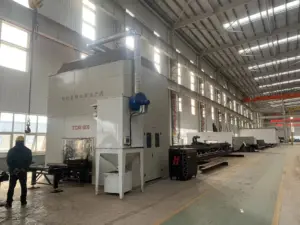
The Dawn of High-Power Fiber Lasers in Vietnamese Maritime Engineering
Haiphong has long been the heartbeat of Vietnam’s shipbuilding sector, home to strategic yards that produce everything from bulk carriers to sophisticated offshore patrol vessels. For decades, the industry relied on oxy-fuel and plasma cutting technologies. While reliable, these methods introduced significant thermal distortion, required extensive edge cleaning, and struggled with the intricate geometries of structural profiles.
The arrival of the 20kW Fiber Laser System changes the fundamental physics of the shipyard. At 20,000 watts, the laser beam possesses a power density capable of vaporizing thick-section carbon steel almost instantaneously. In the context of Haiphong’s humid coastal environment, the stability of fiber optics is a game-changer. Unlike CO2 lasers, fiber lasers deliver the beam via a flexible cable, making them more resilient to the vibrations and temperature fluctuations common in heavy industrial zones. This transition is not merely an upgrade; it is a total reimagining of how a vessel’s skeletal structure is fabricated.
20kW Power: The Threshold of Heavy-Duty Efficiency
Why 20kW? In shipbuilding, the “sweet spot” for material thickness often ranges between 12mm and 50mm. While a 10kW laser can cut these thicknesses, the 20kW source provides the “over-capacity” needed to maintain high feed rates on the thickest hull plates. For instance, a 20kW system can process 20mm carbon steel at speeds three to four times faster than a 6kW unit, with a significantly smaller Heat Affected Zone (HAZ).
The reduction in HAZ is critical for the Haiphong yards. Excessive heat from plasma cutting can alter the grain structure of the steel, leading to potential brittle zones that must be machined away to meet International Association of Classification Societies (IACS) standards. The 20kW fiber laser, through its focused energy and high-speed piercing capabilities, ensures that the structural integrity of the steel remains intact, allowing for immediate transition to the welding stage.
Universal Profile Processing: Handling the Complexity of Stiffeners
A ship is more than just flat plates; it is a complex web of structural reinforcements. The “Universal Profile” capability of this system is what sets it apart. Traditionally, cutting bulb flats, L-profiles, and T-bars required dedicated saw lines or manual torch work. The integrated profile laser system utilizes a multi-axis (typically 5-axis or 6-axis) robotic head or a rotating chuck system to process these 3D shapes.
In Haiphong’s production lines, this means a single machine can handle the cutting of interlocking notches, drainage holes, and complex end-contouring on structural profiles up to 12 meters in length. The software integration—linking CAD/CAM platforms like ShipConstructor or Tekla directly to the laser—allows for “nesting” on profiles, minimizing scrap and ensuring that every stiffener fits perfectly against the hull plating. This “first-time-right” manufacturing is essential for the modular block construction methods used in modern shipbuilding.
Revolutionizing Throughput with Automatic Unloading Systems
The bottleneck in high-power laser cutting is rarely the cut itself; it is the material handling. A 20kW laser cuts so fast that a manual crew cannot clear the bed and reload quickly enough to keep the beam active. This is where the Automatic Unloading System becomes the hero of the Haiphong shipyard.
The system utilizes a combination of heavy-duty conveyor beds and intelligent sorting grippers. Once a profile or plate is cut, the automated system identifies the part and moves it to a designated unloading zone. For heavy profiles, hydraulic lifting arms or vacuum arrays transition the finished piece from the cutting area to a buffer rack without human intervention. This serves two purposes:
1. **Continuous Duty Cycle:** The laser can begin the next program immediately while the previous parts are being sorted.
2. **Safety:** In a shipyard environment, moving 500kg steel sections manually is a high-risk activity. Automation removes the worker from the danger zone, drastically reducing workplace injuries.
Precision Bevelling and Weld Preparation
One of the most significant cost-savers for Haiphong shipyards is the 20kW system’s ability to perform precision bevelling. Most ship plates require a V, Y, or K-shaped bevel to prepare them for submerged arc welding (SAW) or robotic welding.
In the past, bevelling was a secondary process involving mechanical milling or manual grinding. The 20kW Universal Profile system features a tilt-head (3D) cutting nozzle that can create bevels up to 45 degrees during the initial cutting phase. Because the laser maintains such high precision, the “fit-up” gap between two plates is reduced to sub-millimeter tolerances. This precision reduces the volume of welding consumables (wire and gas) required and speeds up the welding process itself, as there is less gap to fill.
The Impact on Haiphong’s Economic Competitive Edge
The maritime sector is a global commodity. Yards in South Korea, China, and Europe are highly automated. For Haiphong to remain competitive, it must lower its cost-per-ton of processed steel. The 20kW Universal Profile Laser System facilitates this by reducing electricity consumption per meter of cut compared to older technologies and significantly lowering the man-hours required per ton of fabricated steel.
Furthermore, the “Smart Factory” data generated by these systems allows yard managers in Haiphong to track production in real-time. They can monitor gas consumption, cutting hours, and material utilization rates. This level of transparency is vital for bidding on international contracts, where tight deadlines and strict quality benchmarks are the norm.
Environmental and Operational Sustainability
Beyond speed and profit, the shift to fiber lasers in Haiphong supports environmental goals. Plasma cutting generates a massive amount of dust and toxic fumes, requiring expensive filtration systems. While laser cutting still produces emissions, the volume is lower, and the high-efficiency dust collection systems integrated into these 20kW units are far more effective at capturing particulates.
Additionally, the energy efficiency of a fiber laser is roughly 35-40%, compared to the 10% efficiency of older CO2 models. In a city like Haiphong, where industrial power demand is high, this energy conservation is both an ecological and an economic benefit.
Future Outlook: Towards Fully Autonomous Ship Fabrication
The installation of a 20kW Universal Profile Steel Laser System with Automatic Unloading is not the final step, but rather a foundational one. As Haiphong’s shipyards integrate these machines with Artificial Intelligence (AI) for predictive maintenance and automated nesting optimization, we are seeing the birth of “Shipbuilding 4.0.”
The future will likely see these laser systems linked with autonomous mobile robots (AMRs) that transport the cut profiles directly to robotic welding cells. For the fiber laser expert, the vision is clear: a shipyard where the heavy lifting and dangerous cutting are handled by light and logic, leaving the human engineers to focus on the complex design and assembly of the world’s next generation of vessels. Haiphong is no longer just a port; through this technology, it is becoming a global center for high-tech maritime manufacturing.