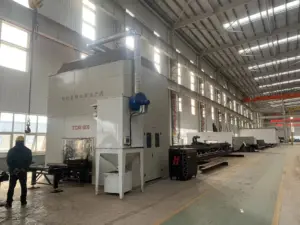
The Dawn of 20kW Fiber Laser Power in Structural Engineering
The transition from traditional thermal cutting to high-power fiber lasers has been steady, but the jump to 20kW marks a definitive turning point for heavy industries. In Katowice, a city with a legacy built on coal and steel, the introduction of a 20kW Universal Profile Steel Laser System is more than an upgrade; it is a reinvention of the fabrication floor.
At 20kW, the energy density of the laser beam is sufficient to vaporize thick-walled structural steel almost instantaneously. Unlike lower-wattage systems that struggle with the heat dissipation inherent in thick profiles, the 20kW source maintains a narrow heat-affected zone (HAZ), ensuring the metallurgical integrity of the steel—a non-negotiable requirement for power towers that must withstand decades of environmental stress. The “Universal” aspect of this system refers to its ability to handle a diverse array of geometries, from standard flat plates to complex open and closed profiles, all within a single workstation.
The Complexity of Power Tower Fabrication
Power towers, whether they are for high-voltage transmission lines or wind turbine supports, are complex assemblies. They require precision-cut lattice members, gusset plates, and heavy-wall tubular sections. Traditionally, these components were produced using a combination of plasma cutting for shapes and mechanical drilling for bolt holes. This multi-step process introduced cumulative tolerances and required significant manual handling.
The 20kW laser system eliminates these silos. It can cut the outer profile, pierce high-tolerance bolt holes, and execute complex bevels for weld preparation in a single continuous operation. For the fabrication of power towers, where structural failure is not an option, the precision of a laser—capable of maintaining tolerances within fractions of a millimeter across a 12-meter beam—ensures that the final assembly fits perfectly on-site, reducing the need for costly field corrections.
Universal Profile Processing: Beyond the Flat Sheet
While flat-bed lasers are common, a Universal Profile System is an engineering marvel. It utilizes a multi-axis 3D cutting head, often mounted on a gantry or a robotic arm, capable of articulating around the workpiece. In the context of Katowice’s steel plants, this means the system can process H-beams, U-channels, and rectangular hollow sections (RHS) with ease.
The software integration is key here. Advanced CAD/CAM nesting for profiles allows the laser to “wrap” cuts around corners and perform “one-hit” processing of holes through both flanges of a beam simultaneously. The 20kW power source is particularly advantageous here; it allows for high-speed “fly-cutting” on thinner sections of the profile while having the raw power to penetrate the thickest structural junctions without slowing down to a crawl.
Bevel Cutting and Weld Preparation
One of the most significant advantages of the 20kW system for power tower fabrication is the ability to perform high-speed beveling. Power towers rely on heavy-duty welding. To ensure deep weld penetration, the edges of the steel profiles must be beveled (V-cut, Y-cut, or K-cut).
Using a 5-axis 3D head, the 20kW laser can cut these angles in real-time. Because of the extreme power, the laser can maintain a consistent cutting speed even when the effective thickness of the material increases due to the angle of the cut. This results in a clean, oxide-free edge (when using nitrogen as the assist gas) that is ready for the welding robot immediately after cutting. This eliminates the need for manual grinding, which is a major bottleneck and a health and safety concern in traditional fabrication shops.
The Role of Automatic Unloading in Throughput
High-speed cutting is only valuable if the material can be moved into and out of the machine at a matching pace. This is where the “Automatic Unloading” component becomes vital. A 20kW laser cuts so quickly that manual unloading would result in the machine sitting idle for 60-70% of its operational life.
In the systems currently being deployed in Katowice, the unloading process is synchronized with the cutting cycle. As the laser completes the final cut on a profile, a series of automated conveyors and hydraulic lifters engage. For large profiles, specialized “pick and place” systems or transverse discharge conveyors move the finished part to a sorting zone. This automation ensures that the laser is almost always in a state of “beam-on” time. Furthermore, it significantly reduces the risk of workplace injuries associated with moving heavy, sharp-edged steel members manually or with overhead cranes.
Katowice: A Strategic Hub for Infrastructure Fabrication
Choosing Katowice for the deployment of such advanced technology is a strategic move. The Silesian region possesses a dense concentration of technical universities, skilled engineers, and a robust supply of raw steel. By localizing 20kW laser capacity in Katowice, European energy projects—particularly those in the North Sea wind belt or the expanding Eastern European electrical grids—can source precision-machined components with reduced logistics costs.
The presence of this technology also fosters a “Center of Excellence” atmosphere. Local engineers are mastering the nuances of high-power photonics, from optimizing gas pressures (oxygen vs. nitrogen vs. shop air) to fine-tuning the nesting algorithms that minimize material waste. This expertise is a valuable export in itself.
Economic and Environmental Impact
From an expert’s perspective, the ROI (Return on Investment) of a 20kW system is driven by more than just speed. The energy efficiency of modern fiber laser sources is significantly higher than older CO2 lasers or even some plasma systems when considering the “per part” energy cost.
Environmentally, the precision of the 20kW laser means less scrap metal. The ability to nest parts tightly on a profile or sheet reduces the carbon footprint of the raw material. Additionally, because the laser process is so clean and precise, the “rework rate” drops to near zero. In the fabrication of hundreds of towers for a massive grid project, the cumulative savings in energy, material, and man-hours are staggering.
Future-Proofing Power Infrastructure
As we look toward the future of the global energy transition, the demand for structural steel will only increase. Power towers are getting taller and more complex to support larger turbines and higher-capacity lines. The 20kW Universal Profile Steel Laser System is the tool that meets this challenge.
In Katowice, the integration of this technology marks the end of the “sledgehammer and torch” era of steel fabrication. We are now in the era of “digital steel,” where a 3D model is sent to a 20kW laser, and hours later, a perfectly cut, beveled, and labeled profile emerges from the automated unloading line, ready to become the backbone of the modern electrical grid. For the fiber laser expert, this is the ultimate realization of the technology: high-power photonics serving the fundamental needs of human civilization.