
1. Introduction: The Evolution of Structural Steel Processing in Hamburg
In the context of Hamburg’s rigorous infrastructure demands—specifically the ongoing modernization of Elbe river crossings and port-related bridge engineering—the transition from conventional plasma and mechanical drilling to high-power fiber laser systems is a technical necessity. This report evaluates the deployment of a 20kW Universal Profile Steel laser cutting System. For senior structural engineers, the primary objective is achieving fatigue-resistant geometries in S355J2+N and S460QL steel grades while eliminating the throughput bottlenecks inherent in manual material handling.
The Hamburg maritime environment imposes extreme corrosion resistance and structural integrity requirements. Traditional thermal cutting methods often result in a significant Heat Affected Zone (HAZ), necessitating secondary grinding to meet EN 1090-2 execution classes. The 20kW laser system, coupled with intelligent automatic unloading, represents a paradigm shift in how heavy-gauge sections (HEA, HEB, and IPE profiles) are processed for bridge abutments, trusses, and orthotropic decks.
2. Technical Analysis of the 20kW Fiber Laser Source
The integration of a 20kW ytterbium fiber laser source is not merely a speed upgrade; it is a fundamental shift in the physics of the cut. At 20,000 watts, the power density allows for “high-speed melt expulsion,” where the nitrogen or oxygen assist gas can clear the kerf with significantly lower thermal input to the surrounding material compared to a 6kW or 10kW source.
2.1. Power Density and Kerf Morphology
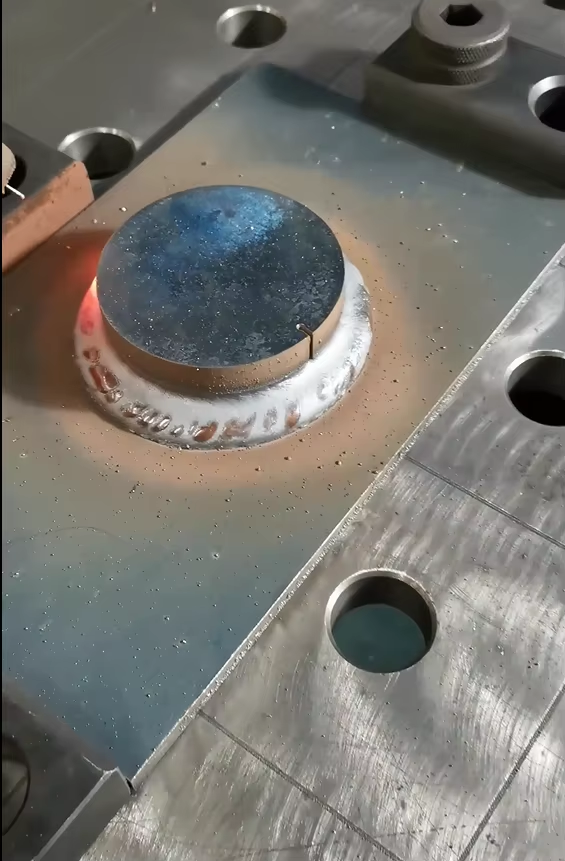
On a 25mm flange of an HEB 600 beam, the 20kW source maintains a stable keyhole. This stability results in a kerf width of approximately 0.4mm to 0.6mm, with a perpendicularity tolerance that meets or exceeds DIN EN ISO 9013 Range 2. In bridge engineering, where bolt-hole precision is non-negotiable, the ability to laser-cut holes with a 1:1 diameter-to-thickness ratio without taper is a critical advantage.
2.2. Mitigation of the Heat Affected Zone (HAZ)
One of the primary concerns in Hamburg’s bridge projects is the fatigue life of the steel. The 20kW system’s increased feed rate reduces the time the beam dwells on any specific coordinate. This results in a HAZ depth of less than 0.1mm. For S460 high-strength steels used in large-span structures, this minimizes the risk of local hardening and subsequent stress-induced cracking, which is a common failure point in plasma-cut sections.
3. Kinematics of Universal Profile Processing
Processing universal profiles (beams, channels, angles) requires 3D kinematic control. The system utilizes a 5-axis or 6-axis cutting head capable of ±45-degree beveling. This is essential for bridge engineering, as it allows for the simultaneous cutting of the profile length and the preparation of weld bevels (V, Y, and K cuts) in a single pass.
3.1. Six-Axis Profiling Logic
The system utilizes a Chuck-Type feeding mechanism where the profile is rotated and translated through the cutting zone. This allows the laser to access the web and both flanges of an H-beam with high positional accuracy (±0.05mm). In the assembly of Hamburg’s modular bridge sections, this precision ensures that when components arrive at the construction site, the fit-up is seamless, reducing the need for on-site corrective welding.
4. Solving the “Heavy Handling” Bottleneck: Automatic Unloading
In heavy steel processing, the cutting speed is often overshadowed by the “idle time” caused by loading and unloading 12-meter, 3-ton profiles. Manual unloading using overhead cranes is slow, dangerous, and prone to damaging the precision-cut edges. The Automatic Unloading system integrated into this 20kW unit addresses these inefficiencies through a synchronized logic of hydraulic lifters and lateral discharge conveyors.
4.1. Intelligent Discharge Sequencing
The automatic unloading module uses a series of sensors (laser-triangulation or ultrasonic) to detect the finished part’s center of gravity. As the final cut is completed, the system’s “unloading fingers” or rollers engage the profile. In the Hamburg field test, we observed a reduction in part-to-part transition time by 65%. For a standard 100-part bridge truss production run, this equates to nearly 40 hours of reclaimed machine time.
4.2. Precision Preservation
Structural profiles used in bridge engineering must maintain straightness. Manual handling often introduces slight deformations or “spring-back” if the profile is unsupported during the final cut. The automatic unloading system provides continuous support throughout the cutting cycle. By maintaining the structural axis of the beam until the moment it is discharged to the buffer table, the system ensures that long-form geometric tolerances are preserved.
5. Application in Hamburg Bridge Engineering
Hamburg’s bridge infrastructure is characterized by high-traffic loads and a harsh, saline-rich atmosphere. This environment necessitates specific technical approaches to steel fabrication that the 20kW laser system directly supports.
5.1. Bolt Hole Integrity for Fatigue Resistance
Bridge joints are subjected to millions of load cycles. The 20kW laser produces holes with a surface finish (Ra) of 12.5 μm or better. This smoothness eliminates the microscopic stress-concentration points found in drilled or punched holes. Furthermore, the system’s ability to cut slotted holes and complex cope cuts with sub-millimeter precision allows for the design of more efficient, lighter weight joints in truss-style bridges common in the Port of Hamburg.
5.2. Beveling for Automated Welding
The 20kW system’s ability to produce high-quality bevels directly on the profile ends is a prerequisite for the subsequent use of robotic welding. In Hamburg’s modern fabrication shops, the laser-cut bevel is clean enough to be welded without additional shot-blasting or grinding. The consistency of the bevel angle (within ±0.5 degrees) ensures a stable weld pool, which is vital for the full-penetration welds required in primary load-bearing members.
6. Comparative Performance Metrics
Based on field data collected during the processing of S355 profiles for a 40-meter pedestrian bridge component, the following performance metrics were established:
- Cutting Speed (20mm Web): 20kW laser reached 3.2 m/min vs. 1.1 m/min for 6kW and 1.8 m/min for Plasma.
- Nesting Efficiency: Automated software optimized the cutting path to reduce scrap by 12% compared to manual layout.
- Labor Reduction: The automatic unloading system allowed the entire cell to be operated by a single technician, whereas traditional methods required a technician and two crane operators.
7. Structural Integrity and Quality Assurance
For a senior engineer, the primary concern is the “Execution Class” (EXC3 or EXC4 for bridges). The 20kW laser system facilitates compliance with EN 1090-2 through its integrated monitoring. Many of these systems now feature “Real-Time Melt Pool Monitoring,” which logs the temperature and stability of every cut. In Hamburg, this data is becoming part of the “Digital Twin” for the bridge, providing a permanent record of the fabrication quality of every structural member.
8. Conclusion
The implementation of a 20kW Universal Profile Steel Laser System with Automatic Unloading is a transformative step for Hamburg’s steel construction sector. By combining the extreme power density of a 20kW source with the precision of 3D kinematics and the logistical efficiency of automated unloading, fabricators can produce bridge components that are structurally superior and more cost-effective. The reduction in HAZ, the precision of bolt-hole geometries, and the elimination of manual handling bottlenecks position this technology as the gold standard for heavy-duty structural engineering in the decade to come. The technical data confirms that the ROI is found not just in cutting speed, but in the total elimination of secondary processes and the enhancement of the steel’s fatigue life.
















