The Dawn of High-Power Fiber Lasers in Saudi Railway Infrastructure
The landscape of structural steel fabrication in Riyadh is undergoing a radical transformation. For decades, the construction of railway infrastructure—bridges, gantries, and rolling stock frames—relied on a fragmented workflow of mechanical sawing, manual oxy-fuel cutting, and laborious edge grinding. However, the arrival of the 20kW Universal Profile Steel Laser System has effectively consolidated these processes into a single, automated workstation.
At 20,000 watts, the fiber laser source offers a power density that transcends the limitations of traditional CO2 lasers or plasma cutting. In the context of Riyadh’s massive railway expansion, this power is not just about speed; it is about the ability to maintain a narrow Kerf and a minimal Heat Affected Zone (HAZ) in thick-section structural steels. This is critical for railway components that must endure decades of high-frequency vibration and thermal expansion in the harsh desert climate of the Central Province.
Mastering the Universal Profile: Beyond Flat Sheet Cutting
The “Universal Profile” designation indicates that this system is not confined to flat plates. It is a sophisticated 3D processing powerhouse capable of handling the entire geometry of structural steel used in railway construction. This includes H-beams for station frameworks, U-channels for cable management along tracks, and L-profiles for reinforcement.
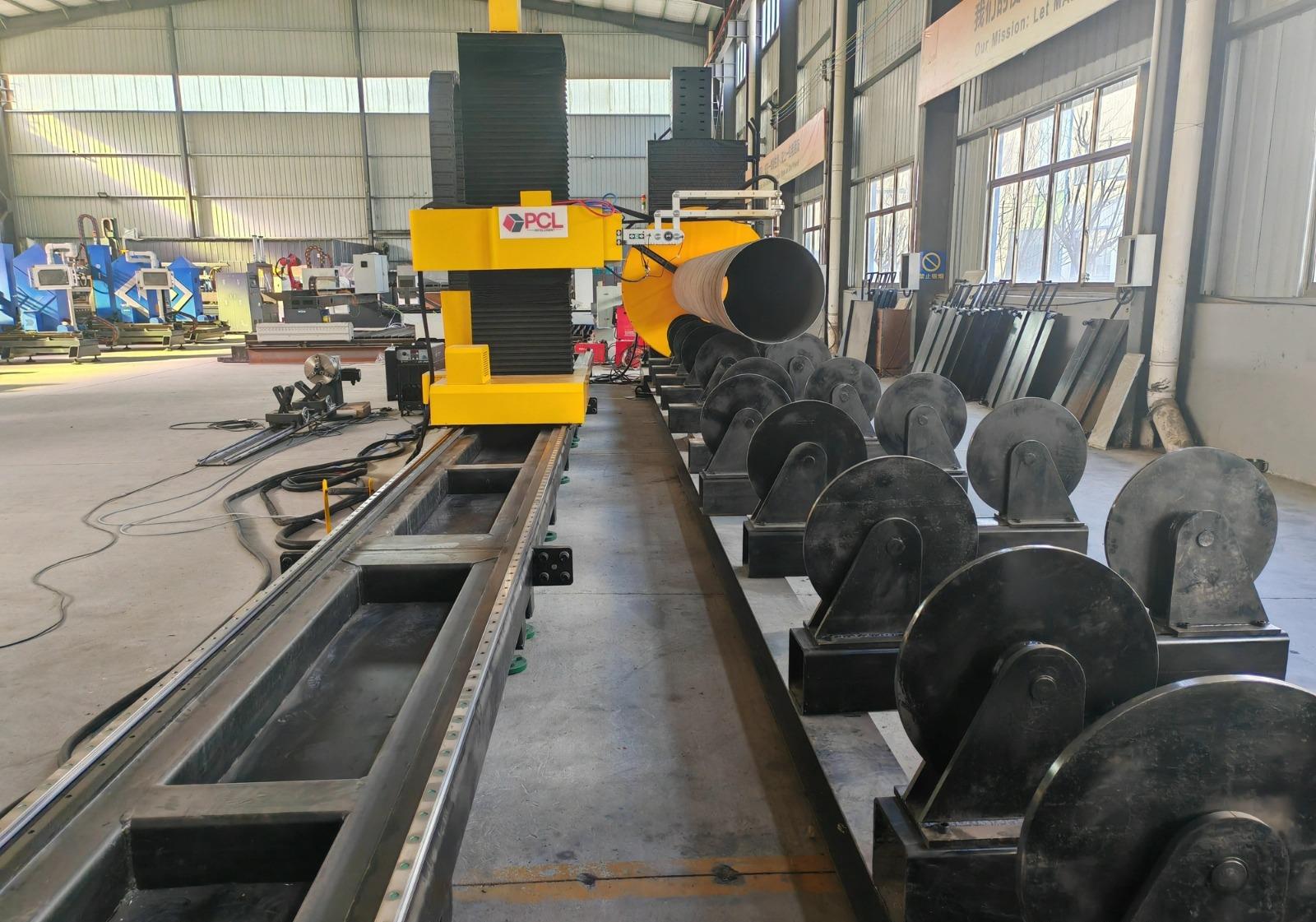
The system utilizes a series of synchronized chucks and support rollers that rotate and feed long-form profiles (often up to 12 or 15 meters) through the cutting zone. For the Riyadh railway projects, where consistency across kilometers of infrastructure is mandatory, the laser’s ability to execute complex bolt-hole patterns, notches, and cut-outs in a single pass ensures that components arrive at the construction site ready for immediate assembly. This “Lego-style” precision reduces onsite errors and significantly lowers the logistical burden of the Saudi Railway Company (SAR) contractors.
The ±45° Bevel: Engineering Perfection for Weld Preparation
In heavy-duty railway engineering, the strength of a structure is only as good as its welds. Traditional 2D laser cutting produces a 90° edge, which often requires secondary machining or grinding to create the V, Y, or K-shaped grooves necessary for deep-penetration welding.
The 20kW system’s ±45° beveling head is a 5-axis marvel of opto-mechanical engineering. By tilting the laser head in real-time as it traverses the profile, the system can create precise chamfers and bevels on the fly. This capability is vital for the thick-walled steel tubes and beams used in railway bridge piers and overhead electrification (OHE) masts. By automating the beveling process, the Riyadh-based fabricator eliminates the inconsistencies of manual grinding, ensuring that every weld joint meets the stringent international safety standards required for high-speed rail.
Tailoring Technology for Riyadh’s Environmental Challenges
Operating a 20kW laser in Riyadh presents unique environmental challenges that the Universal Profile system is specifically engineered to overcome. The extreme ambient temperatures, which frequently exceed 45°C, and the presence of fine silica dust require specialized infrastructure.
High-performance industrial chillers with redundant cooling circuits are integrated into these systems to ensure the fiber laser source and the cutting head maintain a constant operating temperature. Furthermore, the optical path is kept under positive pressure with ultra-clean, dry air or nitrogen to prevent dust ingress, which could otherwise lead to catastrophic lens failure at such high power levels. For Riyadh’s industrial zones, such as Sudair Industrial and Business City, these “tropicalized” laser systems represent the gold standard in reliability, ensuring 24/7 operation despite the external climate.
Boosting Production Efficiency for Vision 2030
The Saudi Landbridge Project, connecting the Port of Jeddah to the Port of Dammam via Riyadh, requires millions of tons of processed steel. A 20kW fiber laser processes 20mm structural steel at speeds nearly five times faster than a 6kW system and with significantly better edge quality than plasma cutting.
The economic impact for Riyadh-based manufacturers is profound. By utilizing high-nesting efficiency software specifically designed for profiles, material waste is minimized. The “Common Cut” feature allows the laser to share a single cut line between two parts, saving both time and gas. In a market where steel prices are subject to global fluctuations, the ability to squeeze the maximum number of components out of every ton of steel provides a competitive edge to local fabricators bidding on massive government infrastructure tenders.
Integration with BIM and Digital Twin Technology
Modern railway infrastructure in Saudi Arabia is increasingly managed through Building Information Modeling (BIM). The 20kW Universal Profile Laser System is a native participant in this digital ecosystem. Engineers in Riyadh can export 3D CAD files (such as Tekla or SolidWorks) directly to the laser’s NC (Numerical Control) software.
This digital-to-physical workflow ensures that the physical beam cut in the factory is a perfect mirror of the digital twin used in the project’s design phase. This level of integration is essential for the Riyadh Metro expansion, where complex geometries are the norm. The laser system can automatically compensate for slight deviations in the raw material’s straightness using touch-probes or laser sensors, ensuring that every hole and bevel is positioned with sub-millimeter accuracy relative to the actual center-line of the beam.
Safety and Sustainability in the Railway Sector
The shift to fiber laser technology also aligns with the sustainability goals of the Kingdom. Compared to plasma or oxy-fuel cutting, fiber lasers are remarkably energy-efficient, converting a higher percentage of electrical wall-plug power into light. Furthermore, the 20kW system produces significantly less fumes and noise, creating a safer and more ergonomic environment for the Saudi workforce.
The enclosed nature of the Universal Profile system, featuring OD4+ certified laser-safe glass, protects operators from the intense infrared radiation of the 1070nm beam. As Riyadh strives to become one of the most livable cities in the world, the transition of its industrial base to clean, high-tech manufacturing processes like fiber laser cutting is a key component of that vision.
Conclusion: The Future of Riyadh’s Industrial Fabric
The deployment of a 20kW Universal Profile Steel Laser System with ±45° beveling is more than just a capital equipment investment; it is a strategic asset for the Kingdom’s railway future. By combining extreme power with 3D geometric flexibility, Riyadh is positioning itself as a regional hub for advanced steel fabrication.
As the tracks of the Saudi Landbridge and the Riyadh Metro continue to spread across the peninsula, the precision and speed of fiber laser technology will be the invisible force ensuring these structures are built faster, stronger, and more efficiently. For the fiber laser expert, the message is clear: the era of “brute force” steel processing is over; the era of “intelligent power” has arrived in Riyadh.