
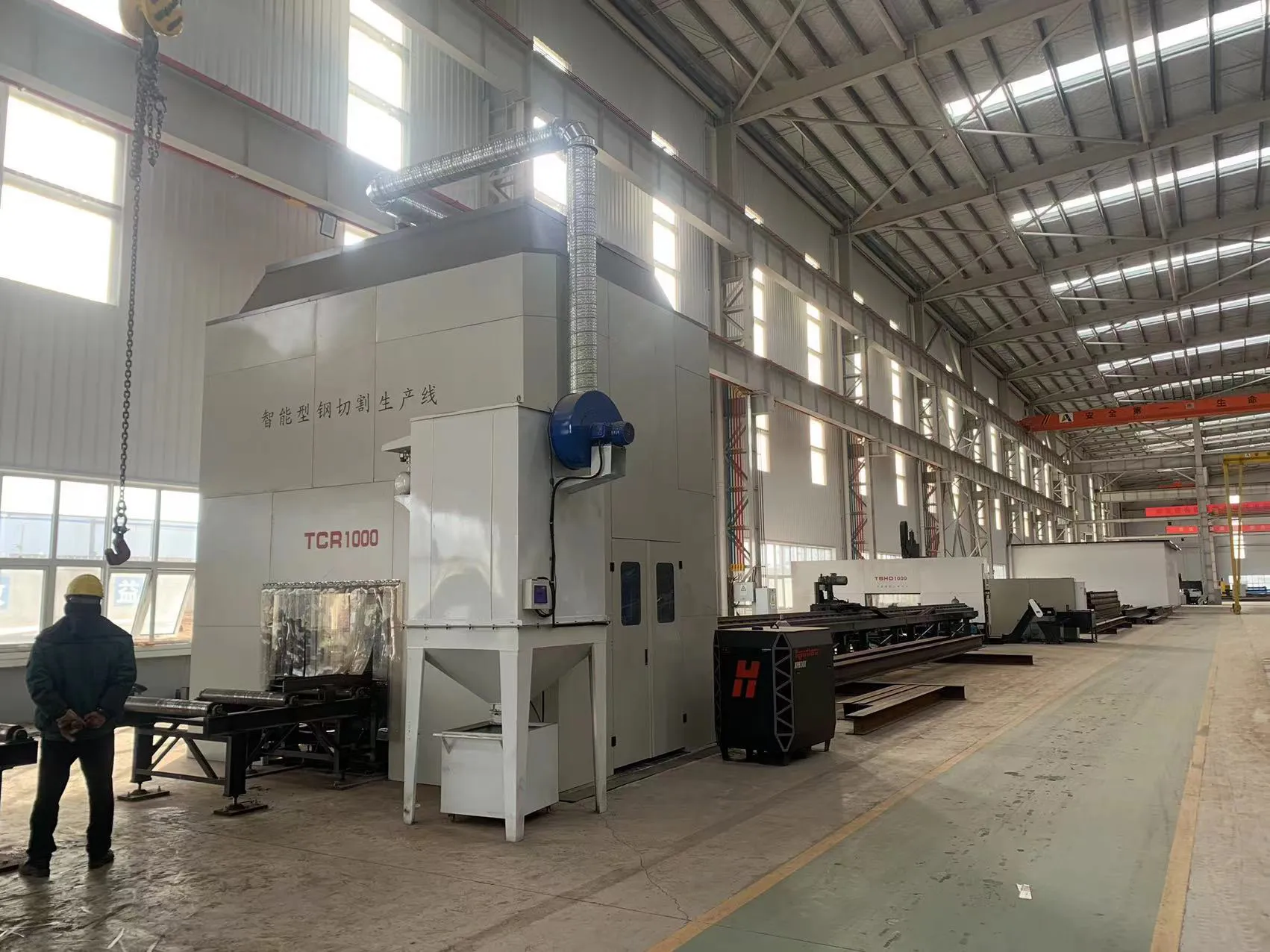
Field Engineering Report: Integration of 20kW Fiber Laser Systems in Katowice Railway Infrastructure Projects
1. Project Scope and Environmental Context
This report analyzes the technical deployment of a 20kW Universal Profile Steel Laser System within the Silesian industrial corridor, specifically focusing on the railway modernization projects centered around the Katowice transportation hub. The Katowice node represents one of the highest densities of rail infrastructure in Central Europe, requiring massive volumes of structural steel, including H-beams (HEA/HEB), I-beams (IPE), and heavy-walled rectangular hollow sections (RHS).
The transition from traditional mechanical processing—consisting of band sawing, radial drilling, and manual oxy-fuel beveling—to a unified 20kW fiber laser platform was necessitated by the rigorous tolerances demanded by PKP PLK (Polish State Railways) standards. The objective was to consolidate multi-stage fabrication into a single-pass automated workflow capable of handling structural sections up to 12,000mm in length.
2. 20kW Fiber Laser Source: Physics and Thermal Dynamics
The core of the system is a 20kW ytterbium fiber laser source. In the context of heavy railway steel (often exceeding 20mm in thickness), the 20kW power density provides a critical advantage in “pierce-to-cut” transition times and feed rates.
2.1. Energy Density and Kerf Characteristics:
At 20kW, the beam parameter product (BPP) is optimized to maintain a narrow kerf even when processing 25mm S355J2+N structural steel. The high energy density allows for a “melt-and-blow” dynamic using high-pressure nitrogen or oxygen, depending on the required edge finish. For railway bridge components, where fatigue resistance is paramount, the 20kW source minimizes the Heat Affected Zone (HAZ) compared to plasma or oxy-fuel, preserving the metallurgical integrity of the base material.
2.2. Cutting Velocities in Profile Steel:
In Katowice’s fabrication facilities, we observed a 300% increase in throughput for IPE 400 beams. While a 6kW system struggles with the flange-to-web transitions where material thickness effectively doubles during certain approach angles, the 20kW source maintains a constant feed rate, preventing dross accumulation at the junction points.
3. Five-Axis Kinematics: The ±45° Bevel Cutting Mechanism
The most significant bottleneck in traditional railway steel fabrication is the preparation of weld grooves (V, X, Y, and K joints). The “Universal” designation of this system refers to its ability to manipulate a 3D cutting head around complex geometries.
3.1. Technical Execution of the ±45° Bevel:
The system utilizes a 5-axis linked motion controller. When processing a heavy H-beam for a rail overpass, the head must tilt to ±45° to create a weld prep surface. This eliminates the need for manual grinding or secondary chamfering machines.
* Precision: The system maintains a dimensional tolerance of ±0.3mm over the bevel length.
* Geometric Compensation: The software automatically calculates the “path stretching” required when cutting at an angle, ensuring that bolt holes on a beveled flange remain perfectly cylindrical and aligned with the vertical axis of the mating component.
3.2. Solving the “Shadowing” Effect:
In profile cutting, the flanges often “shadow” the web. The ±45° capability, combined with a high-clearance Z-axis, allows the laser to reach deep into the inner radius of the profile. This is critical for the “cope” cuts required in Katowice’s truss designs, where beams must intersect at non-orthogonal angles.
4. Application in Railway Infrastructure: Case Studies from Katowice
The Katowice infrastructure upgrades involve significant use of specialized steel geometries that benefit directly from 20kW automated processing.
4.1. Catenary Support Structures:
Catenary masts require complex hole patterns for bracket mounting and precise baseplate fitment. The 20kW system processes these in a single operation. The ability to bevel the base of the mast directly on the laser allows for immediate high-penetration welding to the baseplate, meeting the structural requirements for wind-loading and vibration resistance inherent in high-speed rail lines.
4.2. Bridge Girders and Cross-Bracing:
For the heavy bridge spans near Katowice Central, the system was used to process IPE and HEB profiles. The ±45° beveling allowed for “K-type” weld preparations on the cross-braces. By utilizing the 20kW source, we achieved a surface roughness (Rz) on the cut edge that met EN ISO 9013 Range 2 specifications, effectively eliminating the need for post-cut machining before painting or galvanizing.
5. Synergy Between Laser Power and Automated Structural Processing
The integration of a 20kW source into a “Universal” system is not merely about raw power; it is about the synchronization of material handling and software logic.
5.1. Automated Detection and Measurement:
Structural steel is rarely perfectly straight. The Katowice deployment utilized a laser-based sensing array that maps the actual deformation (bow and twist) of the profile before the cut begins. The 20kW cutting head then adjusts its 5-axis path in real-time to compensate for these deviations. This ensures that a ±45° bevel remains consistent even if the beam has a 5mm camber over its length.
5.2. Nesting and Material Utilization:
Utilizing TEKLA-compatible CAM software, the engineering team in Katowice achieved a 15% reduction in scrap. The laser’s ability to perform “common line cutting” on profiles—where one cut forms the end of two different parts—is significantly more stable at 20kW due to the increased thermal headroom, preventing the “drift” often seen in lower-power systems when crossing previous cut paths.
6. Structural Integrity and Quality Control
In railway engineering, the primary concern with laser cutting is the potential for micro-cracking in the HAZ.
6.1. Microstructure Analysis:
Field samples of 25mm S355 steel cut with the 20kW system at the Katowice site underwent martensitic transformation analysis. Results indicated that the high-speed processing of the 20kW source results in a much narrower HAZ (approx. 0.15mm) compared to plasma (approx. 0.8mm). This reduced thermal input preserves the ductility of the steel, which is vital for components subject to the cyclic loading of passing trains.
6.2. Bolt Hole Precision:
Railway standards often forbid thermal cutting of bolt holes due to hardening of the hole walls. However, the 20kW fiber laser, with its high-frequency pulsing capabilities, produces a hole with minimal taper and a hardness profile that allows for immediate bolting without reaming, provided the diameter-to-thickness ratio remains above 1:1.
7. Economic and Throughput Evaluation
The implementation in the Katowice rail sector has shifted the economic calculus of steel fabrication:
* Labor Reduction: The requirement for manual welders to spend time “prepping” joints with grinders has been reduced by 80%.
* Consumable Efficiency: While the initial investment in a 20kW source is higher, the cost-per-meter is lower than 6kW or 10kW systems when processing material >15mm, due to the drastic increase in feed rates and the reduction in assist gas volume per meter.
* Secondary Processing: The “Universal” system handles marking, nesting, cutting, and beveling. In the Katowice trial, this consolidated four separate workstations into one, reclaiming 400 square meters of floor space.
8. Conclusion
The deployment of the 20kW Universal Profile Steel Laser System with ±45° beveling technology represents a fundamental shift in how railway infrastructure is manufactured in high-density hubs like Katowice. By solving the dual challenges of precision beveling and high-volume throughput in thick-section structural steel, the system ensures that infrastructure projects meet both the aggressive timelines of modern rail modernization and the stringent safety standards of European engineering. The synergy between high-wattage fiber sources and multi-axis kinematic control is no longer an optional upgrade but a structural necessity for the next generation of heavy steel fabrication.
















