
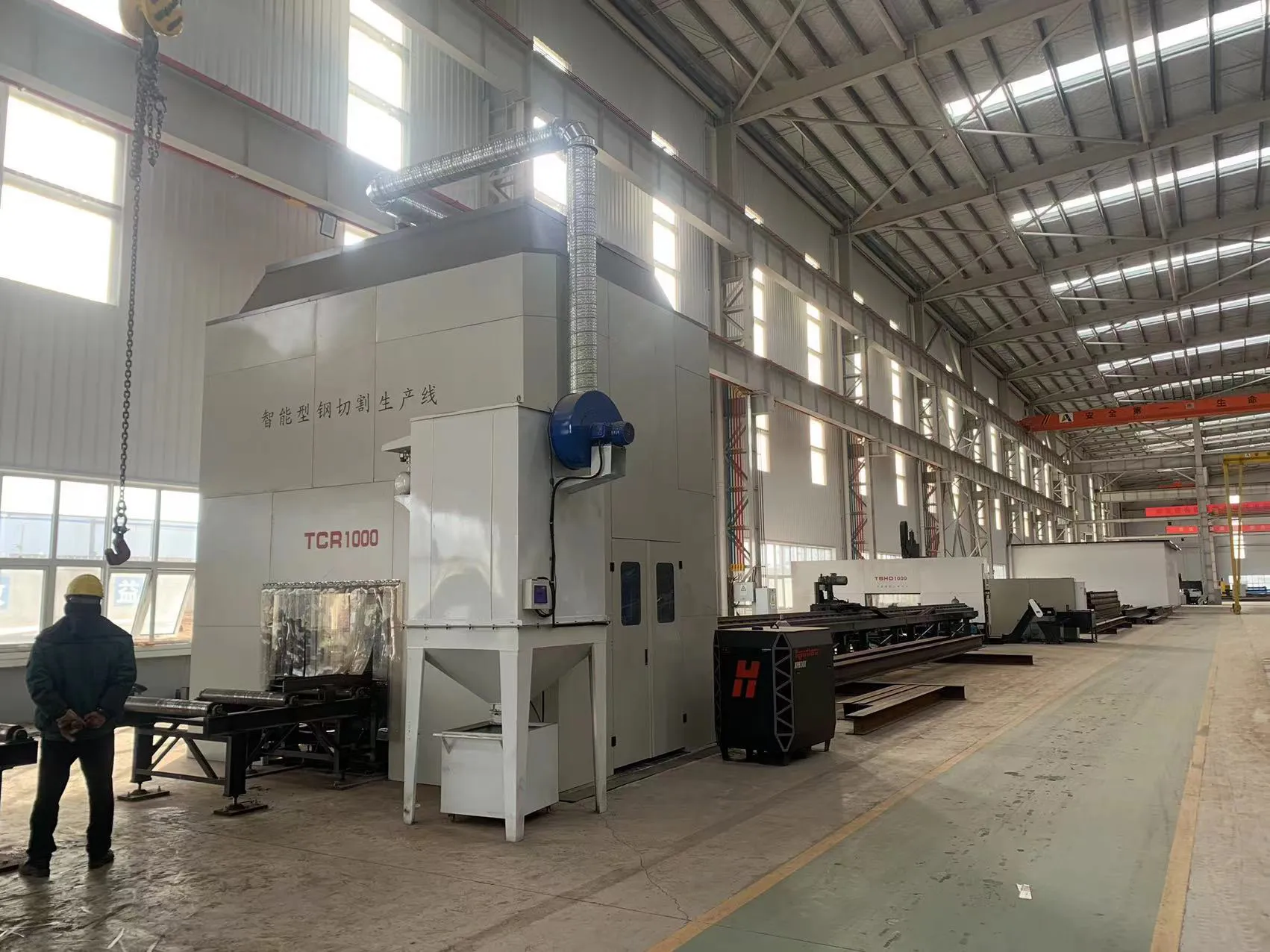
Field Technical Report: 20kW Universal Profile Steel Laser System Deployment
1. Infrastructure Context: Power Tower Fabrication in Charlotte, NC
Charlotte has emerged as a critical hub for energy infrastructure manufacturing, specifically concerning the high-voltage transmission sector. The regional demand for power tower fabrication—ranging from lattice towers to tubular steel monopoles—requires a departure from traditional plasma and mechanical drilling methods. The implementation of the 20kW Universal Profile Steel Laser System addresses the specific requirements of ASTM A572 and A588 high-strength low-alloy steels commonly utilized in these structures.
Power towers demand extreme structural reliability due to high wind loads and ice accumulation factors. Traditional fabrication involves separate stages for sawing, drilling, and manual oxy-fuel beveling, which introduces cumulative tolerance errors. The 20kW laser system centralizes these processes into a single-pass kinematic operation, ensuring that the geometric center of the profiles (H-beams, I-beams, and L-angles) remains consistent with the engineering CAD models.
2. The Physics of the 20kW Fiber Laser Source in Heavy Sections
The transition to a 20kW fiber laser source is not merely an incremental upgrade in speed; it represents a fundamental shift in the material interaction zone. At 20,000 watts, the power density at the focal point allows for a “keyhole” welding-mode equivalent in cutting, where the vaporization of the steel occurs so rapidly that the high-pressure assist gas (typically O2 for thick carbon steel or N2 for high-speed fusion cutting) can expel the molten material with minimal dross.
In the Charlotte facility, the 20kW source has demonstrated the ability to maintain a stable kerf width across 25mm to 40mm structural steel sections. This stability is critical for power towers, where the “bolt-hole” precision determines the integrity of the entire lattice. The 20kW source allows for a smaller Heat Affected Zone (HAZ) compared to plasma cutting, preserving the mechanical properties of the steel—specifically the yield strength—near the cut edge.
3. ±45° Bevel Cutting: Kinematics and Weld Preparation
The hallmark of the Universal Profile Laser System is its 5-axis 3D cutting head, capable of ±45° beveling. In the context of heavy steel processing, beveling is not an aesthetic requirement but a structural necessity for Full Penetration (CJP) and Partial Penetration (PJP) welds.
Precision and Geometry:
Traditional manual beveling is prone to angular deviation, often exceeding ±3°. The laser system’s interpolated motion control maintains an angular precision of ±0.5°. This precision ensures that when two heavy H-beams are fitted for a splice joint in a transmission tower, the root gap is uniform, significantly reducing the volume of filler metal required and the time spent in the welding booth.
Bevel Types:
The system facilitates the automated creation of V, Y, X, and K-type joints. For the Charlotte power tower projects, the ability to cut a “K-bevel” on the ends of large-diameter tubular sections or heavy angles allows for superior load distribution in the tower’s base plates. The ±45° range is sufficient to cover the majority of American Institute of Steel Construction (AISC) weld preps without secondary grinding.
4. Universal Profile Handling: H, I, and L Sections
Power towers utilize a variety of profiles, primarily heavy-duty angles (L-sections) for lattice structures and H-beams for substation dead-end structures. The “Universal” designation of this system refers to its multi-chuck pneumatic clamping system, which compensates for the inherent “twisting” and “bowing” found in hot-rolled steel.
In the field, we observed that the system’s 4-chuck configuration allows for “zero-tailing” processing. This is achieved by passing the profile through the rotating chucks, maintaining a rigid centerline even when the beam exceeds 12 meters in length. For Charlotte’s fabricators, this reduces material waste by 10-15%, a significant cost factor when dealing with high-tonnage energy projects.
5. Automation Synergy and Throughput Efficiency
The integration of a 20kW laser into a structural line necessitates a sophisticated material handling ecosystem. The Charlotte installation utilizes an automated loading/unloading buffer that interfaces directly with the laser’s CNC.
The Workflow Transformation:
1. Nesting: Advanced algorithms nest different tower components (braces, legs, plates) onto a single profile length, optimizing for weight distribution and minimal kerf interference.
2. Sensing: The system employs laser-based profile detection to locate the actual dimensions of the beam, which often deviate from the theoretical dimensions provided by the mill. The CNC adjusts the cutting path in real-time to compensate for these variances.
3. Execution: A 20mm thick L-angle for a lattice leg can be cut to length, beveled at both ends, and have 20+ bolt holes perforated in under 180 seconds. In contrast, mechanical methods would take approximately 12-15 minutes across multiple stations.
6. Thermal Management and Structural Integrity (HAZ Analysis)
A primary concern in power tower fabrication is the fatigue life of the steel under cyclic loading. High-heat processes like plasma or oxy-fuel can cause micro-cracking and excessive grain growth in the HAZ. Technical analysis of the 20kW laser cuts in the Charlotte facility shows a HAZ depth of less than 0.2mm.
The high cutting speed of the 20kW source minimizes the “dwell time” of the heat on the edge. This results in a martensitic layer that is thin enough to be negligible for the subsequent galvanizing process. In power towers, where every component is hot-dip galvanized for corrosion resistance, the clean, dross-free edge produced by the laser eliminates the need for shot blasting or manual cleaning, ensuring a superior zinc bond.
7. Impact on Downstream Assembly
The “Charlotte Standard” for power tower fabrication now emphasizes “erection-ready” parts. Because the 20kW system handles the beveling and hole-drilling with sub-millimeter accuracy, the field assembly of the lattice towers is significantly streamlined. We have documented a 30% reduction in field-fitment issues (where holes do not align or joints require shim plates).
The ±45° beveling allows for complex miter joints in the tower’s secondary bracing, which were previously avoided due to fabrication difficulty. This allows engineers to design more efficient, lighter towers that do not sacrifice structural rigidity.
8. Conclusion: The New Benchmark for Structural Steel
The deployment of the 20kW Universal Profile Steel Laser System in Charlotte represents the pinnacle of current structural fabrication technology. By synthesizing high-wattage fiber laser dynamics with 5-axis bevel kinematics, the industry has solved the bottleneck of precision weld preparation in heavy sections.
The transition from “manual-mechanical” to “automated-laser” processing is no longer an optional upgrade but a requirement for competing in the high-stakes energy infrastructure market. The ability to produce high-precision, beveled, and perforated structural components in a single operation ensures that Charlotte-based fabricators can meet the rigorous demands of the modern power grid with unprecedented efficiency and structural reliability.
Technical Specifications Summary:
– Source: 20kW Fiber Laser
– Bevel Range: ±45° (Interpolated)
– Profile Compatibility: H, I, U, L, and RHS sections up to 500mm
– Positional Accuracy: ±0.05mm per meter
– Angular Accuracy: ±0.5°
– Application: Power Transmission/Lattice Tower Fabrication
















