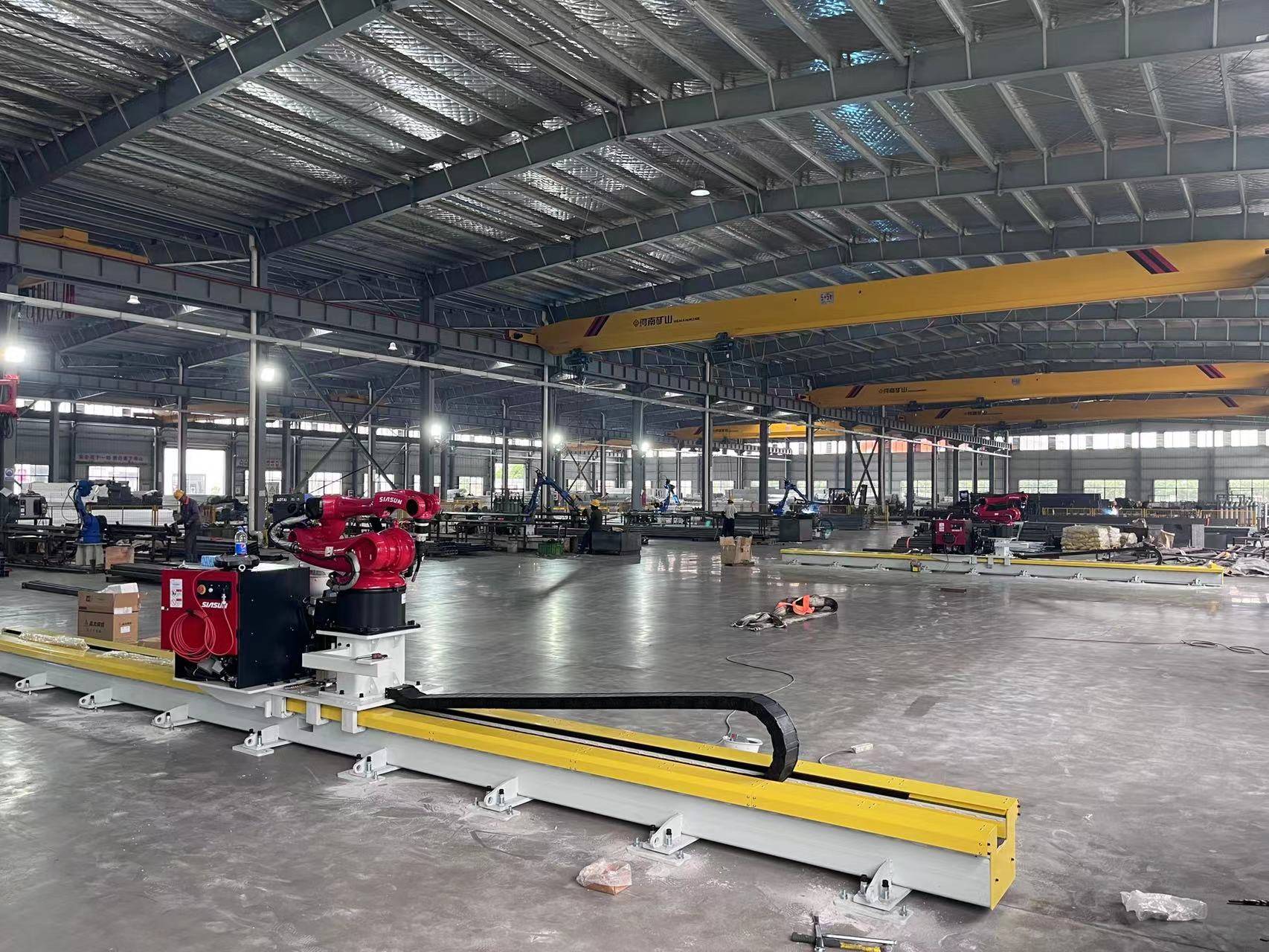
The Dawn of High-Power Structural Fabrication in Riyadh
The skyline of Riyadh is currently a testament to global architectural ambition. From the expansion of sports cities to the construction of world-class stadiums designed for international tournaments, the structural requirements are immense. These projects demand I-beams, H-beams, and C-channels of unprecedented scale and thickness.
Traditionally, processing these sections involved a fragmented workflow: mechanical sawing, followed by manual layout, and finally, oxygen-fuel or plasma beveling for weld preparation. The 20kW Heavy-Duty I-Beam Laser Profiler consolidates these steps into a single, automated process. In the context of Riyadh’s rapid development timelines, the ability to move from raw beam to weld-ready component in a fraction of the time is not just an advantage—it is a necessity.
The 20kW Advantage: Piercing Through Thick-Section Steel
In the realm of fiber lasers, “Power is Performance.” A 20kW laser source provides a power density that allows for high-speed fusion cutting of structural steel that was previously the sole domain of plasma or oxy-fuel.
For stadium structures, where I-beams often feature web and flange thicknesses exceeding 25mm, the 20kW source offers a “sweet spot” of efficiency. It delivers a remarkably narrow kerf and a reduced Heat Affected Zone (HAZ). This is critical for maintaining the metallurgical integrity of the high-strength steel grades used in cantilevered stadium roofs and massive load-bearing columns. The high wattage ensures that even when cutting at high speeds, the edge remains smooth and free of dross, significantly reducing the need for post-cut grinding.
Mastering Complexity with ±45° Bevel Cutting
The most significant hurdle in structural steel assembly is the preparation of weld joints. Stadium designs often involve complex geometries where beams meet at non-orthogonal angles, requiring precise V, X, Y, or K-shaped bevels.
The ±45° bevel cutting head is a marvel of 5-axis engineering. Integrated into the heavy-duty profiler, this head can rotate and tilt in real-time as it traverses the profile of the I-beam. This allows the laser to create a weld-ready edge during the initial cutting phase. By achieving a precise ±45° angle, the profiler ensures that when beams are brought together on the construction site in Riyadh, the fit-up is perfect. This “first-time-right” approach is vital for the structural safety of large-scale public venues, where every joint is a critical point of failure.
Heavy-Duty Architecture for Massive Profiles
Stadium beams are not standard structural components; they are heavy, long, and cumbersome. A 20kW profiler designed for this environment must feature a robust mechanical “backbone.” This includes:
1. **Reinforced Machine Bed:** A high-tensile, heat-treated bed designed to withstand the static and dynamic loads of I-beams that can weigh several tons.
2. **Large-Bore Pneumatic Chucks:** Four-chuck systems are often employed to provide continuous support and rotation for beams up to 12 meters (or more) in length. This prevents sagging and ensures that the laser focal point remains consistent throughout the entire length of the cut.
3. **Automated Loading/Unloading:** In a high-throughput Riyadh facility, manual handling is a bottleneck. Heavy-duty chain conveyors and hydraulic lifting systems are integrated to feed the laser profiler, ensuring the 20kW source is constantly “burning” rather than waiting for material.
Software Integration: From Tekla to the Laser Path
In Riyadh’s modern fabrication shops, the hardware is only as good as the software. For stadium projects, engineers typically use BIM (Building Information Modeling) software like Tekla Structures.
The 20kW I-Beam Profiler utilizes advanced CAM (Computer-Aided Manufacturing) interfaces that directly import these 3D models. The software automatically identifies the beam type, calculates the optimal cutting path for the ±45° bevels, and nesting logic to minimize material waste. This seamless digital-to-physical workflow ensures that the complex curvature of a stadium’s secondary steelwork is captured with sub-millimeter accuracy.
Operating in the Riyadh Climate: Engineering for Extremes
Riyadh’s environment poses unique challenges for high-power fiber lasers. Ambient temperatures can exceed 50°C, and fine desert dust is a constant threat to optical components.
A 20kW laser generates significant internal heat. For a profiler to operate reliably in Riyadh, it must be equipped with an oversized, industrial-grade dual-circuit cooling system. One circuit cools the laser source, while the other maintains the temperature of the cutting head and the optics.
Furthermore, the machine must be “hardened” against dust. This includes positive-pressure electrical cabinets and hermetically sealed optical pathways. Without these Saudi-specific modifications, the lifespan of the 20kW source and the precision of the ±45° head would be compromised by the harsh local conditions.
The Economic Impact: Efficiency and ROI
While the capital expenditure for a 20kW heavy-duty laser is significant, the Return on Investment (ROI) for Riyadh-based fabricators is compelling.
* **Labor Reduction:** By automating the layout, cutting, and beveling, a single operator can perform the work of a five-man team using traditional methods.
* **Consumable Savings:** Fiber lasers are significantly more energy-efficient than CO2 lasers and do not require the expensive gas mixtures needed for high-definition plasma in thick-plate cutting.
* **Time-to-Market:** In the race to complete stadiums for upcoming international events, the ability to process steel 3x to 5x faster than legacy systems provides a massive competitive edge during the bidding process.
Safety and Structural Integrity in Stadium Construction
Stadiums are high-occupancy structures subject to extreme wind loads and seismic considerations. The precision of a 20kW laser cut ensures that the structural calculations made by engineers are reflected in the physical build.
Unlike mechanical shearing or plasma cutting, which can introduce micro-cracks or excessive thermal stress into the steel, the fiber laser’s concentrated energy beam preserves the material’s properties. The ±45° bevels produced by the laser are uniform, allowing for deep-penetration welds that meet the most stringent international NDT (Non-Destructive Testing) standards required for Riyadh’s marquee projects.
Future-Proofing Riyadh’s Industrial Sector
As we look toward the next decade of Saudi Arabia’s industrial evolution, the 20kW Heavy-Duty I-Beam Laser Profiler is more than just a tool; it is a catalyst for sophisticated manufacturing. It allows local fabricators to move up the value chain, handling the most complex parts of a stadium’s anatomy locally rather than importing pre-fabricated sections from abroad.
The integration of ±45° bevel cutting technology ensures that Riyadh becomes a hub for specialized steel fabrication, capable of supporting not just stadiums, but also bridges, skyscrapers, and industrial plants. By investing in this level of power and precision, the Kingdom is building a foundation of engineering excellence that will stand long after the final whistle of a stadium’s inaugural match.
Conclusion: The Pinnacle of Fabrication
The 20kW Heavy-Duty I-Beam Laser Profiler with ±45° Bevel Cutting represents the pinnacle of modern fabrication technology. In the specific context of Riyadh’s stadium construction boom, it solves the dual challenges of extreme scale and extreme precision. By eliminating secondary processes, surviving the local climate, and delivering weld-ready components with surgical accuracy, this technology is the silent partner in Riyadh’s journey toward becoming a global architectural icon. For the fiber laser expert, the message is clear: the future of structural steel in Saudi Arabia is powered by 20,000 watts of focused light.