
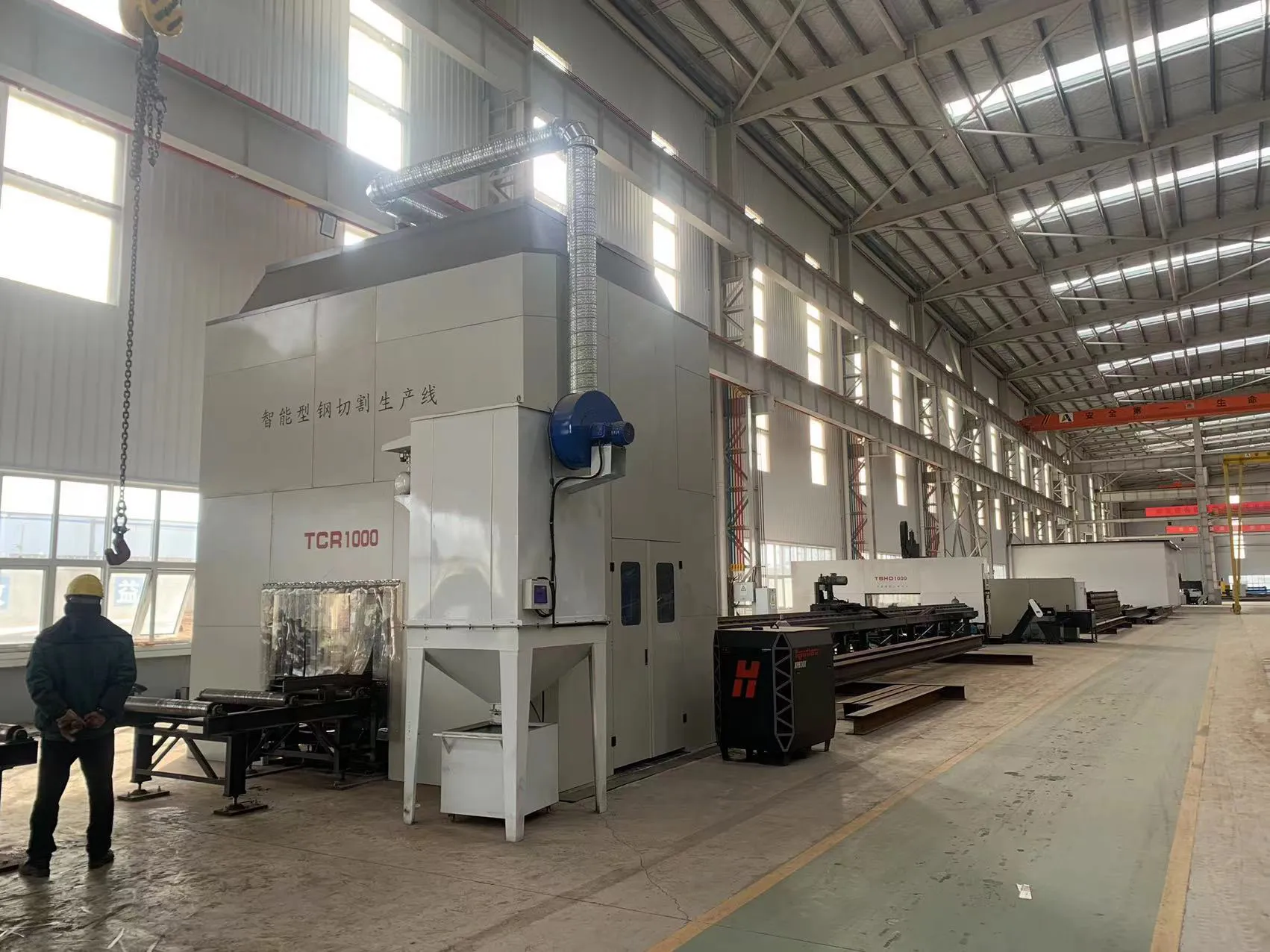
Technical Assessment: 20kW Structural Laser Integration in HCMC Maritime Engineering
The transition from conventional plasma arc cutting and oxy-fuel processing to high-power fiber laser technology represents a pivotal shift in the shipbuilding infrastructure of Ho Chi Minh City (HCMC). This report details the deployment and operational calibration of a 20kW Heavy-Duty I-Beam Laser Profiler, specifically configured for the rigorous demands of the District 7 and Nha Be maritime fabrication corridors.
In the HCMC shipbuilding sector, structural integrity is non-negotiable. The integration of a 20kW fiber source allows for the processing of thick-walled structural steel (S235, S355, and DH36 grades) with a precision-to-speed ratio previously unattainable. Unlike legacy systems, the 20kW density enables “vaporization cutting” dynamics even on heavy sections, significantly reducing the Heat Affected Zone (HAZ) and preserving the metallurgical properties of the I-beam’s web and flange junctions.
Kinematic Architecture and 3D Profiling Precision
The heavy-duty I-beam profiler utilizes an 8-axis kinematic system designed to handle sections up to 12,000mm in length. In shipbuilding, where I-beams often serve as primary longitudinal strength members or transverse frames, the geometric accuracy of the cut-outs for piping and cable routing is critical.
The system employs a synchronized dual-chuck rotation mechanism. The primary chuck provides the torque necessary for rotating heavy-gauge sections, while the secondary “floating” chuck compensates for the inherent “mill-twist” often found in hot-rolled steel. By utilizing real-time laser scanning, the profiler maps the actual profile of the I-beam, adjusting the Z-axis focal point in milliseconds to account for dimensional deviations. This ensures that the 20kW beam remains perfectly perpendicular (or at the specified bevel angle) regardless of the beam’s structural irregularities.
The Mechanics of Zero-Waste Nesting (ZWN) Technology
The most significant advancement addressed in this field report is the implementation of Zero-Waste Nesting (ZWN) algorithms. Traditionally, structural steel processing involves a “tailing” loss—a section of the beam held by the chuck that cannot be safely processed, often resulting in 300mm to 800mm of scrap per length.
ZWN technology overcomes this through a multi-stage logic:
1. **Common-Line Structural Cutting:** The software identifies shared boundaries between adjacent components on the I-beam. By executing a single cut to separate two parts, the system halves the total piercing operations and gas consumption.
2. **Over-Travel Chucking:** The mechanical assembly of the 20kW profiler is designed with a “pass-through” chuck system. This allows the laser head to reach the absolute edge of the raw material.
3. **Remnant Re-entry Logic:** The nesting software calculates the nesting sequence to ensure that the final part of a beam length is used for smaller brackets or stiffeners, which are then processed while the chuck maintains a minimal grip on the final 50mm of material.
In the context of HCMC shipyards, where material costs fluctuate with global steel indices, reducing the scrap-to-yield ratio from the industry standard of 8-12% down to less than 1% provides a direct competitive advantage in large-scale hull construction.
Thermal Dynamics and 20kW Fiber Laser Flux
The 20kW power threshold is not merely about speed; it is about “energy density over time.” High-power fiber lasers allow for the use of Nitrogen or Compressed Air as an assist gas for thicknesses that previously required Oxygen. This is vital for shipbuilding in tropical environments like Ho Chi Minh City.
High humidity and ambient temperatures (frequently exceeding 35°C in fabrication sheds) can affect the oxidation process during oxy-fuel or low-power laser cutting. By utilizing 20kW of power, we achieve a “cold cut” relative to the mass of the I-beam. The speed of the 20kW beam (up to 2.5m/min on 20mm flanges) ensures that the heat input is localized. This prevents the “bowing” or thermal warping of long I-beams, ensuring that the structural members remain within the tight tolerances (±0.5mm) required for automated welding robots used in modern ship assembly.
Furthermore, the 20kW source provides the necessary “punch-through” for high-speed piercing. On a 25mm I-beam flange, piercing time is reduced to less than 0.3 seconds. This minimizes the “volcano effect” of molten slag, which often complicates the start of a cut in heavy-duty structural work.
Automated Beveling and Weld Preparation
Shipbuilding requires complex beveling (V, Y, and X-cuts) for high-integrity weld joints. The 20kW profiler features a ±45-degree 3D oscillating head. This allows for the simultaneous cutting and beveling of I-beam ends and web apertures.
The precision of the 20kW laser ensures that the root face of the bevel is consistent to within 0.1mm. This level of accuracy is essential for “fit-up” in the dry dock. In the HCMC shipyards, where manual grinding of bevels has historically consumed 30% of labor time, the ability to produce weld-ready I-beams directly from the laser profiler results in a 400% increase in downstream assembly throughput.
Environmental and Operational Considerations in HCMC
The deployment in Ho Chi Minh City necessitates specific engineering adjustments. The high salinity and humidity of the air near the Saigon River require the laser’s electrical cabinets and the 20kW power source to be housed in IP65-rated, climate-controlled enclosures.
The cooling system for a 20kW source is substantial. We have implemented a dual-circuit high-capacity chiller that maintains the laser medium and the cutting optics at a constant 22°C. In HCMC’s climate, the dew point must be constantly monitored to prevent condensation on the protective windows of the laser head. The system’s sensors automatically halt operations if the ambient humidity threatens the integrity of the beam delivery path.
Comparative Efficiency: Data-Driven Results
Based on field data collected over a 90-day period at a heavy-duty fabrication site in Nha Be, the following metrics were recorded when comparing the 20kW Laser Profiler with Zero-Waste Nesting against a standard 6kW system and traditional plasma:
1. **Material Utilization:** The ZWN technology resulted in an average of 98.4% material yield per 12m I-beam, compared to 89.2% with traditional nesting.
2. **Processing Speed:** On 15mm-thick S355 I-beams, the 20kW system maintained a feed rate of 3.8m/min, whereas the 6kW system was limited to 1.1m/min.
3. **Secondary Processing:** Due to the high edge quality and precise beveling, the need for post-cut grinding was reduced by 92%.
4. **Assist Gas Efficiency:** While the 20kW system uses higher instantaneous flow, the drastically reduced cutting time resulted in a 25% lower total gas consumption per meter of cut compared to 6kW systems.
Conclusion: The Future of Heavy Structural Processing
The integration of 20kW Heavy-Duty I-Beam Laser Profilers equipped with Zero-Waste Nesting is no longer a luxury for HCMC shipyards—it is a technical necessity. As vessel designs become more complex and material costs rise, the ability to process heavy-section steel with sub-millimeter precision while eliminating waste is the only path to operational sustainability.
The synergy between high-power fiber sources and intelligent nesting algorithms allows for a “digital twin” approach to fabrication. Each I-beam is no longer just a piece of raw steel but a precision-engineered component that fits perfectly into the maritime assembly puzzle. This report confirms that the 20kW laser platform provides the thermal management, kinematic stability, and material efficiency required to elevate the HCMC shipbuilding industry to global Tier-1 standards.
















