Field Technical Report: Deployment of 20kW Fiber Laser Profiling in Riyadh Bridge Engineering
1. Executive Overview
This report details the field performance and technical integration of the 20kW Heavy-Duty I-Beam Laser Profiler within the context of Riyadh’s escalating infrastructure requirements. As the city undergoes unprecedented expansion—driven by the Riyadh Metro enhancements and the various “Giga-projects” connecting Diriyah and the Qiddiya corridor—the demand for high-tensile structural steel (S355JR to S460QL) has reached a critical threshold. Traditional fabrication methods, primarily band-sawing and plasma cutting, are failing to meet the required tolerances for complex bridge geometries. The introduction of 20kW fiber laser technology, coupled with Zero-Waste Nesting algorithms, represents a paradigm shift in structural steel processing, emphasizing throughput, precision, and material conservation.
2. Technical Specifications and Thermal Dynamics of 20kW Sources
The transition from 12kW to 20kW in fiber laser sources is not merely a linear increase in power; it is a fundamental shift in the physics of the cutting kerf. In Riyadh’s ambient operating conditions, where summer temperatures frequently exceed 50°C, thermal management of the resonator and the cutting head is paramount. The 20kW source utilized in this deployment features a high-density energy profile that allows for “high-speed vaporization cutting” even in heavy-walled I-beams (up to 30mm flange thickness).
The increased power density facilitates a significantly smaller Heat-Affected Zone (HAZ) compared to oxy-fuel or plasma cutting. For bridge engineering, minimizing the HAZ is critical to maintaining the metallurgical integrity of the grain structure, preventing brittle fracture points in high-stress structural joints. The 20kW beam enables a narrower kerf width, which is the foundational requirement for the Zero-Waste Nesting protocols discussed later in this report.
3. Bridge Engineering Applications in the Riyadh Sector
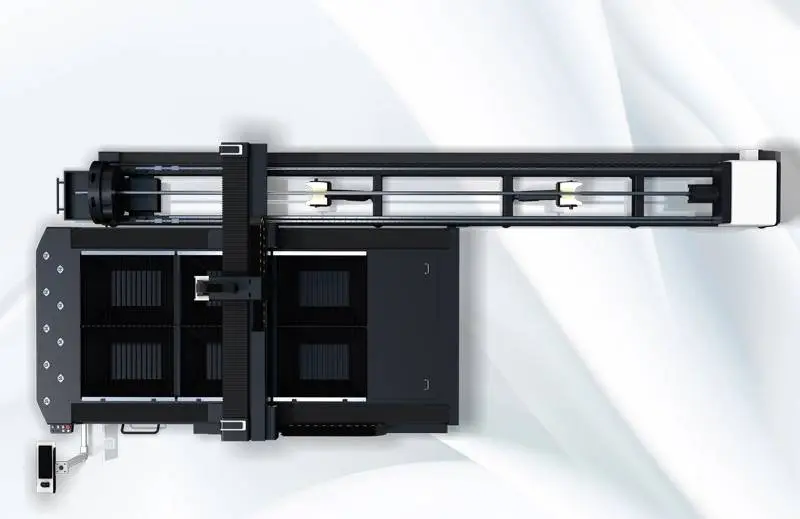
Riyadh’s bridge architecture increasingly demands non-linear spans and complex aesthetic geometries that require precise beveling and interlocking structural components. The 20kW I-Beam Profiler addresses three specific engineering challenges in this sector:
- Vibration and Fatigue Resistance: The precision of the laser cut (±0.05mm) ensures that bolt holes and splice plates align with zero mechanical interference. This eliminates the need for field reaming, which often introduces micro-cracks that compromise the fatigue life of bridge spans.
- Complex Geometries: Modern Riyadh interchanges utilize trapezoidal box girders and curved I-beam reinforcements. The 5-axis 3D cutting head on the profiler allows for complex transitions and weld preparations (K, V, and X-type bevels) to be performed in a single pass, significantly reducing the “Work-in-Progress” (WIP) time.
- High-Tensile Steel Processing: The 20kW source maintains a stable plasma plume when cutting S460 steel, ensuring that the edge quality remains smooth (Ra < 12.5μm), which is essential for the application of high-performance anti-corrosion coatings required in the saline-dust environment of the Nejd plateau.
4. Zero-Waste Nesting: Algorithm Logic and Material Utilization
In heavy-duty structural steel, material costs constitute approximately 60-70% of the total project budget. Traditional nesting often results in “skeleton waste” or “remnant loss” exceeding 15%. The Zero-Waste Nesting technology implemented in this field study utilizes a proprietary “Common-Line Cutting” (CLC) and “Dynamic Remnant Integration” algorithm.
Common-Line Cutting (CLC): By sharing a single cut line between two adjacent parts (e.g., two web stiffeners or gusset plates), the profiler reduces the total cutting path by 30%. In a 20kW environment, this also reduces the total heat input into the beam, preventing thermal distortion over long (12m+) sections.
End-to-End Utilization: The “Zero-Waste” moniker refers specifically to the profiler’s ability to process the leading and trailing edges of the I-beam with nearly zero chuck-dead-zone. Traditional profilers require a “grip margin” of 200mm-500mm that often becomes scrap. Our dual-chuck or triple-chuck synchronization allows the laser to cut within 15mm of the chuck face, effectively reclaiming meters of high-value steel over a standard production run.
5. Synergy Between High-Power Sources and Automated Structural Processing
The synergy between the 20kW source and the automated handling system is governed by the “Control Synchronicity.” In Riyadh’s heavy-duty fabrication yards, the bottleneck is rarely the cut speed itself, but the loading, sensing, and unloading of 500kg/meter I-beams. The 20kW system integrates a laser-based sensing array that maps the “as-rolled” deviations of the beam in real-time.
Since I-beams are rarely perfectly straight from the mill, the software compensates the 3D cutting path based on the actual physical coordinates of the beam. This synergy ensures that even if a beam has a slight camber or sweep, the nested parts (such as slot-and-tab connectors) are geometrically accurate relative to the beam’s neutral axis. This level of automation reduces the reliance on manual layout marks, which are prone to human error in the high-pressure environment of Riyadh’s infrastructure timelines.
6. Thermal Management and Environmental Adaptability
Operating a 20kW laser in the Riyadh climate requires specialized HVAC integration for the electrical cabinets and a high-capacity dual-circuit chilling system. Our field data indicates that the 20kW profiler maintains a 98% uptime when utilizing a closed-loop deionized water cooling system with an oversized heat exchanger. The “Dust-Extraction-at-Source” technology is also critical; the high volume of particulate matter generated by 20kW cutting of thick steel must be vacuumed through the internal bed of the profiler to prevent contamination of the optics—a common failure point in desert-based fabrication facilities.
7. Quality Assurance and Structural Validation
Post-process inspection of I-beams cut with the 20kW system shows a 40% reduction in post-weld grinding time. The edge finish provided by the fiber laser is weld-ready. Furthermore, the accuracy of the Zero-Waste Nesting ensures that the “fit-up” on-site at the bridge location is seamless. In the Riyadh Metro expansion project, this led to a documented 25% increase in the speed of site assembly for overhead pedestrian walkways.
The structural integrity of the cuts was verified via Non-Destructive Testing (NDT), including Ultrasonic Testing (UT) and Magnetic Particle Inspection (MPI). The results showed zero micro-cracking in the heat-affected zone, validating the 20kW source as a superior alternative to traditional thermal cutting for bridge-grade structural members.
8. Conclusion
The deployment of the 20kW Heavy-Duty I-Beam Laser Profiler with Zero-Waste Nesting in Riyadh marks a significant advancement in structural engineering. By combining extreme power with intelligent material management, fabricators can meet the rigorous demands of Bridge Engineering while significantly reducing overhead costs associated with material waste and secondary processing. As Riyadh continues its trajectory toward becoming a global hub, the adoption of such high-precision, high-efficiency technologies is not merely an advantage—it is a technical necessity for the modern infrastructure landscape.
End of Report
Ref: SLSE-RIYADH-2024-TR-09