The Infrastructure Context: Ho Chi Minh City’s Engineering Evolution
Ho Chi Minh City (HCMC) stands as the industrial heartbeat of Vietnam, currently undergoing a massive structural transformation. The city’s geography, defined by the winding Saigon River and a network of canals, necessitates sophisticated bridge engineering to connect the burgeoning Thu Thiem New Urban Area with the traditional commercial districts.
Historically, the fabrication of large-scale bridge components—specifically I-beams, H-beams, and box girders—relied on manual layout, oxy-fuel cutting, or high-definition plasma systems. While functional, these methods introduced significant heat-affected zones (HAZ) and required extensive post-processing, such as grinding and drilling. The introduction of the 20kW Heavy-Duty I-Beam Laser Profiler changes this dynamic. In the humid, high-intensity construction environment of Southern Vietnam, the speed and precision of ultra-high-power fiber lasers allow local firms to meet aggressive project timelines for the North-South Expressway and various urban flyovers without compromising the metallurgical properties of the steel.
The 20kW Advantage: Breaking Through Thickness and Speed
In the world of fiber lasers, power is the primary determinant of both throughput and the maximum gauge of material that can be processed. A 20kW light source provides an immense energy density that allows for the “high-speed vaporization” of carbon steel.
For bridge engineering, where flange thicknesses on I-beams often exceed 25mm to 40mm, a 20kW laser provides two distinct advantages:
1. **Continuous Wave (CW) Penetration:** The laser can maintain a stable keyhole during the cutting process, ensuring that the verticality of the cut remains perfect across the entire depth of the beam’s web or flange.
2. **Reduced Heat Input:** Counterintuitively, a higher power laser often results in a smaller heat-affected zone. Because the 20kW beam moves significantly faster than a 6kW or 10kW counterpart, the surrounding metal has less time to absorb conductive heat. This is critical for maintaining the tempered strength of structural steel used in load-bearing bridge sections.
In HCMC’s manufacturing outskirts, such as the industrial parks in Binh Duong or Dong Nai, these machines are now being utilized to process S355 and S460 structural steels, providing the clean edges necessary for automated welding robots to follow.
Mechanical Architecture: The Heavy-Duty I-Beam Profiler
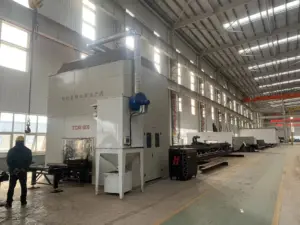
A laser is only as good as the motion system that carries it. For bridge engineering, we are not dealing with flat sheets but with massive, 12-meter-long structural members that can weigh several tons. The “Heavy-Duty” designation refers to the reinforced machine bed and the specialized chuck systems designed to rotate and feed these gargantuan profiles.
The profiler utilizes a synchronized multi-chuck system—often three or four independent pneumatic chucks—that can support, rotate, and move the I-beam along the X-axis with zero slippage. This is vital for bridge components where bolt-hole patterns must be accurate to within a fraction of a millimeter over a ten-meter span. If the beam shifts even slightly during the transition, the entire structural integrity of a bridge joint could be compromised. In HCMC’s humid climate, these machines are often equipped with climate-controlled enclosures for the racks, pinions, and linear motors to prevent thermal expansion from affecting the tight tolerances required.
The Infinite Rotation 3D Head: Engineering Without Limits
The “Infinite Rotation” 3D head is perhaps the most significant technological leap in this assembly. Standard 5-axis laser heads are often limited by internal cabling, requiring a “rewind” after rotating a certain number of degrees (usually +/- 360). An infinite rotation head uses advanced slip-ring technology or specialized fiber-optic routing to allow the cutting head to spin indefinitely.
For an I-beam, this is revolutionary. Bridge structures often require complex bevels (K-cuts, V-cuts, and Y-cuts) for weld preparation. The 3D head can tilt up to 45 or even 50 degrees, allowing the laser to carve out a bevel directly on the edge of a thick flange. Because the head can rotate infinitely, it can transition seamlessly from cutting the top flange to the vertical web and finally the bottom flange in one continuous movement. This eliminates the “start-stop” dwell marks that can become points of stress concentration in bridge components.
Applications in Bridge Engineering: Beyond the Straight Cut
Bridge engineering in the 21st century involves more than just straight lines. Modern designs, like the iconic bridges in Da Nang or the newer spans in HCMC, utilize complex truss geometries and aesthetic curvatures.
* **Truss Intersections:** The 20kW profiler can cut complex “fish-mouth” joints where tubular or I-beam sections meet at oblique angles. The precision of the 3D head ensures that the fit-up is perfect, requiring less filler material during the welding process.
* **Perforated Webs:** To reduce the weight of a bridge without sacrificing strength, engineers often design beams with hexagonal or circular openings in the web (castellated beams). The 20kW laser processes these openings in seconds, with a surface finish that requires no further machining.
* **Expansion Joint Components:** The laser’s ability to handle heavy plate and profiles makes it ideal for the thick, interlocking “comb” structures used in bridge expansion joints, which must withstand constant vibration and heavy vehicle loads.
Local Economic Impact: Elevating HCMC’s Fabrication Capacity
The deployment of such high-end machinery in Ho Chi Minh City is a signal of the region’s maturing industrial base. By moving away from labor-intensive manual fabrication, Vietnamese engineering firms are becoming more competitive on the global stage.
The 20kW laser reduces the reliance on a large workforce for “roughing out” parts, allowing skilled labor to focus on the high-value assembly and specialized welding. Furthermore, the efficiency of the fiber laser—which converts electrical energy into light at a much higher rate than CO2 lasers—reduces the carbon footprint of these massive infrastructure projects. As Vietnam commits to greener construction standards, the energy efficiency of the 20kW fiber source becomes a key selling point for government-contracted bridge projects.
Maintenance and Technical Challenges in a Tropical Environment
Being a fiber laser expert in HCMC involves addressing the specific environmental challenges of the region. The high humidity and ambient temperatures of Southern Vietnam can be detrimental to high-power optics.
1. **Chiller Efficiency:** A 20kW laser generates significant internal heat. The cooling systems for these profilers in HCMC must be oversized and highly redundant to ensure the laser source remains at a stable 22-25°C, even when the factory floor exceeds 35°C.
2. **Air Filtration:** The cutting of heavy structural steel produces significant particulate matter. In the dense industrial zones of HCMC, high-volume dust extraction and filtration are mandatory to protect both the machine’s optical path and the health of the operators.
3. **Power Stability:** The HCMC power grid, while improving, can experience fluctuations. High-duty profilers are typically installed with dedicated voltage stabilizers and UPS systems to protect the sensitive 20kW diodes from electrical surges.
Conclusion: Building the Future of Vietnam
The 20kW Heavy-Duty I-Beam Laser Profiler with Infinite Rotation 3D Head is more than just a piece of industrial equipment; it is a catalyst for the next generation of Vietnamese infrastructure. By providing bridge engineers in Ho Chi Minh City with the ability to cut thicker, faster, and with more geometric complexity than ever before, this technology ensures that the city’s skyline and its river crossings are built on a foundation of precision and strength.
As we look toward the future, the integration of AI-driven nesting and real-time monitoring on these 20kW platforms will further optimize material usage and minimize waste, making the dream of a modern, interconnected HCMC a reality, one perfectly cut I-beam at a time.