
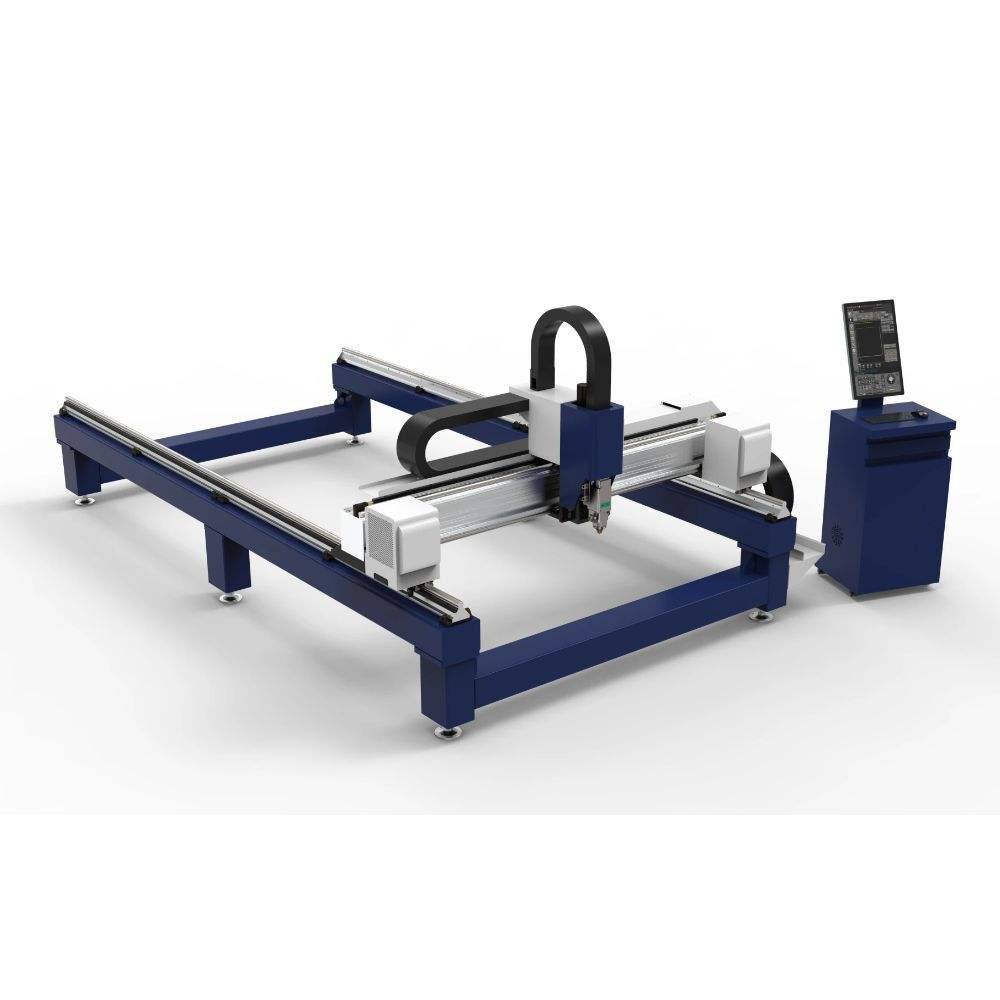
Technical Field Report: Implementation of 20kW High-Power Laser Profiling in Riyadh Railway Infrastructure
1. Executive Summary
This report analyzes the deployment of 20kW Heavy-Duty I-Beam Laser Profiling systems within the context of Riyadh’s escalating railway infrastructure requirements. As part of the Kingdom’s Vision 2030, the demand for high-tolerance structural steel components—specifically I-beams, H-beams, and U-channels—has necessitated a shift from traditional mechanical processing to high-power fiber laser thermal cutting. The focus of this evaluation is the synergy between the 20kW fiber source and integrated automatic unloading cycles, addressing the challenges of material weight, thermal distortion, and throughput bottlenecks inherent in heavy-scale structural engineering.
2. Project Context: Riyadh Railway Expansion
The Riyadh Metro and the broader Saudi North-South Railway expansion involve the fabrication of complex junctions, elevated track supports, and station framework. These structures rely on massive I-beams (predominantly S355JR and S355J2 grades) that must adhere to stringent EN 1090-2 execution standards. Traditional methods—comprised of band sawing, CNC drilling, and manual oxy-fuel coping—introduce cumulative tolerances that often exceed the +/- 1.0mm margin required for high-speed rail vibration damping.
In the arid, high-temperature environment of Riyadh, thermal expansion during fabrication is a critical factor. The 20kW laser profiler provides a localized Heat Affected Zone (HAZ), significantly narrower than plasma or oxy-fuel, ensuring that the structural integrity of the I-beam’s web and flange remains within metallurgical specifications.
3. Technical Specification of the 20kW Fiber Source
The transition to a 20kW power density represents a quantum leap in structural processing. At this wattage, the laser achieves “high-speed melt-shearing,” allowing for the processing of carbon steel flanges up to 40mm with exceptional perpendicularity.
3.1. Beam Quality and Kerf Management:
The 20kW source utilizes a high-brightness fiber delivery system. For heavy-duty I-beams, the Beam Parameter Product (BPP) is optimized to maintain a consistent focal spot across the irregular geometry of the beam. The system’s ability to dynamically adjust the focal point—compensating for the transition from the thin web to the thicker flange—is critical for maintaining a dross-free finish.
3.2. Assist Gas Dynamics:
In the Riyadh field tests, the use of High-Pressure Air or Oxygen-assisted cutting was evaluated. While Oxygen provides the exothermic reaction necessary for thickness, the 20kW overhead allows for “Nitrogen-High-Speed” cutting on medium-thickness webs (up to 20mm), resulting in an oxide-free surface ready for immediate welding without secondary grinding—a massive labor saving for railway contractors.
4. Kinematics of Heavy-Duty 3D Profiling
Unlike flatbed lasers, the I-Beam profiler utilizes a 5-axis or 7-axis robotic/gantry movement profile. The machine must rotate the heavy structural section or orbit the cutting head around the profile.
4.1. Chucking and Centering:
For the Riyadh projects, beams often exceed 12 meters in length. The system utilizes large-bore pneumatic or hydraulic chucks. Sensors detect the inevitable “camber” and “sweep” (natural deformations) in hot-rolled steel. The 20kW profiler’s software compensates for these deviations in real-time, ensuring that bolt holes and coping cuts are indexed to the beam’s actual center line, not a theoretical CAD model.
5. The Role of Automatic Unloading Technology
In heavy-duty processing, the “bottle-neck” is rarely the cutting speed, but rather the material handling. An I-beam used in rail supports can weigh several tons. Manual unloading using overhead cranes is high-risk and slow, often resulting in “dead time” where the laser is inactive.
5.1. Mechanical Integration of Unloading Systems:
The Automatic Unloading system consists of a heavy-duty chain-driven conveyor integrated with hydraulic lifting “flippers.” Once the 20kW head completes the final cut, the unloading sequence initiates:
1. Support Synchronization: Multiple support points rise to meet the processed beam, preventing the “drop” that can damage the precision-cut edges.
2. Lateral Transfer: The beam is moved laterally out of the cutting envelope onto a buffer rack.
3. Simultaneous Loading: As the finished beam exits, the next raw section is indexed into the chuck.
5.2. Impact on Precision:
Manual handling of hot-rolled steel often results in surface scarring or slight bending of flanges. Automatic unloading preserves the “as-cut” precision. For Riyadh’s railway bridge components, where “fit-up” must be seamless to prevent resonance issues under train load, this mechanical consistency is non-negotiable.
6. Efficiency Analysis: 20kW vs. Conventional Methods
Data collected from the Riyadh field site indicates the following performance metrics:
- Hole Cutting: A 20kW laser can pierce and cut a 24mm diameter bolt hole in 30mm steel in under 2 seconds. Conventional drilling, including tool change and positioning, averages 45-60 seconds per hole.
- Coping and Notching: Complex “rat-hole” cuts for weld access, which previously required manual layout and oxy-fuel cutting, are now executed in a single continuous path.
- Duty Cycle: With automatic unloading, the machine’s “Beam-On” time increased from 45% (manual handling) to 82% (automated handling).
7. Structural Integrity and Quality Control
In railway engineering, the Heat Affected Zone (HAZ) is a primary concern. Excessive heat input can lead to local martensitic transformation, increasing brittleness. The 20kW laser’s high feed rate ensures that the total heat input per millimeter is significantly lower than plasma or oxy-fuel.
7.1. Surface Roughness (Rz):
The resulting surface finish on the I-beam flanges meets ISO 9013 Range 2 or 3 standards. This eliminates the need for shot-blasting or edge-rounding specifically for the purpose of removing slag, although standard protective coatings are still applied post-fabrication.
7.2. Bolt Hole Tolerance:
For the Riyadh Metro’s structural steel connectors, the 20kW laser maintains a cylindricity tolerance within 0.1mm. This allows for “friction-grip” bolting configurations which are essential for structures subject to dynamic loading and vibration.
8. Environmental Considerations in Riyadh
The Riyadh climate presents unique challenges for 20kW fiber lasers. The high ambient dust (silica) and temperatures exceeding 45°C require:
- Positive Pressure Cabinets: To prevent dust ingress into the optical path.
- Dual-Circuit Chilling: The 20kW source generates significant waste heat. High-capacity chillers with oversized condensers were required to maintain the laser medium at a stable 22°C.
- Automatic Unloading Lubrication: Heavy-duty conveyors were fitted with high-viscosity lubricants to prevent seizure under the fine-grain dust conditions characteristic of the region.
9. Economic Impact and Throughput
The capital expenditure (CAPEX) of a 20kW I-beam profiler with automatic unloading is substantial. However, the Operational Expenditure (OPEX) per ton of processed steel is reduced by approximately 40% compared to traditional multi-machine lines. In the Riyadh infrastructure market, where project timelines are aggressive, the ability to process a 12-meter I-beam with 50+ holes and 4 complex notches in under 12 minutes—including loading and unloading—provides a significant competitive advantage.
10. Conclusion
The deployment of 20kW Heavy-Duty I-Beam Laser Profiling with Automatic Unloading technology represents the current apex of structural steel fabrication for the railway sector. By solving the precision issues associated with manual handling and the efficiency limitations of lower-power sources, this technology ensures that Riyadh’s infrastructure is built to a standard that exceeds traditional civil engineering expectations. The integration of 20kW optics with robust mechanical unloading creates a continuous, high-precision manufacturing loop that is essential for the scale and complexity of modern Saudi Arabian rail projects.
Field Report Prepared By:
Senior Engineering Lead, Structural Laser Division
Riyadh Infrastructure Technical Group
















