The Paradigm Shift: Why 20kW Matters for Pune’s Aviation Infrastructure
In the realm of structural engineering, particularly for large-scale projects like airports, the I-beam is the fundamental building block. Traditionally, fabricating these beams involved a disjointed workflow: mechanical sawing for length, radial drilling for bolt holes, and manual oxy-fuel or plasma cutting for notches and cope cuts. This process is not only slow but prone to human error—errors that become incredibly costly when dealing with the high-grade structural steel required for airport terminals and hangars.
The introduction of the 20kW Fiber Laser Profiler to Pune’s construction ecosystem changes the math entirely. At 20kW, the laser isn’t just cutting; it is vaporizing thick-walled steel with surgical precision. For airport construction, where beams often feature flanges exceeding 25mm to 40mm in thickness, the 20kW power density ensures that the laser can maintain high feed rates without sacrificing edge quality. This eliminates the need for secondary grinding or deburring, allowing the steel to move directly from the machine to the assembly site at the airport.
Technical Architecture of the Heavy-Duty Profiler
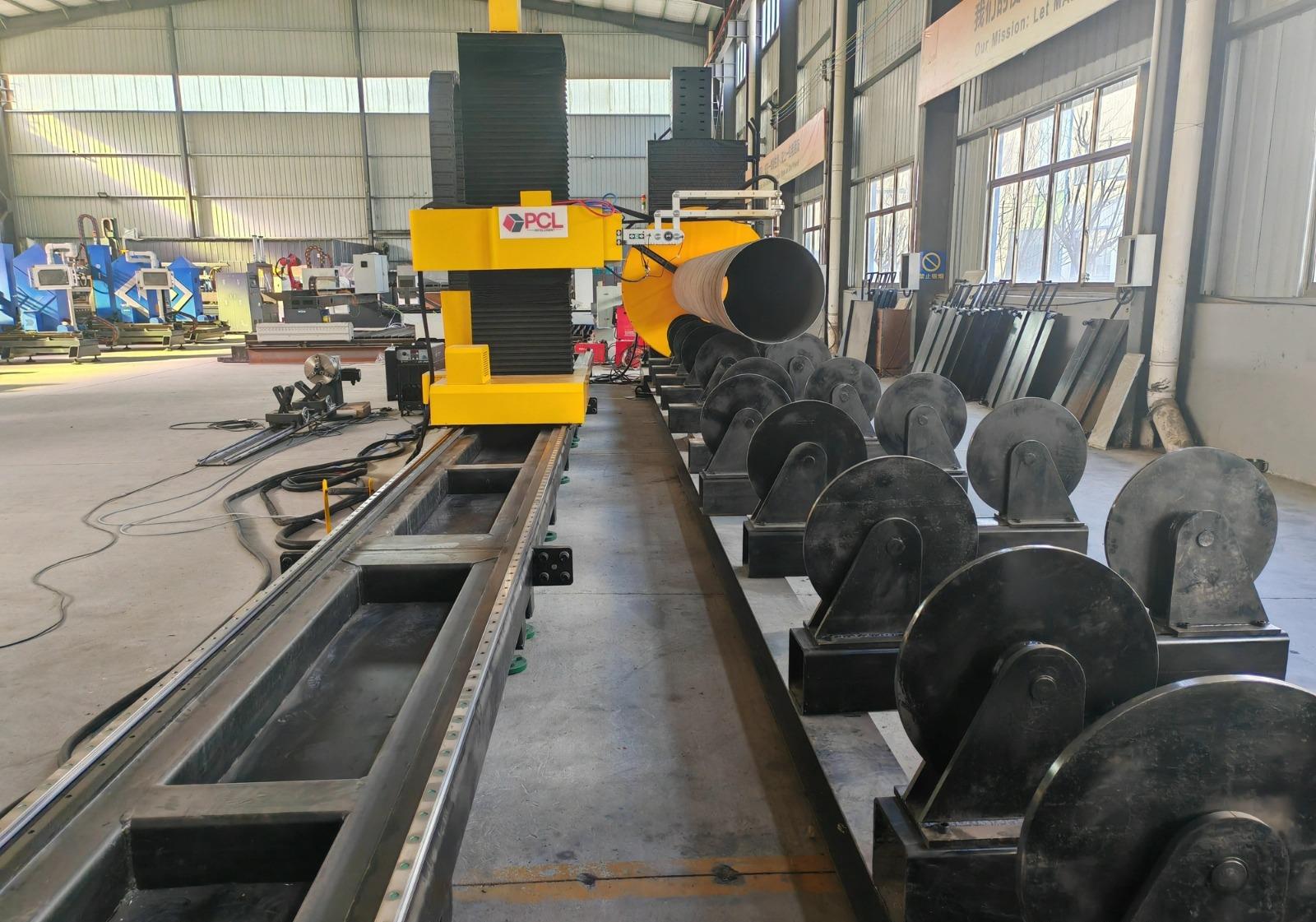
A 20kW laser source is only as good as the machine that houses it. A “Heavy-Duty” profiler designed for I-beams is a massive installation, often stretching 15 to 24 meters in length. It utilizes a multi-chuck system—typically three or four pneumatic chucks—that can synchronize to rotate and feed massive structural members through the cutting zone.
In Pune’s industrial climate, where precision is a legacy, these machines offer “zero-tailing” technology. This means the chucks can pass the beam through the cutting head in a way that minimizes wasted material at the end of the beam. Given the fluctuating prices of steel, saving 300mm to 500mm of an I-beam on every cut provides a significant ROI over the course of a multi-year airport project. Furthermore, the specialized 3D cutting head allows for +/- 45-degree beveling, which is essential for creating the weld-ready edges required for the heavy-duty joints found in airport seismic-resistant frames.
The Efficiency of Automatic Unloading Systems
One of the most significant bottlenecks in heavy steel fabrication is material handling. A single 12-meter I-beam can weigh several tons. Relying on overhead cranes and manual labor to unload finished parts is a recipe for downtime and potential workplace injury.
The “Automatic Unloading” component of this system is a logistical game-changer for Pune-based fabricators. Once the 20kW head completes the profiling, a series of hydraulic lifters and motorized conveyor chains take over. The finished beam is automatically moved to a stacking area, while the next raw beam is simultaneously prepared for loading. This parallel processing ensures that the laser is “on-beam” for the maximum possible percentage of the shift. In the context of the tight deadlines associated with airport infrastructure, where “time-to-wing” is a critical metric, this automation can increase daily output by as much as 300% compared to semi-automated systems.
Application in Airport Terminals and Hangars
Airport architecture is moving away from the “box” design toward more organic, flowing structures that maximize natural light and passenger flow. These designs require complex “tree” columns and curved roof trusses made of structural steel.
The 20kW I-beam laser allows architects and engineers in Pune to design with more ambition. Because the laser can cut complex apertures, slots, and interlocking joints directly into the I-beams, the “Lego-style” assembly of the airport’s skeletal frame becomes possible. Instead of measuring and welding on-site in the heat of a Pune summer, workers can simply bolt together pre-indexed parts. This precision ensures that the massive glass facades of modern airports, which rely on the steel frame being perfectly plumb and square, can be installed without the need for shimming or structural adjustments.
Pune: The Ideal Ecosystem for Advanced Laser Adoption
Pune is uniquely positioned to lead the adoption of 20kW laser technology in India. As a hub for automotive and heavy engineering, the city already possesses a skilled workforce capable of operating sophisticated CNC machinery. Local service centers for international laser brands and domestic manufacturers are concentrated in areas like Chakan, Pimpri-Chinchwad, and Talegaon.
Furthermore, the logistical proximity of Pune to the upcoming airport sites means that a centralized fabrication hub equipped with a 20kW profiler can serve as the “factory floor” for the entire project. The ability to produce “Just-In-Time” (JIT) structural components reduces the need for massive on-site storage at the airport, which is often constrained by security and operational requirements.
Comparative Advantages: Laser vs. Plasma in Large-Scale Projects
While plasma cutting has long been the standard for structural steel, the move to 20kW fiber laser is driven by three factors: Heat Affected Zone (HAZ), precision, and operational cost.
1. **HAZ and Material Integrity:** High-power lasers concentrate energy so intensely that the area surrounding the cut remains relatively cool. This prevents the metallurgical deformation of the steel, which is vital for the load-bearing beams used in airport hangars that must support the weight of massive aircraft maintenance equipment.
2. **Precision of Bolt Holes:** Airport structures rely on thousands of bolted connections. Plasma-cut holes are often slightly tapered, requiring reaming. The 20kW laser produces perfectly cylindrical holes with a tolerance of +/- 0.1mm, allowing for immediate bolting.
3. **Operational Cost:** While the initial investment in a 20kW laser is higher, the cost per meter of cut is significantly lower than plasma when accounting for gas consumption, electrode wear, and the speed of the 20,000-watt source.
Economic Impact on Pune’s Construction Sector
The deployment of a 20kW Heavy-Duty I-Beam Laser Profiler represents a significant capital expenditure, but for the Pune construction sector, the macro-economic benefits are clear. It elevates the local industry from “commodity fabrication” to “high-precision engineering.” Pune-based firms using this technology can compete for international airport contracts, not just domestic ones, by proving they can meet the stringent European or American standards for structural steel.
Moreover, the automatic unloading and high-speed cutting reduce the reliance on a fluctuating labor market, providing contractors with more predictable timelines and pricing. This stability is crucial for government-backed infrastructure projects where budget overruns are heavily scrutinized.
Conclusion: The Future of the Skyline
As Pune continues its trajectory toward becoming a global megacity, its gateways—its airports—must reflect the height of technological achievement. The 20kW Heavy-Duty I-Beam Laser Profiler with Automatic Unloading is more than just a piece of machinery; it is an enabler of grander visions. It allows for the construction of safer, more beautiful, and more efficient aviation hubs.
By integrating this technology today, Pune is not just building an airport; it is building a blueprint for how modern India will construct its future. The roar of a 20kW laser cutting through an I-beam is the sound of progress, signaling a move toward an era where our infrastructure is built with the same precision as the aircraft that will eventually fly from it. For the engineers, developers, and citizens of Pune, this technology ensures that the new airport will stand as a testament to Indian engineering excellence for decades to come.