The Dawn of Ultra-High Power in Heavy Structural Fabrication
As a fiber laser expert who has watched the industry evolve from the early 1kW kilowatt systems to the current era of “Extreme Power,” the jump to 20kW represents more than just a numerical increase—it is a qualitative shift in what is possible for structural engineering. In the context of wind turbine towers, we are dealing with massive scale and high-tensile materials, typically S355 or S460 structural steel.
Traditionally, I-beams and heavy structural sections were processed using plasma cutting or oxy-fuel systems. While effective, these methods introduce significant heat-affected zones (HAZ) and require extensive secondary grinding to achieve the weld-ready surfaces required by stringent international standards like ISO 9001 and AWS D1.1. The 20kW fiber laser changes this equation. At 20,000 watts, the laser beam—focused to a diameter thinner than a human hair—vaporizes steel so rapidly that the surrounding material remains relatively cool. This minimizes distortion, a critical factor when dealing with the long spans of I-beams used in the base grillage and internal structural supports of wind towers.
Why 20kW? The Physics of Speed and Penetration
When processing heavy-duty I-beams, the thickness of the flanges often exceeds 25mm to 40mm. Lower power lasers struggle with these thicknesses, often resulting in “dross” (hardened slag) on the bottom of the cut. A 20kW source provides the photon density required to maintain a stable keyhole throughout the cut, even at high speeds.
In Houston’s manufacturing hubs, where labor costs and throughput are primary KPIs, the 20kW system allows for cutting speeds that are 3x to 5x faster than 6kW counterparts on thick sections. Furthermore, the 20kW power reserve allows for “nitrogen cutting” on thicker materials, which leaves an oxide-free edge. For wind turbine components, which are often painted or galvanized to withstand offshore or coastal salt-spray environments (common in the Gulf of Mexico), an oxide-free edge is essential for coating adhesion.
Mastering the Bevel: ±45° 5-Axis Innovation
Perhaps the most significant advancement for wind tower fabrication is the integration of the ±45° 3D beveling head. Wind turbine towers are not just simple tubes; they are complex assemblies subjected to immense cyclic loading and vibration. Every structural joint must be perfectly welded to prevent fatigue failure.
The 5-axis bevel head allows the 20kW laser to perform V, X, Y, and K-shaped bevels directly on the I-beam’s flanges and webs in a single pass. Previously, a fabricator would cut the beam to length and then use a secondary manual or semi-automated beveling machine to prep the edges for welding. This “double handling” increased the risk of error and added hours to the production cycle.
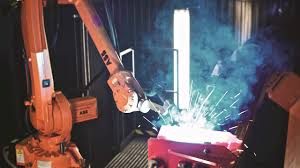
With a ±45° laser profiler, the geometry is programmed into the CAD/CAM software (such as Tekla or Lantek), and the machine executes the profile and the bevel simultaneously. The precision is staggering—tolerances are often held within ±0.1mm, a level of accuracy that ensures the subsequent robotic welding cells can operate with perfect fit-up, reducing the volume of weld wire used and the time spent on each joint.
Strategic Importance: Houston as a Global Hub
Houston is uniquely positioned for this technology. As the energy capital of the world, it possesses the logistical infrastructure—Port Houston and the massive rail networks—to move the oversized components required for wind energy. However, the local environment also presents challenges: high humidity and ambient temperatures.
A 20kW system in Houston requires specialized environmental controls. Modern fiber lasers for this region are equipped with hermetically sealed cabinets and advanced chilling systems that manage the “dew point” to prevent condensation on the sensitive optics. As an expert, I emphasize that the reliability of a 20kW system in the Gulf Coast is as much about its cooling and filtration as it is about its power. These machines are built with heavy-duty gantry systems designed to handle the 40-foot to 60-foot I-beams standard in the industry, often incorporating automated loading and unloading zones to keep the laser “head-down” and cutting as much as possible.
Optimizing the Internal Structures of Wind Towers
While the outer “can” or shell of a wind turbine tower is the most visible part, the internal infrastructure is where the I-beam profiler shines. Each tower contains several internal platforms for maintenance, cable routing, and elevator systems. These platforms are supported by heavy I-beams and channel sections.
By utilizing a 20kW laser profiler, manufacturers can “nest” parts more efficiently. The software can calculate the best way to cut multiple components from a single beam, minimizing scrap. Additionally, the laser can cut precise bolt holes and slots that are perfectly perpendicular or beveled, depending on the design. Because the laser process is so precise, there is no need for “reaming” holes afterward, which is a common requirement with plasma-cut holes due to taper. In a wind tower, where thousands of bolts are used, the time savings of laser-quality holes are monumental.
Metallurgical Integrity and Fatigue Resistance
In the wind industry, “fatigue life” is the metric that keeps engineers up at night. The vibrations caused by the rotating blades and the sheer force of the wind create constant stress on the tower’s skeleton. Traditional thermal cutting methods can create a brittle “martensitic” layer on the edge of the steel.
The 20kW fiber laser, due to its high speed and concentrated energy, creates a significantly smaller heat-affected zone. This preserves the base metal’s grain structure and ductility. When you apply a ±45° bevel with a laser, the resulting surface is nearly as smooth as a machined edge. This lack of surface irregularities prevents the formation of “micro-cracks” that could eventually lead to structural failure under the harsh conditions of a wind farm.
The Economics of 20kW Fiber Technology
The capital expenditure for a 20kW heavy-duty I-beam profiler is significant, but the ROI (Return on Investment) for a Houston-based wind fabricator is compelling.
1. **Reduced Labor:** Eliminates the need for manual beveling and secondary grinding.
2. **Material Savings:** High-precision nesting reduces the amount of expensive structural steel wasted.
3. **Energy Efficiency:** Modern fiber lasers have a wall-plug efficiency of about 40-45%, far exceeding the efficiency of older CO2 lasers or the gas consumption of oxy-fuel.
4. **Speed:** Increasing the throughput of the factory allows for the pursuit of larger contracts with tighter deadlines.
Conclusion: The Future of Renewable Fabrication
The 20kW Heavy-Duty I-Beam Laser Profiler with ±45° Bevel Cutting is more than just a tool; it is a catalyst for the renewable energy sector. In the industrial heart of Houston, these machines are proving that massive scale and microscopic precision are no longer mutually exclusive. As wind turbines grow larger and move further offshore, the demand for thicker materials and more complex geometries will only increase.
For the fabricator, the message is clear: the transition from traditional cutting to ultra-high-power fiber laser profiling is no longer an optional upgrade—it is a requirement for remaining competitive in a global market that demands perfection, speed, and sustainability. The ability to take a raw, heavy-duty I-beam and turn it into a precision-beveled, weld-ready component in a single, automated process is the pinnacle of modern manufacturing, and it is the foundation upon which the next generation of wind energy will be built.