Field Technical Report: 20kW Fiber Laser Implementation in Heavy-Duty Structural Profiling
1. Project Overview and Environmental Context
The following report details the technical deployment and operational performance of a 20kW Heavy-Duty I-Beam Laser Profiler equipped with a ±45° 3D beveling head. The subject site is the Edmonton regional infrastructure expansion, specifically targeting airport terminal structural reinforcements and hangar frameworks. Given Edmonton’s specific seismic requirements and the extreme thermal cycling (ranging from -35°C in winter to +30°C in summer), the structural integrity of steel junctions is paramount. Traditional methods—mechanical sawing, manual plasma gouging, and drilling—were deemed insufficient for the required throughput and tolerance levels of this project.
2. The Shift to 20kW High-Brightness Fiber Sources
In heavy-duty steel construction (ASTM A992/A572 Grade 50), the flange thickness of I-beams often exceeds 25mm. Traditional 6kW or 10kW laser systems struggle with the energy density required to maintain a vertical kerf at high feed rates on these thicknesses. The integration of a 20kW Ytterbium fiber laser source shifts the processing paradigm. At 20kW, the power density allows for “high-speed melt-blowing,” where the laser maintains a stable vapor capillary (keyhole) even in thick-walled sections.
This power level is critical for the Edmonton project because it minimizes the Heat Affected Zone (HAZ). Excessive HAZ can lead to grain coarsening in structural steel, potentially compromising the fracture toughness required for sub-zero temperature performance. The 20kW source ensures that the energy is concentrated, the feed rate is maximized (3-4x faster than 6kW on 20mm sections), and the thermal input per unit length is significantly reduced.
3. Kinematics of ±45° Bevel Cutting in Structural Sections
The core technical challenge in I-beam processing is the transition from the flange to the web. Unlike flat-bed laser cutting, I-beam profiling requires a 5-axis or 6-axis robotic/gantry head capable of interpolating complex geometries. The ±45° beveling capability is not merely an aesthetic feature; it is a fundamental requirement for Complete Joint Penetration (CJP) welds.
3.1 Weld Preparation Optimization
For the airport hangar’s primary load-bearing columns, engineering specifications required V-groove and Y-groove preparations. Historically, these were performed via secondary grinding or oxy-fuel beveling. The 20kW profiler executes these bevels in a single pass. By tilting the cutting head to ±45°, the system creates precise knife-edges or land-faces on the flanges of W-shapes. This precision reduces the volume of filler metal required by up to 30% and ensures that the ultrasonic testing (UT) of the welds meets the stringent aviation-grade structural codes.
4. Machine Architecture and Material Handling
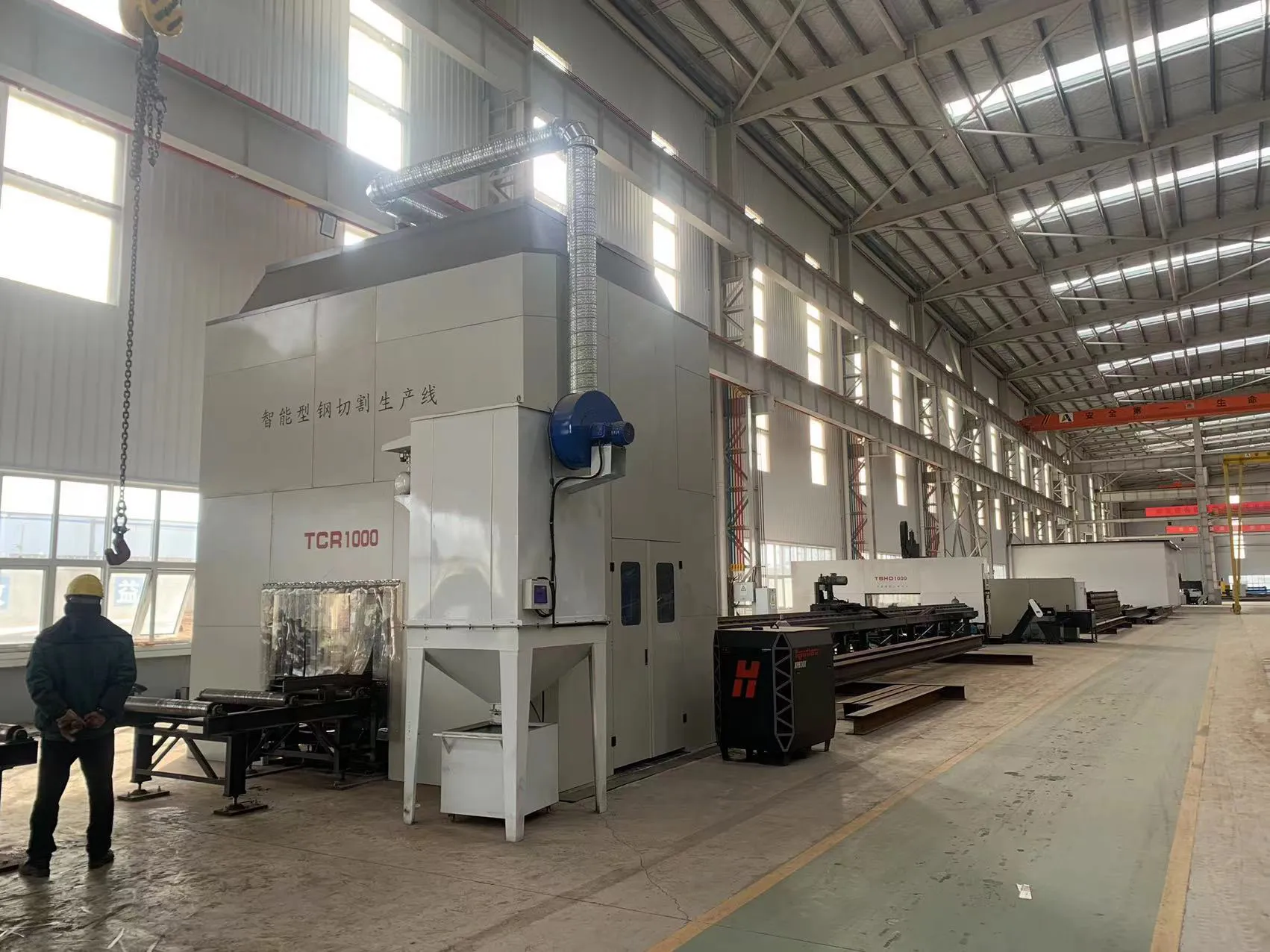
The “Heavy-Duty” designation refers to the machine’s ability to handle beams up to 12 meters in length with weights exceeding 400 kg/m. In the Edmonton facility, the profiler utilizes a heavy-duty chuck system with four-point pneumatic clamping to neutralize “camber” and “sweep” inherent in hot-rolled steel.
Automatic structural processing is facilitated through a synchronized in-feed and out-feed conveyor system. The software integration—utilizing direct TEKLA or CAD/CAM plugin imports—allows for the “nesting” of bolt holes, cope cuts, and bevels on a single beam. This eliminates the “stacking error” common when moving a beam between a drill line, a saw, and a manual layout station. For the airport expansion, where tolerances for bolt-hole alignment in long-span trusses are ±0.5mm, this integrated approach is the only viable method for maintaining geometric consistency.
5. Precision Challenges in Edmonton’s Structural Steel
One of the primary field observations in Edmonton was the variability in material surface quality. Mill scale on heavy I-beams can interfere with capacitive height sensing. The 20kW system deployed utilizes a specialized gas-flow nozzle design that creates a stable high-pressure zone, clearing slag and mill scale ahead of the beam.
Furthermore, the ±45° head must compensate for the “radius” (the fillet) where the web meets the flange. Standard 2D profiling fails at this junction. The 3D profiling algorithm calculates the precise intersection of the laser vector with the fillet’s varying thickness, adjusting the power modulation and gas pressure in real-time to prevent “blow-outs” or dross accumulation at the web-flange transition.
6. Operational Efficiency and Throughput Analysis
A comparative analysis conducted on-site demonstrated the following efficiency gains:
- Secondary Processing: Reduction of 85%. Since the laser produces a weld-ready bevel, the manual grinding phase is virtually eliminated.
- Accuracy: Layout errors were reduced to near-zero. Digital twin synchronization ensures the physical beam matches the BIM (Building Information Modeling) model exactly.
- Gas Consumption: While 20kW requires high volumes of Oxygen (for exothermic cutting of carbon steel) or Nitrogen (for high-pressure melt-blowing), the speed of the cut reduces the total gas volume used per meter compared to lower-power systems.
7. Synergy with Automatic Structural Processing
The 20kW profiler is part of a larger automated ecosystem. In the Edmonton workflow, beams are automatically measured for length and cross-sectional variance upon loading. The system’s controller then “warps” the cutting path to match the real-world dimensions of the beam, rather than the theoretical dimensions from the CAD file. This “Best-Fit” logic is crucial for large-scale airport structures where the cumulative effect of minor mill tolerances can result in massive misalignments during site erection.
The synergy between high-wattage laser sources and automated sensing allows for the execution of “complex copes”—rat holes and flange thinnings—that are typically high-stress areas. By utilizing the 20kW laser, the internal corners of these cuts have a superior surface finish (low Ra value), which significantly reduces the risk of fatigue cracking under the vibration and wind loads associated with airport environments.
8. Conclusion
The deployment of the 20kW Heavy-Duty I-Beam Laser Profiler with ±45° beveling technology represents a significant leap in structural engineering capability for the Edmonton region. By combining high-density energy sources with multi-axis kinematic precision, the project has achieved a level of structural reliability and assembly speed that traditional methods cannot replicate. The ability to move directly from digital design to weld-ready structural components, with zero manual layout and minimal HAZ, sets a new benchmark for heavy steel processing in critical infrastructure applications.
Report Prepared By:
Senior Engineering Consultant
Laser & Structural Metallurgy Division