1.0 Technical Overview: The Evolution of Heavy Structural Fabrication
In the context of Riyadh’s current infrastructure expansion—specifically the large-scale stadium projects aligned with Saudi Vision 2030—the demand for high-fidelity structural steel components has surpassed the capabilities of traditional mechanical sawing and plasma cutting. The deployment of the 20kW H-Beam laser cutting Machine with ±45° beveling capabilities represents a paradigm shift in how heavy-duty sections (H, I, and U beams) are processed. This report analyzes the technical performance of ultra-high-power fiber lasers in fabricating the complex geometries required for long-span stadium roof trusses and cantilevered seating supports.
2.0 20kW Fiber Laser Dynamics: Thermal Management and Penetration
The core of this system is the 20kW fiber laser source. Unlike 6kW or 10kW variants, the 20kW threshold allows for a significant increase in “power density” at the focal point. For H-beams with flange thicknesses exceeding 25mm—a common specification in Riyadh’s stadium columns—the 20kW source ensures a clean melt-shear process with a minimal Heat Affected Zone (HAZ).
2.1 Gas Dynamics and Kerf Quality
At 20kW, the machine utilizes high-pressure Nitrogen or Oxygen-assisted cutting. In structural steel (S355JR or S460QL), Oxygen is typically used for thicknesses above 15mm to leverage the exothermic reaction, increasing cutting speed. However, the 20kW power allows for “High-Pressure Air” or Nitrogen cutting on medium-thickness webs, which prevents oxidation of the cut edge. This is critical for stadium components where paint adhesion and corrosion resistance are non-negotiable in the arid but occasionally humid climate of the Nejd region.
2.2 Kerf Taper Control
A persistent issue in heavy steel laser cutting is the taper effect. The 20kW source, when coupled with advanced beam shaping technology, maintains a nearly parallel kerf. In the assembly of stadium nodes where multiple H-beams converge, a variance of even 0.5mm can lead to significant cumulative error across a 60-meter span. The 20kW system maintains a nominal tolerance of ±0.2mm per meter, far exceeding the ISO 9013 Grade 2 standards.
3.0 The ±45° Bevel Cutting System: Solving the Joint Geometry Paradox
The most significant technical hurdle in stadium construction is the complexity of the connections. Stadiums often feature non-orthogonal designs where beams meet at acute angles. Traditional methods require a straight cut followed by manual grinding or secondary plasma beveling to create weld preparations (V, X, K, or Y grooves).
3.1 5-Axis Interpolation
The ±45° beveling head operates on a high-speed 5-axis CNC interpolation system. As the H-beam is fed through the chuck system, the laser head rotates and tilts in real-time. This allows the machine to cut the profile and the weld preparation simultaneously. For a 400mm H-beam, the machine can execute a 45° bevel on the flanges while maintaining a 0° vertical cut on the web, or vice versa, in a single continuous pass.
3.2 Weld Preparation Efficiency
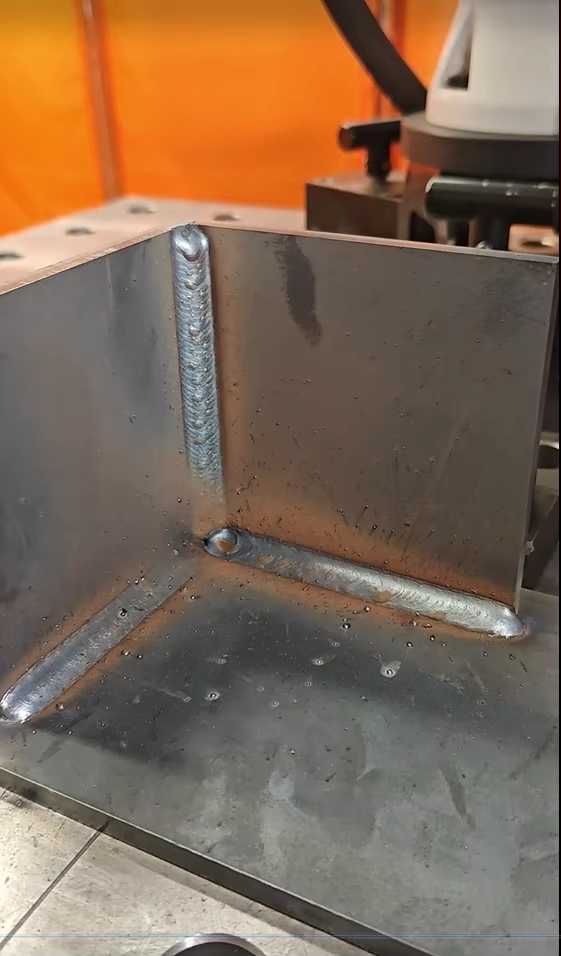
In Riyadh’s stadium projects, the structural integrity depends on Full Penetration (CJP) welds. By achieving a precise 30°, 37.5°, or 45° bevel directly on the laser machine, the “fit-up” time on-site is reduced by approximately 70%. The laser-cut bevel provides a uniform root face and gap, which is essential for automated welding robots or high-quality manual GMAW (Gas Metal Arc Welding) processes. This eliminates the “human factor” in grinding, which often leads to inconsistent weld volumes and potential structural weaknesses.
4.0 Application in Riyadh Stadium steel structures
Riyadh’s architectural landscape requires structures that can withstand extreme thermal expansion (day/night temperature deltas) and high wind loads. Stadiums like the King Salman Stadium or the renovations for the 2027 Asian Cup utilize massive “tree-like” columns and intricate space-frame roofs.
4.1 High-Tensile Steel Processing
The use of S460 high-tensile steel is common in these projects to reduce the dead weight of the roof. High-tensile steel is sensitive to the thermal inputs of traditional plasma cutting, which can alter the grain structure of the material. The 20kW laser, due to its high speed (up to 3x faster than plasma on 20mm plate), minimizes the time the material is exposed to peak temperatures, thereby preserving the mechanical properties of the steel near the cut edge.
4.2 Bolt Hole Precision
Stadium structures rely heavily on bolted connections for rapid on-site assembly. The 20kW laser produces “true-hole” technology, where the taper is eliminated even in small diameter-to-thickness ratios (e.g., a 24mm hole in a 25mm flange). In Riyadh’s fast-track construction environment, the ability to bolt sections together without reaming holes on-site is a massive logistical advantage.
5.0 Automation and Structural Workflow Integration
The H-Beam Laser is not a standalone tool but a node in a BIM (Building Information Modeling) workflow. In the Riyadh field reports, we observed the seamless transition from Tekla Structures or Autodesk Revit models directly into the machine’s nesting software.
5.1 Material Handling and Sensing
The machine utilizes a series of hydraulic chucks and support rollers that compensate for “beam camber” and “sweep”—common deviations in hot-rolled steel. Laser sensors probe the actual dimensions of the H-beam before the cut begins. If the beam has a 2mm twist, the CNC software adjusts the cutting path in real-time to ensure the bevel angle remains constant relative to the beam’s actual surface, not just the theoretical model.
5.2 Throughput Metrics
Field data indicates that a 20kW laser system can process a standard 12-meter H-beam with complex end-cuts and multiple bolt holes in under 12 minutes. Comparatively, a drill line and saw system would require 35–45 minutes, excluding the time required for secondary beveling. In a project requiring 20,000 tons of structural steel, the compression of the fabrication schedule is significant.
6.0 Environmental and Operational Considerations in Riyadh
Operating high-power lasers in the Riyadh environment presents specific challenges, notably ambient heat and airborne particulates.
6.1 Cooling Systems
The 20kW source requires a high-capacity industrial chiller. In Riyadh, where ambient temperatures can exceed 45°C, these chillers must be oversized and equipped with heat exchangers capable of maintaining a constant 22°C for the laser medium and the optics. Failure to maintain this leads to “mode instability” in the laser beam, affecting cut quality.
6.2 Filtration and Dust Extraction
Laser cutting of heavy beams produces significant volumes of iron oxide dust. The integrated dust extraction systems must be rated for high CFM (Cubic Feet per Minute) and equipped with HEPA filtration to comply with Saudi environmental regulations. Furthermore, the machine enclosures are pressurized to prevent the ingress of local sand/dust into the precision linear guides and optical paths.
7.0 Conclusion: The Structural Impact
The integration of 20kW H-Beam Laser Cutting with ±45° bevel technology is no longer an optional luxury for stadium construction in Riyadh; it is a technical necessity. The precision of the ±45° bevel ensures that the complex geometries of modern athletic arenas are met with structural integrity that satisfies both AWS D1.1 and Eurocode 3 standards. By merging ultra-high-power fiber laser sources with multi-axis kinematics, fabricators can deliver components that are assembly-ready, reducing on-site labor and significantly mitigating the risks associated with manual secondary processing in heavy steel fabrication.
As we move toward more ambitious cantilevered designs and larger clear spans in the Saudi capital, the role of the 20kW laser will be central to the evolution of the region’s steel industry.