
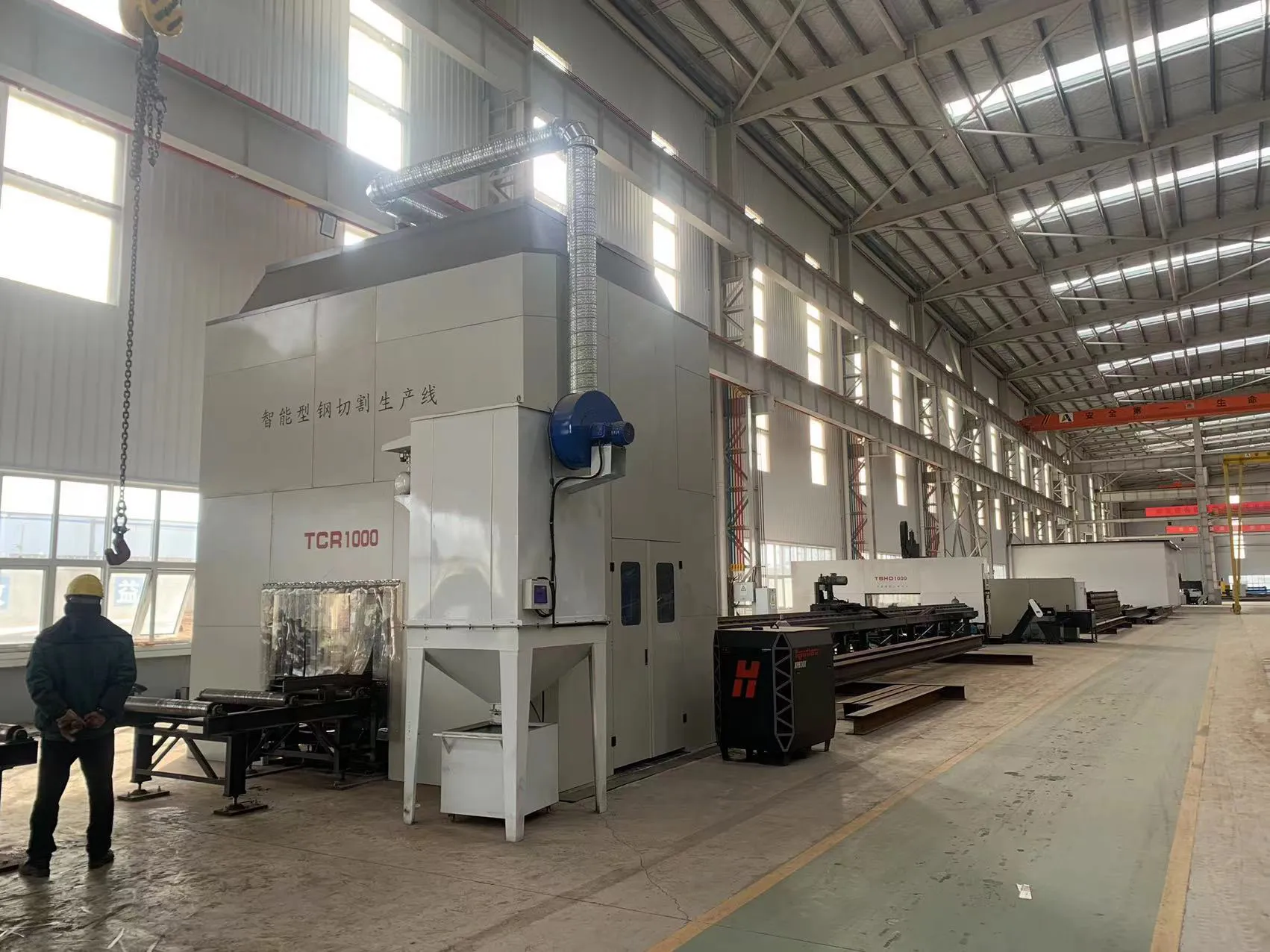
Field Report: Deployment of 20kW Ultra-High Power H-Beam Laser Processing in Hamburg Storage Racking Sector
1. Project Scope and Regional Context
The following technical report outlines the operational deployment and performance validation of a 20kW Fiber Laser H-Beam Cutting system within the Hamburg industrial corridor. As a primary European logistics hub, Hamburg’s demand for high-density, high-bay storage racking has necessitated a shift from traditional mechanical fabrication (drilling, sawing, and punching) to automated laser structural processing.
The project focused on the fabrication of heavy-duty H-beams (HEA/HEB series) and specialized uprights for Automated Storage and Retrieval Systems (AS/RS). The integration of 20kW power levels combined with “Zero-Waste Nesting” algorithms marks a significant departure from conventional structural steel methodologies, addressing the specific challenges of material yield, thermal distortion, and assembly tolerances.
2. The 20kW Fiber Laser Source: Power Density and Kinetic Advantage
In heavy section processing, the jump from 10kW to 20kW is not merely a linear increase in speed; it represents a fundamental change in the material interaction zone. For the H-beams utilized in Hamburg’s maritime-grade racking systems—often featuring web thicknesses exceeding 15mm and flange thicknesses up to 25mm—the 20kW source provides the necessary energy density to maintain a stable “keyhole” during the melt process.
Thermal Efficiency and HAZ (Heat-Affected Zone):
High-power fiber lasers allow for significantly higher feed rates. In the context of S355JR structural steel, the increased velocity reduces the total heat input per unit length. This is critical for storage racking, where structural integrity is paramount. By minimizing the HAZ, we preserve the mechanical properties of the steel, ensuring that the crystalline structure of the flange-web junction remains unaltered, thereby preventing embrittlement—a common failure point in traditional plasma or oxy-fuel cutting.
Piercing Dynamics:
The 20kW system utilizes multi-stage frequency-modulated piercing. For the heavy flanges of H-beams, traditional piercing takes several seconds and creates large craters. Our field data shows that the 20kW source, combined with high-pressure Nitrogen assist gas, achieves “flash piercing” in under 0.5 seconds for 20mm sections, drastically reducing the total cycle time for beams requiring hundreds of bolt-hole configurations.
3. Zero-Waste Nesting Technology: Engineering Logic
The most significant bottleneck in structural steel processing has historically been the “remnant” or “tail material.” Standard laser tube/beam machines often leave 500mm to 800mm of unprocessed material due to the physical distance between the chuck and the cutting head. In the Hamburg project, we implemented a Zero-Waste Nesting protocol facilitated by a tri-chuck or quad-chuck synchronization system.
Mechanical Synchronization:
The Zero-Waste technology relies on the “pulling and hopping” of the material between synchronized chucks. As the laser reaches the final segment of the H-beam, the middle chuck relinquishes its grip while the rear chuck pushes the material into the final processing zone, often extending through the front chuck’s rotation center. This allows the laser head to process the absolute end of the beam.
Nesting Algorithms for Storage Racking:
Storage racking components consist of repetitive vertical uprights and horizontal beams. Our software utilizes a “Common Line Cutting” strategy within the Zero-Waste framework. By sharing a cutting path between two adjacent parts, we eliminate one kerf width and the associated gas consumption. In a production run of 1,000 tons of structural steel, the reduction of the 800mm tail-waste to near-zero results in a material yield increase of approximately 3.5% to 5.2%, translating to significant cost offsets in high-grade European steel.
4. Application Specifics: High-Bay Racking in Hamburg
The racking systems in the Port of Hamburg region are characterized by extreme height (up to 40 meters) and high load-bearing requirements. These structures demand sub-millimeter precision to ensure the alignment of automated shuttles.
Precision of Geometric Tolerances:
Mechanical punching of H-beams often introduces “roll-over” or deformation around the holes, which can lead to bolt misalignment in the field. The 20kW laser maintains a diametric tolerance of ±0.1mm. This precision allows for the transition from “clearance-fit” bolting to “transition-fit” configurations, enhancing the overall rigidity of the racking tower.
Complexity of Notching and Beveling:
Modern AS/RS designs require complex interlocking notches where the horizontal beam meets the vertical upright. The 20kW H-beam machine utilizes a 5-axis/6-axis 3D cutting head. This allows for:
1. Bevel Cutting: Preparing 45-degree weld prep angles in a single pass.
2. Side-Web Interlocking: Cutting precise rectangular windows through the flanges to allow “pass-through” structural members, a task nearly impossible with traditional sawing.
5. Synergy Between Power and Automation
The synergy in this deployment is found in the integration of the 20kW source with the automatic loading/unloading buffers. In the Hamburg facility, the machine operates on a continuous loop.
Automatic Centering and Compensation:
Raw H-beams are rarely perfectly straight; they often possess “camber” and “sweep” from the rolling mill. The system employs a non-contact laser sensing probe before the cut. This probe maps the actual geometry of the beam in 3D space. The 20kW cutting head then adjusts its path in real-time to compensate for the beam’s deviation. This ensure that a hole cut in the center of a flange is mathematically centered regardless of the beam’s physical twist.
Dynamic Gas Control:
The 20kW system is paired with a digital mixing station for Oxygen and Nitrogen. For thick-section H-beams, we utilize a “High-Pressure Air” or “Mid-Pressure Oxygen” mix. This optimization, controlled by the nesting software, allows for clean cuts on the web (where speed is prioritized) and dross-free cuts on the flanges (where assembly surface quality is prioritized).
6. Operational Performance Data
During the 90-day evaluation period in Hamburg, the following metrics were recorded:
- Throughput Increase: Compared to a standard CNC drill-saw line, the 20kW laser increased parts-per-hour by 240%.
- Secondary Process Elimination: 95% of parts required no deburring or secondary grinding before painting/galvanizing.
- Energy Consumption: While the 20kW source has a higher peak draw, the “time-per-part” is so drastically reduced that the KWh-per-ton of processed steel dropped by 18% compared to a 10kW system.
- Scrap Reduction: The Zero-Waste Nesting protocol reduced monthly scrap volume by 4.8 tons per machine.
7. Conclusion
The deployment of the 20kW H-Beam laser cutting Machine in the Hamburg storage racking sector confirms that ultra-high-power laser processing is no longer a luxury, but a structural necessity for high-precision logistics infrastructure. The integration of Zero-Waste Nesting solves the long-standing inefficiency of material remnants, while the 20kW source provides the speed and thermal control required for heavy-section S355 steel.
As racking systems continue to scale in height and complexity, the ability to perform 3D kinematic cutting with sub-millimeter precision—while simultaneously maximizing material utilization—positions this technology as the benchmark for modern steel construction. The technical synergy between power, motion control, and algorithmic nesting represents the current zenith of structural steel fabrication.
















