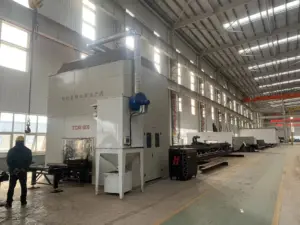
The Paradigm Shift: 20kW Power in Structural Steel
For decades, the fabrication of H-beams and heavy structural sections in Jakarta relied on traditional methods: band sawing, drilling, and plasma cutting. While functional, these methods introduced significant bottlenecks, especially for high-profile projects like the Jakarta International Stadium (JIS) or upcoming regional arenas. The introduction of the 20kW fiber laser has fundamentally altered this landscape.
At 20kW, the laser is no longer just a tool for thin sheet metal; it is a high-energy powerhouse capable of piercing and slicing through thick-walled H-beams (up to 40mm or more depending on the material) with a speed that plasma cannot match. The high energy density of a 20kW beam ensures a narrow kerf and a minimal Heat Affected Zone (HAZ). In stadium construction, where structural integrity is paramount, minimizing the HAZ is critical to maintaining the metallurgical properties of the steel, ensuring that the beams do not become brittle at the point of the cut.
Infinite Rotation 3D Head: The Geometry of Modern Stadiums
The defining feature of this specialized machine is the “Infinite Rotation 3D Head.” Unlike standard 2D laser cutters that move on an X and Y axis, or 3D heads limited by cable winding (which require the head to “unwind” after a certain degree of rotation), an infinite rotation head utilizes advanced slip-ring technology and servo-kinematics to rotate indefinitely.
This is a game-changer for H-beam processing. Stadium roofs and support structures often feature complex “spider” joints or tapered connections where the beam must be cut at compound angles to meet a central node. The 3D head allows for:
1. **Bevel Cutting (V, X, Y, and K-grooves):** Essential for weld preparation. Instead of cutting a beam and then manually grinding a bevel for welding, the 20kW laser performs the cut and the bevel simultaneously.
2. **Complex Intersections:** Stadiums often use hollow sections and H-beams that intersect at non-orthogonal angles. The 3D head can follow the contour of the beam’s flange and web, cutting intricate shapes that allow for a “lock and key” fitment during assembly.
3. **Bolt Hole Precision:** High-strength friction grip bolts require holes with zero taper and perfect alignment. The 20kW laser delivers holes that are perfectly cylindrical, even in thick-walled sections, eliminating the need for secondary drilling.
Applying Precision to Jakarta’s Stadium Infrastructure
Jakarta’s architectural ambitions have grown significantly. The city’s stadiums are no longer just sports venues; they are engineering marvels with massive cantilevered roofs and intricate lattice structures. These designs demand a level of precision that manual fabrication cannot provide.
When fabricating H-beams for a stadium’s primary truss, a discrepancy of even 2mm can lead to massive alignment issues when the beam is hoisted 50 meters into the air. The 20kW laser machine, guided by advanced CAD/CAM software, ensures that every cut is accurate to within microns. In the context of Jakarta’s humid and demanding environment, the speed of laser cutting also prevents the oxidation that can occur when raw steel sits in a fabrication yard for extended periods during slow manual processing.
Furthermore, the “Infinite Rotation” capability allows for the cutting of “Coping” joints. These are notches made in the ends of beams to allow them to fit together. In complex stadium geometries, these copes are often curved or angled. The laser handles these with ease, producing a finish that is ready for immediate assembly and welding.
Overcoming the Challenges of H-Beam Fabrication
H-beams present unique challenges due to their shape. The transition from the flange to the web (the “root” of the beam) is a high-thickness area that often traps heat. Traditional plasma cutting often struggles with the thickness change, resulting in dross and slag.
The 20kW fiber laser, however, utilizes intelligent power modulation. As the 3D head moves from the thinner flange to the thicker root, the CNC controller adjusts the laser frequency and gas pressure in real-time. This ensures a clean, slag-free cut across the entire profile of the H-beam. For Jakarta-based fabricators, this means a massive reduction in “post-processing” time. There is no need for manual chipping of dross or corrective grinding, which are labor-intensive and drive up the “cost-per-joint” in large-scale projects.
Software Integration and the “Digital Twin” in Construction
In the Jakarta construction market, the shift toward Building Information Modeling (BIM) is well underway. The 20kW H-Beam laser machine fits perfectly into this digital ecosystem. The machine’s software can import Tekla or Autodesk Revit files directly.
This means the “Digital Twin” of the stadium being designed by architects in Jakarta’s central business district is the exact same file used to drive the laser cutter in the industrial zones of Bekasi or Tangerang. This integration eliminates human error in measurement and transcription. The software also optimizes “nesting” on the beams—arranging cuts to minimize scrap—which is a vital economic factor given the rising costs of high-grade structural steel in Southeast Asia.
Operational Excellence in the Indonesian Climate
Operating a 20kW fiber laser in Jakarta requires specific considerations regarding the local climate. The high humidity and ambient temperatures of Indonesia can affect the stability of high-power resonators and optics.
Top-tier 20kW machines deployed in Jakarta are equipped with specialized industrial chillers and climate-controlled cabinets for the laser source and electrical components. The “Infinite Rotation” head is also sealed against dust and metallic particles, which are prevalent in heavy fabrication environments. For stadium projects, which often have tight deadlines tied to government mandates or international sporting events, the reliability of the machine is as important as its power. Expert maintenance and local support in Jakarta ensure that these machines operate at the 95% up-time required for 24/7 fabrication schedules.
Economic Impact: ROI for Indonesian Fabricators
While the initial investment in a 20kW H-Beam laser with a 3D head is significant, the Return on Investment (ROI) for stadium-scale projects is compelling.
* **Labor Savings:** One laser machine can replace the output of three to five manual fabrication stations (sawing, drilling, and manual beveling).
* **Speed:** A 20kW laser can cut through structural steel at speeds 3 to 5 times faster than traditional plasma, and 10 times faster than mechanical sawing.
* **Material Utilization:** Advanced nesting reduces waste by 5-10%, which, on a stadium project requiring thousands of tons of steel, equates to millions of dollars in savings.
* **Quality Assurance:** The precision of the laser reduces “re-work,” which is the single biggest hidden cost in structural steel fabrication.
The Future: Jakarta as a Fabrication Hub
The adoption of 20kW infinite rotation laser technology positions Jakarta not just as a consumer of high-tech infrastructure, but as a regional hub for precision fabrication. As Indonesia continues to invest in “smart cities” and world-class sporting facilities, the ability to produce complex steel structures in-house—rather than importing pre-fabricated sections—strengthens the local economy and builds technical expertise within the Indonesian workforce.
In conclusion, the 20kW H-Beam Laser Cutting Machine with Infinite Rotation 3D Head is more than just a piece of equipment; it is a fundamental shift in construction methodology. For the stadium steel structures that will define Jakarta’s skyline in the coming decade, this technology provides the speed, precision, and geometric flexibility required to turn ambitious architectural visions into safe, structural reality. As we move toward more complex and sustainable designs, the fiber laser remains the vanguard of the modern industrial revolution in Southeast Asia.