1.0 Field Report Overview: Structural Laser Integration
This report details the operational deployment and technical performance of a 20kW H-beam laser cutting system equipped with an integrated automatic unloading module. The evaluation took place at a heavy-scale fabrication facility in Edmonton, Alberta, primarily servicing the renewable energy sector—specifically the production of internal structural components for wind turbine towers. The objective was to replace traditional mechanical drilling and plasma cutting methods with a high-flux fiber laser solution to improve tolerances and throughput for heavy-gauge H-beams (ASTM A992).
1.1 Site Conditions and Material Specifications
The Edmonton facility operates under significant ambient temperature fluctuations, requiring the 20kW fiber source to be housed in a climate-controlled enclosure with an advanced dual-circuit chilling system. The primary materials processed are structural H-beams used for wind tower platforms, internal ladder supports, and reinforcement flanges. Material thicknesses range from 12mm to 25mm on the flanges, requiring the sustained high-density energy output that only a 20kW source can provide while maintaining a narrow kerf.
2.0 20kW Fiber Laser Dynamics in Heavy Structural Steel
The transition to 20kW power levels marks a significant shift in structural steel processing. In the context of wind turbine tower internals, precision is non-negotiable; internal components must align perfectly with the cylindrical curvature of the tower sections to ensure weld integrity and structural load distribution.
2.1 Piercing Efficiency and Thermal Management
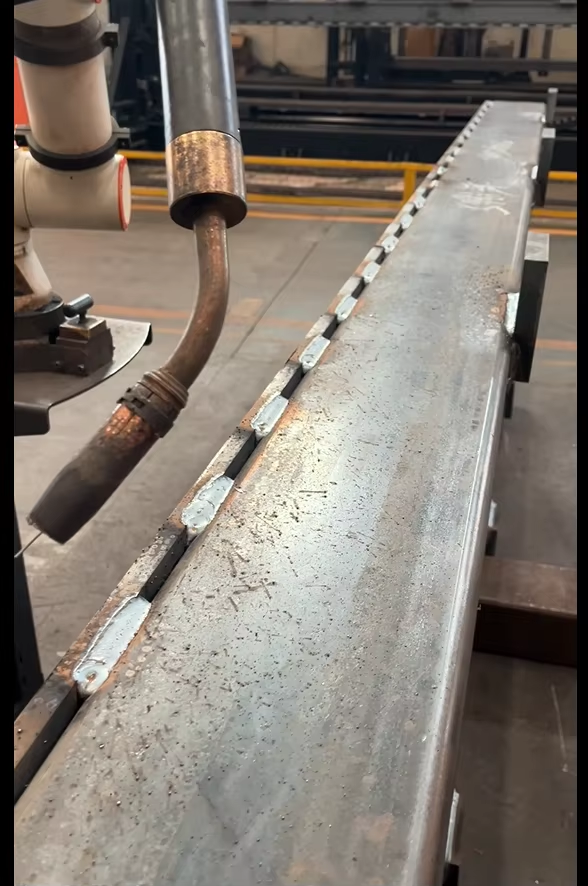
At 20kW, the “lightning pierce” capability significantly reduces the Heat Affected Zone (HAZ) compared to 6kW or 12kW systems. For 20mm H-beam flanges, piercing time is reduced to sub-one-second intervals. This speed is critical in Edmonton’s high-volume production environment. The machine utilizes a specialized gas-path design to maintain stable auxiliary gas pressure (Oxygen for carbon steel, Nitrogen for clean-cut requirements), preventing the slag re-deposition that often plagues slower plasma alternatives.
2.2 3D Five-Axis Cutting Head Precision
The system utilizes a 5-axis swing head capable of ±45-degree beveling. In wind tower fabrication, H-beams often require complex bevels for weld preparation (K, V, and Y-type joints). The 20kW beam, when focused through high-grade silica lenses, maintains a consistent focal point even during rapid axis interpolation. This eliminates the need for secondary grinding, as the laser-cut edge meets the ISO 9013 Grade 2 surface finish standard.
3.0 Automatic Unloading: Solving the Heavy Steel Bottleneck
The most significant technical hurdle in heavy structural processing is not the cutting itself, but the material handling. An H-beam weighing upwards of 150kg/meter presents significant logistical challenges. Traditional manual unloading via overhead crane introduces downtime and safety risks.
3.1 Mechanical Synchronicity and Servo-Driven Offloading
The automatic unloading system evaluated in this report employs a heavy-duty chain-driven conveyor integrated with hydraulic lifting flippers. As the 20kW laser completes the final cut on a beam segment, the unloading logic communicates with the CNC controller to synchronize the movement of the output rollers. The “flippers” transition the finished H-beam from the cutting centerline to a lateral storage rack without human intervention.
3.2 Impact on Positional Accuracy
In heavy steel processing, the inertia of the beam can often cause “creep” or misalignment during the cutting phase if the unloading mechanism is not perfectly calibrated. The Edmonton site utilizes a dual-chuck system where the unloading side provides active support. This prevents the beam from sagging under its own weight as the cut nears completion, ensuring that the final geometry of the H-beam—vital for the precision fitment inside a wind turbine—remains within a ±0.5mm tolerance over a 12-meter span.
4.0 Application in the Wind Turbine Tower Sector
Wind turbine towers are becoming taller and more complex, requiring internal H-beam structures that can withstand harmonic vibrations and extreme torque. The Edmonton region, serving projects across the Canadian Prairies, requires components that meet strict cold-weather impact transition requirements.
4.1 Structural Integrity and the HAZ
A primary concern in Edmonton’s engineering circles is the brittleness of steel in sub-zero temperatures. Laser cutting at 20kW minimizes the duration of heat exposure. By reducing the HAZ, the structural integrity of the H-beam is preserved. Microstructural analysis of the cut edge shows minimal martensite formation, which is essential for components that will be subjected to the cyclic loading inherent in wind energy generation.
4.2 Throughput Optimization
Before the implementation of the 20kW H-beam laser, the fabrication of a standard internal support kit took approximately 4.5 hours using manual layout, drilling, and oxy-fuel cutting. The integrated laser system with automatic unloading reduced this to 42 minutes. The bottleneck shifted from the “tool-on-bit” time to the “material-on-deck” time, which was subsequently resolved by the automated loading/unloading buffers.
5.0 Technical Synergies: Power and Automation
The synergy between a 20kW source and an automated unloading system is found in the “Total Duty Cycle” of the machine. In structural steel, high power is wasted if the machine sits idle for 30 minutes while a crane operator clears the bed.
5.1 CNC Control and Software Integration
The system runs on a bus-based CNC system that integrates the nesting software directly with the unloading sensors. For H-beams, the software must account for “web” and “flange” thickness variations. The 20kW source allows for “on-the-fly” height sensing, where the cutting head adjusts its Z-axis in real-time to compensate for any inherent twisting in the raw H-beam. When the cut is finished, the unloading module receives a signal indicating the center of gravity of the cut piece, allowing the hydraulic arms to balance the load during the transition to the cooling rack.
5.2 Dust and Fume Extraction in Edmonton Facilities
High-power laser cutting of thick structural steel generates significant particulate matter. The Edmonton field site employs a multi-zone partitioned extraction system. As the H-beam moves through the cutting station, only the dampers beneath the cutting head are active. This localized high-vacuum pressure is essential for maintaining the optical health of the 20kW delivery system, preventing “thermal lensing” caused by dust contamination on the protective windows.
6.0 Conclusion and Field Recommendations
The deployment of the 20kW H-Beam Laser Cutting Machine with automatic unloading in Edmonton has demonstrated a paradigm shift in structural steel fabrication for the wind energy sector. The high-power fiber source provides the necessary speed to make laser cutting economically viable for thick-walled H-beams, while the automation module addresses the physical limitations of heavy material handling.
6.1 Summary of Technical Performance
- Precision: Achieved ±0.3mm on bolt-hole diameters in 20mm flanges, eliminating post-process reaming.
- Efficiency: 85% reduction in part-to-part cycle time compared to plasma/drill lines.
- Safety: Zero-contact unloading protocol removed personnel from the “drop zone” of heavy structural members.
6.2 Final Professional Assessment
For operations focused on large-scale infrastructure like wind turbine towers, the 20kW threshold is the current “sweet spot” for balancing electrical efficiency with cutting velocity. The integration of automatic unloading is not a luxury but a mechanical necessity to maintain the OEE (Overall Equipment Effectiveness) required in high-latitude, high-output industrial zones like Edmonton. Future iterations should focus on integrating AI-based vision systems on the unloading side to automatically sort parts by project ID, further streamlining the downstream assembly of wind tower internals.
Report Prepared By: Senior Lead Engineer, Laser Structural Systems Division
Date: October 2023
Location: Edmonton Industrial Research Complex