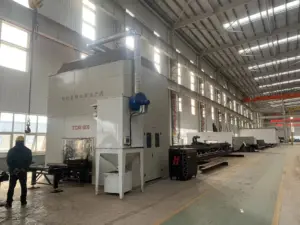
The Industrial Context: Katowice as a Hub for Mining Innovation
Katowice and the surrounding Upper Silesian Metropolitan Area have long been the beating heart of the European coal mining and heavy machinery industry. For decades, the region has produced some of the world’s most robust underground mining equipment, ranging from powered roof supports to massive armored face conveyors. However, as global competition intensifies and the demand for more complex, lightweight yet stronger structures increases, the traditional methods of fabrication—manual oxygen-fuel cutting, plasma cutting, and mechanical machining—have hit a ceiling in terms of efficiency and precision.
The introduction of the 20kW Fiber Laser H-Beam Cutting Machine specifically tailored for mining machinery represents the “Industry 4.0” transition in action. This is not merely a machine; it is a complete structural fabrication center that redefines how H-beams, I-beams, and heavy channels are processed in the Polish market.
Why 20kW? The Power Dynamics of Heavy Structural Steel
In the world of fiber lasers, 20kW is a transformative power level. While 6kW or 10kW systems are standard for general sheet metal fabrication, mining machinery requires the processing of exceptionally thick structural steel, often S355 or S460 grades.
A 20kW fiber laser source provides several critical advantages:
1. **Unmatched Cutting Speed:** In structural profiles with wall thicknesses of 15mm to 25mm, a 20kW laser can operate at speeds three to five times faster than traditional plasma cutting.
2. **Reduced Heat-Affected Zone (HAZ):** For mining equipment subject to immense fatigue and stress underground, maintaining the integrity of the base metal is vital. The high power density of a 20kW laser allows for “flash cutting,” which minimizes the time the beam spends on the material, thereby drastically reducing the HAZ and preserving the metallurgical properties of the H-beam.
3. **Beveling and Weld Preparation:** Most mining components require complex bevels (V, Y, and X joints) for deep-penetration welding. The 20kW source ensures that even at steep angles (which effectively increases the thickness of the material the laser must penetrate), the cut remains clean and the dross remains minimal.
Precision 3D Processing of H-Beams
Unlike flat-bed lasers, an H-Beam laser cutting Machine must operate in three-dimensional space. The Katowice installation utilizes a sophisticated multi-axis chuck system and a 3D cutting head. This allows the laser to rotate around the H-beam, cutting through the flanges and the web with surgical precision.
For mining machinery, this means that bolt holes for conveyor sections, notches for interlocking supports, and complex geometries for hydraulic cylinder mounts can all be cut in a single pass. The accuracy of the fiber laser (often within +/- 0.1mm) ensures that when these massive components arrive at the assembly floor or the mine site, they fit perfectly, eliminating the need for costly “on-site adjustments” that are common with plasma-cut parts.
The Game Changer: Automatic Unloading Systems
In heavy industry, the “bottleneck” is rarely the cutting speed alone; it is the material handling. An H-beam can weigh several hundred kilograms, and a standard 12-meter profile is a logistical challenge to move safely.
The automatic unloading system integrated into the Katowice machine is designed specifically for the heavy-duty cycles of mining manufacturing. It employs a series of synchronized conveyor rollers and pneumatic/hydraulic lifting arms that gently transition the finished workpiece from the cutting zone to a storage rack.
**Benefits of Automatic Unloading include:**
* **Continuous Operation:** The machine does not have to stop while a crane operator maneuvers to pick up a finished beam. This increases the overall equipment effectiveness (OEE) by up to 40%.
* **Safety:** In the high-risk environment of heavy manufacturing, reducing the need for manual intervention with overhead cranes significantly lowers the chance of workplace accidents.
* **Surface Protection:** While mining equipment is rugged, precision-cut edges and surfaces need to be protected from the “slamming” associated with manual unloading. The automated system ensures controlled placement.
Impact on Mining Machinery Components
The application of this 20kW laser in Katowice is primarily focused on several key mining components:
**1. Powered Roof Supports (Longwall Shields):** These are the massive steel structures that hold up the roof of a mine. They require heavy plates and H-beams with precise weld preparations. The 20kW laser allows for the fabrication of these parts with tolerances that were previously only possible with expensive CNC milling.
**2. Armored Face Conveyors (AFC):** The “pans” and drive frames of conveyors are subject to extreme wear. By using the fiber laser to cut hardened, wear-resistant steels often used in these systems, manufacturers can produce components that last longer in the abrasive environments of a coal mine.
**3. Underground Transport Systems:** Monorail systems and heavy-duty transport racks rely on the structural integrity of I-beams and H-beams. The ability to laser-cut these profiles means that light-weighting strategies (removing material where it isn’t needed without compromising strength) can be more easily implemented.
Technical Challenges and Expert Solutions
Operating a 20kW laser in an industrial environment like Katowice requires more than just “plug and play.” As an expert in the field, it is important to highlight the infrastructure required:
* **Beam Delivery and Optics:** At 20kW, even a tiny speck of dust on the protective window can cause a catastrophic thermal runaway. The machine in Katowice is equipped with an ultra-clean, pressurized optical path and intelligent sensors that monitor the temperature and health of the cutting head in real-time.
* **Gas Dynamics:** The choice of assist gas—Nitrogen, Oxygen, or High-Pressure Air—is critical. For mining components, nitrogen is often preferred for a “bright finish” that requires no post-processing before painting or galvanizing. However, for the thickest sections, a specialized oxygen cutting process is used, optimized by the 20kW power to prevent the “rounding” of corners.
* **Software Integration:** The machine uses advanced “nesting” software for profiles. This ensures that the 12-meter H-beams are utilized with maximum efficiency, reducing scrap metal costs—a significant factor when dealing with high-grade structural steel.
Economic and Environmental Impact in the Silesian Region
The shift to 20kW fiber laser technology has a profound economic ripple effect in Katowice. By reducing the time-to-market for mining machinery, local manufacturers can compete more effectively on the global stage, exporting Silesian engineering to mines in Australia, China, and the USA.
Furthermore, there is a significant environmental benefit. A 20kW fiber laser is vastly more energy-efficient than the older CO2 lasers or the high-power plasma systems required to cut similar thicknesses. When combined with the reduction in secondary processing (less grinding, less rework), the carbon footprint of each ton of mining machinery produced is notably reduced.
Conclusion: The Future of Fabrication in Katowice
The 20kW H-Beam Laser Cutting Machine with Automatic Unloading is more than a piece of equipment; it is a statement of intent for the Polish mining machinery industry. It proves that the “Black Diamond” region of Katowice is not just a place of history, but a center of high-tech future-ready manufacturing.
For the mining sector, where safety and reliability are paramount, the precision and integrity offered by 20kW fiber laser technology are the new benchmarks. As this technology becomes the standard, we can expect to see mining machines that are not only stronger and more reliable but also produced with an efficiency that was unimaginable a decade ago. The integration of 3D laser cutting and automated logistics is, quite literally, the steel backbone of the modern industrial revolution in Silesia.