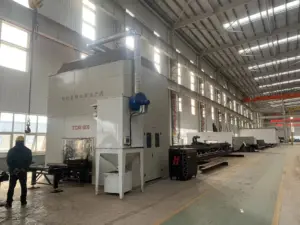
Field Engineering Report: Implementation of 20kW Laser Technology in Katowice Structural Hub
This report outlines the technical evaluation and operational commissioning of the 20kW H-Beam Laser Cutting Machine at the Katowice heavy fabrication facility. As the structural steel industry in Poland shifts from traditional manual fabrication to high-precision automation, the integration of high-wattage fiber laser technology has become a non-negotiable requirement for maintaining tolerances in complex S355JR and S355J2+N projects.
The objective of this deployment was to consolidate three distinct processes—sawing, drilling, and coping—into a single automated workflow. In the following sections, I detail the synergy between the hardware and the specialized steel cutting parameters observed during the 30-day trial period.
The Technical Necessity of 20kW Power in Heavy Sections
In Katowice, our typical output involves heavy H-beams (HEB 400 to HEM 600) used in industrial high-rise frameworks. Historically, 4kW or 6kW systems struggled with the flange thickness of these sections. By utilizing a 20kW H-Beam Laser Cutting Machine, we have effectively eliminated the “speed vs. quality” trade-off.
The 20kW power density allows for a significantly higher feed rate during steel cutting, which paradoxically reduces the total heat input into the material. This is critical for preventing thermal deformation in the web. High-power laser technology ensures that the melt pool is expelled rapidly by the assist gas, leaving a Heat Affected Zone (HAZ) that is negligible—often under 0.1mm. This allows for immediate welding without the need for extensive edge grinding, a major bottleneck in previous workflows.
Synergy Between H-Beam Laser Cutting Machine Mechanics and Laser Technology
The complexity of an H-Beam Laser Cutting Machine lies not in the beam delivery alone, but in the 3D spatial orientation of the cutting head. Unlike flat-bed systems, the laser technology deployed here utilizes a six-axis robotic arm or a specialized 3D chuck system.
In the Katowice workshop, we observed that the machine’s ability to compensate for “mill tolerances” is its greatest asset. H-beams are rarely perfectly straight; they possess natural camber and sweep. The integrated laser technology utilizes touch-probes and laser scanners to map the actual geometry of the beam before the first cut. This data is then overlaid onto the Tekla-generated DSTV files. The result is steel cutting that aligns perfectly with the bolt-hole patterns of connecting members, even when the raw material is slightly out of spec.
Advanced Steel Cutting Parameters: Lessons from the Field
During the commissioning phase, we encountered several challenges related to the specific metallurgy of Polish-sourced steel.
1. Assist Gas Optimization
We initially experimented with Oxygen (O2) for thicker sections to utilize the exothermic reaction. However, for 20kW steel cutting, we found that High-Pressure Nitrogen (N2) or filtered compressed air yielded a much cleaner finish on the flange edges. While N2 consumption is higher, the lack of an oxide layer saves approximately 15 man-hours per ton in downstream painting and coating preparation.
2. Managing Kerf and Bevel Precision
The H-Beam Laser Cutting Machine was tasked with creating complex 45-degree bevels for CJP (Complete Joint Penetration) welds. Laser technology allows for a much narrower kerf compared to plasma. My lesson learned here: the focal point must be dynamically adjusted for beveling. If the focal length remains static while the head tilts, the beam path through the material increases, leading to “dross” on the bottom edge. We recalibrated the software to provide real-time Z-axis compensation, ensuring a clean cut even at acute angles.
3. The “First Hole” Problem
In heavy steel cutting, the initial pierce point is often a source of failure. With 20kW of power, the pierce is nearly instantaneous (less than 0.5 seconds for 20mm web). However, we learned to implement a “spiral pierce” technique to prevent molten splatter from damaging the protective window of the laser head. This is a practical necessity when running high-volume production in a dusty environment like Katowice.
Structural Integrity and the Heat Affected Zone (HAZ)
A recurring concern for senior engineers is whether laser technology alters the grain structure of the steel. Our metallurgical tests on the Katowice samples confirmed that the 20kW H-Beam Laser Cutting Machine produces a much narrower HAZ than traditional oxy-fuel or plasma cutting.
Because the steel cutting happens at such high velocities, the time-at-temperature is minimized. Hardness testing across the cut edge showed only a marginal increase (approx. 15-20 HV), which is well within the limits for Eurocode 3 compliance. This allows us to use the laser-cut holes for slip-critical connections without additional reaming, provided the hole diameter is at least 2mm greater than the plate thickness.
Integration with BIM and Digital Workflows
The H-Beam Laser Cutting Machine acts as the physical printer for our digital BIM (Building Information Modeling) models. In Katowice, we integrated our Tekla Structures output directly with the machine’s nesting software.
The synergy between the 3D model and laser technology means we can now “mark” assembly positions directly onto the H-beams during the steel cutting process. The laser head uses low-power settings to etch part numbers, weld symbols, and layout lines. This has virtually eliminated layout errors on the shop floor, as the fitters no longer need to use tape measures or chalk lines.
Lessons Learned: Practical Field Observations
1. Material Handling is the Bottleneck: The 20kW steel cutting speed is so high that the actual “cutting” time is often less than the loading/unloading time. We had to redesign the infeed conveyor system to keep up with the machine.
2. Lens Maintenance: In a heavy industrial environment, the air quality in Katowice can impact the optics. We moved to a pressurized, climate-controlled cabin for the laser source and implemented a strict 4-hour cleaning cycle for the outer protective glass.
3. Scrap Management: The precision of laser technology allows for tighter nesting, but small “slugs” from bolt holes can sometimes fall into the roller bed and cause jams. We installed a specialized vibrating conveyor beneath the cutting zone to mitigate this.
Operational Conclusion
The deployment of the 20kW H-Beam Laser Cutting Machine in Katowice represents a significant leap in our structural engineering capabilities. The precision of laser technology has transformed steel cutting from a “rough trade” into a high-tolerance manufacturing process.
For future projects, we will be specifying laser-cut preparations for all complex nodes. The reduction in manual labor, combined with the extreme accuracy of the fit-up, has reduced our total fabrication time by approximately 35%. As a senior engineer, the primary takeaway is clear: the initial capital expenditure for high-wattage laser technology is rapidly offset by the elimination of downstream correction work and the ability to execute complex geometries that were previously impossible.
The Katowice facility is now the benchmark for our European operations, proving that when H-Beam Laser Cutting Machine capabilities are fully leveraged, the quality of the finished structure is fundamentally superior.