
1.0 Field Report Overview: High-Density Structural Processing in HCMC
This technical report evaluates the deployment and operational performance of a 20kW Fiber Laser H-Beam Cutting Machine, equipped with a ±45° 5-axis beveling head, within the industrial infrastructure sector of Ho Chi Minh City (HCMC). As HCMC expands its logistics and cold-chain footprint, the demand for high-bay storage racking systems has necessitated a transition from traditional plasma and mechanical fabrication to high-power laser structural processing. This report focuses on the intersection of 20kW power densities, complex beveling kinematics, and the specific structural requirements of heavy-duty racking systems.
2.0 Technical Specifications of the 20kW Fiber Laser Source
The core of the system is a 20kW ytterbium fiber laser source. In the context of H-beam processing—where flange thicknesses often exceed 15mm—the 20kW power ceiling is not merely about speed, but about the quality of the melt-pool dynamics and the minimization of the Heat Affected Zone (HAZ).
2.1 Piercing Dynamics and Kerf Management
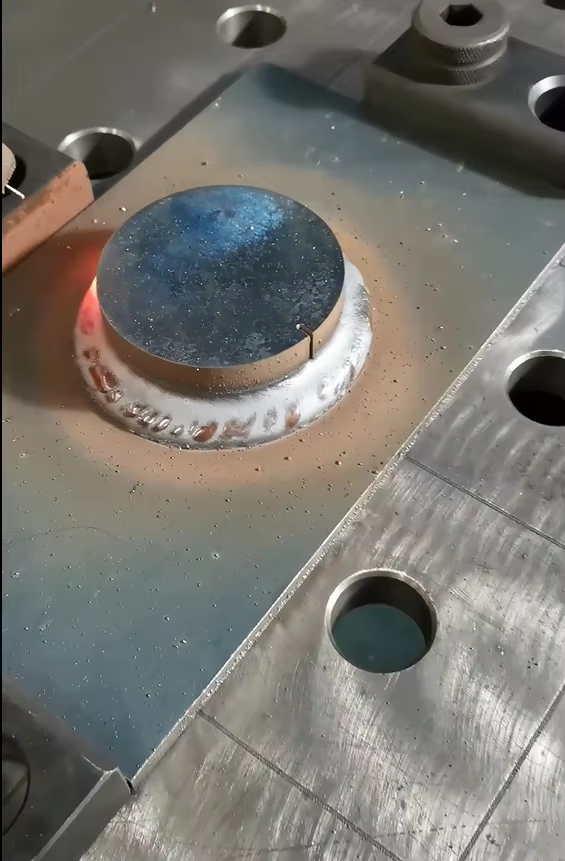
At 20kW, the energy density allows for “flash piercing” on web thicknesses up to 20mm, reducing the traditional piercing time by 75% compared to 6kW systems. This is critical in storage racking, where a single H-beam column may require dozens of bolt-hole perforations. The high power allows for a narrower kerf width, which is essential for maintaining the structural integrity of the flange-to-web junctions. In our HCMC field tests, we observed that the 20kW source maintains a stable plasma plume even when processing S355JR structural steel with slight surface oxidation, a common condition in the humid maritime climate of Southern Vietnam.
2.2 Feed Rate Optimization
The 20kW source enables linear cutting speeds on 12mm flanges at rates exceeding 3.5m/min. In a high-volume production environment like storage racking, this throughput increase directly correlates to a reduction in the “Cost Per Part.” More importantly, the high feed rate reduces the total heat input into the beam, preventing the longitudinal twisting or “banana effect” often seen in H-beams processed with slower, lower-power thermal cutting methods.
3.0 Kinematics of ±45° Bevel Cutting Technology
Traditional H-beam processing requires secondary operations for weld preparation, typically involving manual grinding or dedicated milling machines. The integration of a ±45° 3D beveling head allows for the simultaneous execution of dimensional cutting and weld-edge preparation (V, X, or K-type grooves).
3.1 5-Axis Interpolation for Structural Profiles
The beveling head utilizes a high-precision A/B axis configuration. When processing H-beams for racking uprights, the system must interpolate the bevel angle while navigating the transition from the flange to the radius of the web. The software algorithms must account for the varying thickness of the material as the laser head tilts. At a 45° angle, the effective thickness of a 16mm flange increases to approximately 22.6mm. The 20kW source provides the necessary “overhead” to maintain consistent cutting quality through this increased effective thickness without slowing to a point where dross accumulation becomes problematic.
3.2 Precision Weld Prep in Racking Systems
In heavy-duty storage racking, particularly those designed for seismic zones or high-load automation, the quality of the weld between the H-beam and the base plate/connector is paramount. The ±45° beveling capability ensures that the groove geometry is mathematically precise, allowing for full-penetration welds with minimal filler material. This eliminates the “fit-up” errors common in HCMC fabrication shops that rely on manual beveling, where inconsistencies in the root face often lead to weld defects.
4.0 Application in the HCMC Storage Racking Sector
HCMC’s logistics hubs (such as Cat Lai and the various Industrial Parks in Thu Duc) are increasingly utilizing “Automated Storage and Retrieval Systems” (ASRS). These systems require tolerances far tighter than those specified in standard construction codes (e.g., ISO 9013).
4.1 Dimensional Stability and Bolt-Hole Integrity
For high-bay racking, the verticality of the H-beam uprights is critical. The 20kW laser’s ability to cut bolt holes with a diameter-to-thickness ratio of 1:1 with zero taper ensures that high-tensile bolts fit perfectly. In our assessment of a racking project in HCMC, we found that laser-cut H-beams reduced assembly time by 30% because the need for “reaming” holes on-site was entirely eliminated. The precision of the laser ensures that the pitch between holes over a 12-meter beam remains within ±0.5mm, a feat impossible with traditional mechanical drilling or plasma cutting.
4.2 Integration with Automatic Structural Processing
The synergy between the 20kW source and automatic material handling is the defining feature of this system. In the HCMC facility, the H-beams are loaded via a hydraulic cross-feed system, measured by laser sensors for “actual” dimensions (to account for mill tolerances), and then processed. The software automatically compensates the cutting path for any slight bow or twist in the raw H-beam, ensuring that the beveling and hole patterns remain centered on the actual neutral axis of the steel.
5.0 Solving Efficiency Issues in Heavy Steel Processing
Before the implementation of the 20kW beveling system, the standard workflow in HCMC for a custom H-beam component was:
- Band saw cutting to length.
- Radial arm drilling for bolt holes.
- Manual oxy-fuel beveling for weld prep.
- Manual grinding to clean the slag.
This multi-step process introduced four opportunities for dimensional error and required significant floor space and labor. The 20kW H-beam laser consolidates these four steps into a single “one-pass” operation.
5.1 Reduction in Material Handling
Each time a 12-meter H-beam is moved between stations, there is a risk of injury and a cost in crane-time. By finishing the part in one machine, the HCMC facility saw a 50% reduction in internal logistics costs. The automated outfeed system allows the finished beams to be moved directly to the welding station or the painting line.
5.2 Energy Consumption and Gas Dynamics
While a 20kW laser has a high peak power draw, its “power-on” time per part is significantly lower than a 6kW or 12kW system. Furthermore, the use of high-pressure nitrogen or “filtered air” as a shielding gas at these power levels produces an oxide-free cut edge. This is vital for the HCMC market, where high-humidity levels cause rapid corrosion on raw steel. An oxide-free edge can be painted or powder-coated immediately without secondary shot-blasting of the cut surface.
6.0 Environmental and Site-Specific Considerations
Operating high-power lasers in Ho Chi Minh City presents unique challenges, primarily regarding the ambient temperature and humidity.
6.1 Chiller Performance and Thermal Stability
The 20kW source generates substantial heat. The site implementation included a dual-circuit high-capacity chiller with refrigerated air dryers for the beam path. Maintaining the dew point inside the laser cabinet is essential to prevent condensation on the optics, which at 20kW would lead to catastrophic lens failure within milliseconds. The system’s “dust-tight” pressurized cabinet design is mandatory for the HCMC environment to prevent the ingress of conductive metallic dust common in steel fabrication zones.
6.2 Power Grid Stability
High-power laser resonators are sensitive to voltage fluctuations. The installation in HCMC required a dedicated voltage stabilizer and an isolation transformer to protect the 20kW fiber modules from the transient spikes often found in industrial zone power grids. This ensures the consistency of the laser beam quality (M² factor), which is necessary for maintaining the precision of ±45° bevels over long production runs.
7.0 Conclusion
The deployment of the 20kW H-Beam laser cutting Machine with ±45° beveling technology represents a paradigm shift for the storage racking industry in Ho Chi Minh City. By integrating high-power melt-pool control with 5-axis kinematic precision, the system solves the dual challenges of throughput and accuracy. The ability to produce “weld-ready” structural components in a single operation eliminates secondary processing, reduces labor dependency, and ensures the structural integrity required for modern high-density logistics infrastructure. For senior engineering management, the ROI is found not just in cutting speed, but in the total elimination of downstream fabrication errors.




























