The Industrial Evolution of Mexico City: A New Era for Storage Racking
Mexico City and its surrounding industrial corridors, such as Querétaro and the State of Mexico, have become the epicenter of a logistics revolution. With global supply chains shifting closer to the North American market, the “nearshoring” phenomenon has triggered a massive expansion in warehousing and distribution centers. At the heart of this expansion lies a critical component: storage racking.
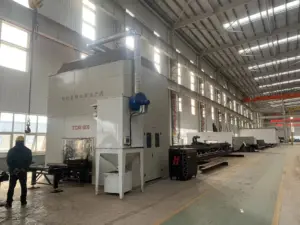
High-capacity pallet racks, cantilever systems, and mezzanine structures are the skeletal framework of modern commerce. Traditionally, the fabrication of the heavy-duty channels, I-beams, and C-profiles required for these systems involved labor-intensive processes, including mechanical sawing, manual drilling, and plasma cutting. However, the introduction of the 20kW CNC Beam and Channel Laser Cutter has fundamentally altered this paradigm. By offering a localized solution in Mexico City that bridges the gap between massive power and surgical precision, fabricators are now able to meet the rigorous safety standards of the racking industry while significantly reducing lead times.
The Power of 20kW: Speed and Thickness in Structural Steel
The jump to 20kW of fiber laser power is not merely a marginal improvement over previous 6kW or 12kW systems; it is a generational leap in capability. In the context of storage racking, where uprights and beams are often constructed from thick carbon steel or high-tensile alloys to support tons of inventory, power is the primary driver of efficiency.
A 20kW laser source allows for the high-speed processing of structural beams with wall thicknesses that would have previously required slow, messy plasma cutting or mechanical punching. This high wattage creates a high-density energy beam that vaporizes metal almost instantaneously. The result is a significantly reduced Heat Affected Zone (HAZ), which is vital for maintaining the structural integrity of the steel. In storage racking, where the load-bearing capacity is calculated down to the millimeter, preventing thermal distortion ensures that every beam and upright fits perfectly during site installation, eliminating the need for costly field adjustments.
Revolutionizing Efficiency with Zero-Waste Nesting
One of the most significant challenges in beam and channel fabrication has historically been the “tailings” or the scrap metal left over at the end of a stock length. In a traditional CNC setup, the chucks holding the material require a certain amount of clearance, often resulting in 300mm to 500mm of wasted material per profile. When processing thousands of tons of steel for a massive warehouse project in Mexico City, this waste represents a staggering financial and environmental cost.
The latest 20kW CNC systems feature “Zero-Waste Nesting” or “Zero-Tailings” technology. This is achieved through advanced multi-chuck systems (often utilizing three or four independent chucks) that can pass material through one another. As the laser reaches the end of a beam, the chucks reposition dynamically to allow the laser to cut right to the very edge of the material.
Combined with sophisticated nesting software, the machine can calculate the optimal sequence to utilize every inch of a standard 12-meter beam. This capability allows manufacturers to produce uprights, bracing, and beams from a single length of raw material with near-zero scrap. For Mexico City-based fabricators, this means a direct increase in profit margins and a significantly lower carbon footprint, aligning with the growing corporate demand for “Green Logistics.”
Precision Geometry: Teardrops, Keyholes, and Beyond
Storage racking is defined by its modularity. The “teardrop” or “keyhole” patterns punched into racking uprights allow for adjustable beam heights and secure locking mechanisms. Traditionally, these patterns were created using mechanical turret punches, which are limited by die wear and fixed geometries.
A 20kW CNC Laser Cutter offers a level of geometric freedom that mechanical punching cannot match. The fiber laser can cut complex bolt patterns, slots for safety pins, and weight-reduction apertures in a single pass. Because the laser is a non-contact tool, there is no tool wear. Every hole—from the first to the ten-thousandth—is identical in dimension. This consistency is crucial for the safety of high-bay racking systems, where even a minor misalignment in a connector can compromise the stability of the entire structure. Furthermore, the ability to cut chamfers and bevels in 3D using a tilting laser head allows for superior weld preparation on heavy-duty channel sections used in cantilever racking.
The Competitive Edge in the Mexico City Market
Operating in the Mexico City metropolitan area presents unique logistical challenges and opportunities. The density of the city requires efficient use of space, and the local manufacturing sector is under pressure to deliver high-quality components faster than international competitors.
By adopting 20kW CNC technology, local fabricators can offer “just-in-time” delivery for custom racking solutions. Whether it is a specialized cold-storage rack for the food and beverage sector or a high-capacity system for an automotive parts warehouse, the flexibility of the laser cutter allows for rapid prototyping and immediate mass production.
Moreover, the automation inherent in these machines reduces the reliance on a highly specialized labor force for manual layout and cutting. In a market where skilled welders and layout technicians are in high demand, the CNC system allows a single operator to manage the production output of what would previously have required a team of ten. This shift not only lowers overhead costs but also enhances workplace safety by automating the handling of heavy, cumbersome steel sections.
Sustainability and the Future of Racking Fabrication
As Mexico continues to strengthen its environmental regulations, particularly in the industrial zones of the State of Mexico, the efficiency of the 20kW fiber laser becomes a regulatory advantage. Fiber lasers are significantly more energy-efficient than older CO2 lasers or plasma systems. When combined with zero-waste nesting, the reduction in raw material consumption and energy usage per part produced is substantial.
Looking forward, the integration of Artificial Intelligence (AI) with 20kW laser systems will further optimize nesting patterns and predictive maintenance. For the storage racking industry in Mexico City, this means a future of “Smart Fabrication”—where the design of the warehouse is fed directly into the CNC system, and the finished, ready-to-assemble components emerge with minimal human intervention and zero material waste.
Conclusion
The introduction of the 20kW CNC Beam and Channel Laser Cutter is a watershed moment for the structural steel and storage racking industry in Mexico City. By solving the dual challenges of high-speed processing for thick materials and the elimination of scrap through zero-waste nesting, this technology provides a robust foundation for the region’s logistical growth. As the Valley of Mexico continues to cement its status as a global manufacturing hub, the precision and power of 20kW fiber lasers will be the driving force behind the structures that hold the world’s inventory. For fabricators, the message is clear: the future of racking is faster, cleaner, and more precise than ever before.