
1.0 Introduction: High-Power Laser Integration in Large-Scale Aviation Infrastructure
This technical report evaluates the operational performance and structural implications of deploying a 20kW CNC Beam and Channel Laser Cutter during the structural fabrication phase of airport expansion projects in Dubai. The scale of aviation infrastructure in this region—characterized by massive spans, complex geometries, and stringent deadlines—demands a departure from traditional mechanical sawing and plasma cutting. The integration of 20kW fiber laser technology, paired with multi-axis CNC kinematics, provides the requisite power density to process heavy-wall structural members (I-beams, H-beams, and C-channels) with unprecedented precision.
In the context of Dubai’s climate, where thermal expansion must be accounted for during the fabrication of large-scale modular steel frames, the narrow Heat Affected Zone (HAZ) provided by high-power fiber lasers is critical. This report focuses on the synergy between the 20kW power source and “Zero-Waste Nesting” algorithms, specifically regarding material utilization rates and the elimination of secondary finishing processes.
2.0 20kW Fiber Laser Source: Thermal Dynamics and Penetration Specs
2.1 Power Density and Kerf Quality
The 20kW fiber laser source represents the current zenith for structural steel processing. At this wattage, the energy density at the focal point allows for “high-speed vaporization cutting” even in thick-walled channels (up to 25mm). In Dubai’s airport construction sector, where S355 and high-strength structural steels are standard, the 20kW source ensures that the laser maintains a stable keyhole throughout the cutting process. This stability results in a kerf width of approximately 0.2mm to 0.4mm, significantly lower than the 2.0mm+ typically seen in high-definition plasma systems.
2.2 Management of the Heat Affected Zone (HAZ)
Structural integrity in airport terminals is non-negotiable. Excessive heat input during profiling can lead to localized martensitic transformation, increasing brittleness at the cut edge. The 20kW laser, by virtue of its extreme processing speed (meters per minute vs. centimeters per minute in lower power units), minimizes the duration of thermal exposure. Engineering forensics on processed C-channels show a HAZ depth of less than 0.05mm, which eliminates the need for edge grinding before welding or galvanization, ensuring that the parent metal’s metallurgical properties remain intact.
3.0 Multi-Axis CNC Kinematics for Structural Profiles
3.1 3D Profiling and Beveling
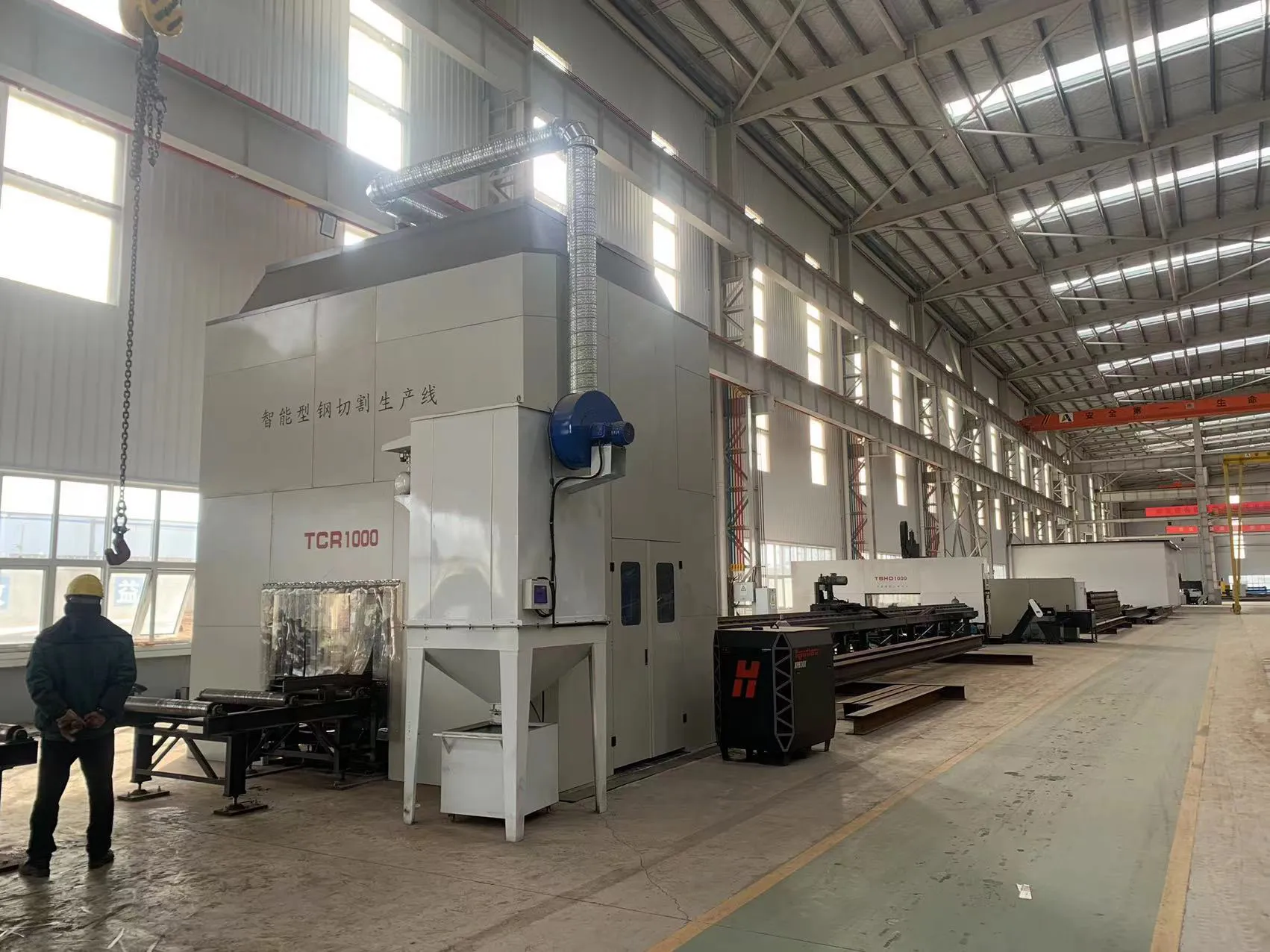
Unlike flat-bed lasers, the Beam and Channel CNC system utilizes a rotating chuck mechanism—often a four-chuck configuration in high-end models—to stabilize long-form structural members. For the complex roof trusses required in Dubai’s latest concourse designs, the ability to perform 45-degree bevel cuts for weld preparations is essential. The CNC controller synchronizes the 5-axis cutting head with the rotation of the beam, allowing for “bird-mouth” joints, miter cuts, and bolt-hole patterns to be executed in a single pass.
3.2 Geometric Accuracy in 12-Meter Workpieces
A significant challenge in Dubai’s heavy steel sector is the processing of 12-meter stock lengths. Mechanical drift and material sag can compromise accuracy. The 20kW system employed utilizes real-time laser scanning to compensate for material “bow” and “twist” inherent in hot-rolled sections. By re-mapping the CNC path based on the actual physical geometry of the beam rather than the theoretical CAD model, the system maintains a positional accuracy of ±0.1mm over the entire length of the member.
4.0 Zero-Waste Nesting Technology: Engineering Mechanics
4.1 Algorithm-Driven Material Optimization
“Zero-Waste Nesting” is not merely a marketing term but a sophisticated computational approach to common-line cutting and tail-end utilization. Traditional beam processing involves a “crop-off” at each end of the profile, often resulting in 150mm to 300mm of scrap per beam. The zero-waste software integrated into the 20kW system uses “Head-to-Tail” nesting, where the trailing edge of one component serves as the leading edge of the next.
4.2 Micro-Joint Strategy and Common-Line Cutting
In the fabrication of C-channels for airport utility galleries, the CNC employs common-line cutting where two separate parts share a single laser path. This reduces gas consumption (Nitrogen or Oxygen) and processing time by 30-40%. To maintain structural stability during the rotation of the beam, the software calculates “micro-joints”—tiny tabs of metal that hold the part in place until the final cycle. These are then snapped or vibrated off, leaving a burr-free finish that requires no manual deburring.
5.0 Field Application: Dubai International Infrastructure
5.1 Environmental Considerations
The Dubai environment presents specific challenges: high ambient temperatures (45°C+) and fine particulate dust. The 20kW CNC units deployed are equipped with high-capacity industrial chillers and pressurized optical cabins. The high power of the 20kW laser allows the use of compressed air as a cutting gas for thinner sections (up to 10mm), which is highly cost-effective in large-scale projects, while high-pressure Oxygen is reserved for the thickest structural flanges to maintain a clean, oxide-free surface.
5.2 Impact on Modular Assembly
Airport construction increasingly relies on Off-site Manufacturing (OSM) and Modular Construction. Because the 20kW laser produces holes and notches with “bolt-ready” precision, the assembly of heavy trusses on-site in Dubai has seen a 25% reduction in man-hours. There is no longer a requirement for on-site reaming of holes or manual adjustment of fit-up gaps; the laser-cut tolerances ensure a “Lego-like” fitment of massive steel components.
6.0 Economic and Operational Efficiency Analysis
6.1 Throughput vs. Traditional Methods
Comparative data indicates that a 20kW CNC laser line can outproduce three traditional saw-and-drill lines combined. For a standard 400mm I-beam with complex cope cuts and 20 bolt holes, the laser cycle time is approximately 120 seconds. A traditional mechanical workflow (measure, saw, layout, drill) exceeds 15 minutes. This throughput is vital for meeting the aggressive “Fast-Track” schedules typical of Dubai’s Department of Civil Aviation (DCA) projects.
6.2 Scrap Reduction and Sustainability
With “Zero-Waste Nesting,” material utilization rates (MUR) have improved from 82% to approximately 96-98%. In a project utilizing 50,000 tons of structural steel, a 14% increase in MUR translates to thousands of tons of saved material, directly impacting the project’s carbon footprint and bottom line. This aligns with Dubai’s 2030 sustainability goals for the construction industry.
7.0 Conclusion
The deployment of 20kW CNC Beam and Channel Laser cutters equipped with Zero-Waste Nesting represents a paradigm shift in structural engineering for the aviation sector. The precision of the fiber laser, combined with advanced multi-axis kinematics, solves the historical conflict between high-speed production and high-tolerance engineering. For Dubai’s massive airport expansions, this technology ensures that structural steel components are fabricated with the metallurgical integrity and geometric accuracy required for 21st-century infrastructure. Future deployments should focus on further integrating BIM (Building Information Modeling) data directly into the CNC environment to further automate the “digital-to-physical” workflow.
Field Report Certified by:
Lead Structural Technologist | Laser Systems Division
















