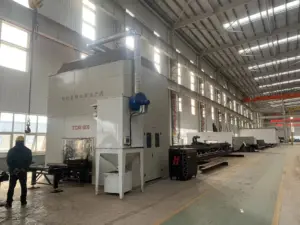
The Dawn of Ultra-High Power: Why 20kW Matters
For decades, the fabrication of heavy structural steel—the “bones” of railway infrastructure—relied on plasma cutting or oxy-fuel torches. While effective, these methods lacked the precision required for modern high-speed rail tolerances and produced significant thermal distortion. The introduction of the 20kW fiber laser to Rayong’s industrial sector changes the physics of the fabrication floor.
At 20kW, the energy density at the focal point is immense. We are no longer just “melting” through metal; we are achieving high-speed sublimation and melt-ejection that leaves a surface finish comparable to milling. For railway channels and I-beams, which often feature thicknesses ranging from 12mm to 40mm, the 20kW source provides the “over-the-horizon” power necessary to maintain high feed rates without sacrificing edge quality. This power level allows for “fly-cutting” on thinner sections and stable, dross-free processing on the massive carbon steel sections required for track support and rolling stock frames.
The transition to 20kW also addresses the “efficiency-to-thickness” ratio. Where a 6kW or 12kW laser might struggle with 30mm steel, requiring slow speeds that increase the Heat Affected Zone (HAZ), the 20kW system punches through with such velocity that the surrounding molecular structure of the steel remains largely undisturbed. This is critical for railway applications where structural integrity and fatigue resistance are non-negotiable.
Infinite Rotation: The 5-Axis Revolution in Beam Processing
The “Infinite Rotation 3D Head” is the true centerpiece of this system. Traditional CNC laser heads are limited by cable management; they can rotate perhaps 360 or 720 degrees before they must “unwind.” In a complex 3D environment—such as cutting a mounting bevel around the flange of an H-beam—this unwinding creates downtime and “start-stop” marks on the metal.
Infinite rotation technology utilizes advanced slip-ring connectors and specialized optical paths that allow the cutting head to spin indefinitely. When paired with a +/- 45-degree (or greater) tilt axis, the machine becomes a 5-axis powerhouse. For railway infrastructure, this means the ability to cut complex weld preparations—K, V, X, and Y-type joints—directly into the beam in a single pass.
In Rayong’s fabrication shops, this eliminates the need for manual grinding or secondary beveling machines. Whether it’s a C-channel requiring a countersunk bolt hole or a heavy beam needing a precision miter cut for a bridge truss, the 3D head moves with fluid, continuous motion. The software compensates for the beam’s geometry in real-time, ensuring the laser nozzle remains at the perfect standoff distance, even when navigating the radius of a structural channel.
Railway Infrastructure: Precision at Scale
Thailand’s railway expansion, particularly the high-speed links connecting the three airports, demands components that meet international safety standards (such as EN 1090-2). The 20kW CNC laser is the only tool capable of meeting these standards at an industrial scale.
1. **Rolling Stock Frames:** The chassis of a train requires a mix of strength and weight optimization. laser cutting allows for intricate weight-reduction cutouts in channels without compromising the structural rigidity of the frame.
2. **Track Fastening Systems:** Precision-cut base plates and brackets require exact hole diameters for high-tensile bolts. The 20kW laser maintains a “perfect circle” geometry that mechanical punches or plasma cutters simply cannot replicate in thick plate.
3. **Bridge and Gantry Structures:** Railway bridges in the EEC must withstand decades of vibration and environmental stress. By using a 3D laser head to create perfect bevels, the subsequent welding process is more consistent, leading to deeper penetration and stronger joints.
The ability to process long-format materials—often up to 12 or 18 meters in a single setup—means that Rayong’s factories can produce entire segments of railway infrastructure with zero cumulative error.
The Rayong Industrial Ecosystem and the EEC
Rayong is not just a location; it is a strategic hub for the Eastern Economic Corridor. The concentration of automotive, aerospace, and heavy machinery industries in this region creates a unique “knowledge cluster.” Deploying a 20kW 3D laser here allows for a synergy of supply chains.
The local workforce in Rayong is rapidly upskilling to manage these “Industry 4.0” machines. Operating a 5-axis laser requires more than just a button-pusher; it requires an understanding of nesting software, 3D CAD/CAM integration, and the nuances of laser gas dynamics (Oxygen vs. Nitrogen vs. Air). The presence of these machines in Rayong is driving a digital transformation in the local manufacturing sector, moving away from “cheap labor” and toward “high-tech value-add.”
Furthermore, the environmental regulations in the EEC are becoming stricter. Fiber lasers are significantly more energy-efficient than CO2 lasers or plasma systems. They produce fewer fumes and require no toxic chemicals for processing, aligning Rayong’s industrial growth with Thailand’s “Bio-Circular-Green” (BCG) economic model.
Overcoming Challenges in Heavy Section Cutting
As an expert, I must highlight that 20kW of power brings its own set of challenges, specifically regarding thermal management and optics. At these power levels, “thermal lensing”—where the protective window or lens heats up and shifts the focal point—can ruin a cut.
The latest systems in Rayong utilize “intelligent” cutting heads equipped with real-time sensors. These sensors monitor the temperature of the optics and the back-reflection of the laser. If the beam hits a high-reflective inclusion in the steel, the system adjusts in milliseconds to prevent damage.
Additionally, the “Infinite Rotation” head requires a sophisticated CNC controller capable of processing huge amounts of data. Moving five axes simultaneously while modulating 20,000 watts of power requires a bus-speed and processing power that was unavailable five years ago. Modern systems use EtherCAT communication protocols to ensure that the mechanical movement and the laser pulse are perfectly synchronized, even at the corners of a heavy channel.
Economic Impact: Throughput and ROI
The capital expenditure for a 20kW 3D beam cutter is significant, but the Return on Investment (ROI) for railway projects is compelling.
– **Consolidation of Processes:** One laser machine replaces a band saw, a drill press, a milling machine, and a manual beveling station.
– **Labor Savings:** A single operator can oversee the production of complex parts that previously required a team of five or six specialized fabricators.
– **Material Yield:** Advanced 3D nesting software allows parts to be “nested” within the flanges and webs of beams, minimizing scrap in a way that manual layout never could.
– **Speed:** A 20kW laser can cut 20mm carbon steel at speeds exceeding 3-4 meters per minute. When compared to the 0.5 meters per minute of traditional methods, the throughput increase is nearly 800%.
For a contractor in Rayong working on a multi-billion baht railway contract, the ability to deliver components weeks ahead of schedule is the difference between a profitable project and one mired in liquidated damages.
The Future: Toward Full Automation
The future of railway fabrication in Rayong lies in the integration of these 20kW lasers with robotic loading and unloading. We are moving toward a “lights-out” manufacturing environment where raw I-beams are fed into the machine from a warehouse management system, and finished, beveled, and labeled components emerge at the other end, ready for the welding robots.
The 20kW CNC Beam and Channel Laser Cutter with Infinite Rotation 3D Head is more than just a tool; it is the cornerstone of Thailand’s modern industrial strategy. By providing the power to cut through the thickest steel and the agility to navigate the most complex geometries, it ensures that the tracks and trains of the future are built with a level of precision that was once thought impossible. In the heart of Rayong, the “spark” of the fiber laser is quite literally forging the future of Southeast Asian connectivity.