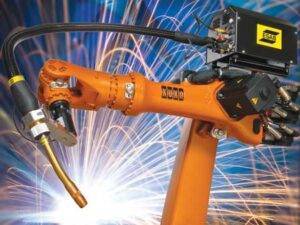
The Industrial Renaissance in Haiphong: Why 20kW Matters
Haiphong has long been the industrial heartbeat of Northern Vietnam, serving as a primary gateway for international trade through its deep-water ports. As the nation accelerates its transition toward renewable energy and modernized power grids, the demand for transmission towers—structures that must withstand extreme environmental stress—has skyrocketed. Traditional fabrication methods, involving mechanical drilling, sawing, and manual plasma beveling, are no longer sufficient to meet the required tolerances or production volumes.
The introduction of the 20kW fiber laser source represents a quantum leap in capability. At 20,000 watts, the laser density is sufficient to “vaporize” thick-walled structural steel almost instantaneously. In power tower fabrication, where carbon steel thicknesses often range from 10mm to 30mm, a 20kW system offers a feed rate that is three to five times faster than a standard 6kW or 12kW unit. This power ensures clean, dross-free cuts that require zero post-processing, which is critical when preparing the massive steel members that form the backbone of high-voltage electrical grids.
The Engineering Marvel of the Infinite Rotation 3D Head
The “Infinite Rotation” capability is the defining feature of modern 5-axis laser cutting. In conventional 3D cutting heads, the rotation (C-axis) is often limited by internal cabling, requiring the head to “unwind” after a certain number of degrees. This creates pauses in the cutting path, leading to heat accumulation and potential defects at the restart point.
For Haiphong’s power tower manufacturers, the infinite rotation 3D head removes these limitations. As the head maneuvers around the complex geometry of an H-beam or a tapered channel, it maintains a continuous, fluid motion. This is particularly vital for:
1. **Bevel Cutting:** Creating V, X, or K-shaped bevels for weld preparation.
2. **Complex Intersections:** Cutting “bird-mouth” joints or intricate interlocking slots where beams meet at non-standard angles.
3. **Contour Accuracy:** Maintaining a constant standoff distance even on warped or non-uniform structural sections.
By utilizing a 5-axis system, the laser can tilt up to 45 degrees, allowing for the immediate creation of welding chamfers during the primary cutting phase. This integration reduces the workpiece handling time by up to 70%, as the beam does not need to be moved to a separate station for beveling.
Streamlining Power Tower Fabrication
Power towers (transmission towers) are complex lattices of angles, channels, and beams. Each component must be perforated with hundreds of bolt holes that align perfectly during field assembly. Traditionally, these holes were punched or drilled, processes that introduce mechanical stress or require frequent tool changes.
A 20kW CNC laser cutter treats a 12-meter H-beam as a canvas of precision. The CNC software integrates directly with BIM (Building Information Modeling) and CAD/CAM platforms like Tekla or SolidWorks. The laser cuts bolt holes with a diameter-to-thickness ratio that was previously impossible with plasma. Because the fiber laser is a non-contact process, there is no tool wear, ensuring that the 1st hole and the 1,000th hole are identical in dimension.
Furthermore, the “Heat Affected Zone” (HAZ) in fiber laser cutting is significantly smaller than that of plasma or oxy-fuel cutting. In the context of structural engineering, a smaller HAZ means the metallurgical properties of the steel remain intact, reducing the risk of brittle fractures in the high-stress environments where power towers are deployed.
Efficiency and Nesting in the Haiphong Context
In the competitive landscape of Haiphong’s industrial zones, such as Dinh Vu or Trang Due, operational efficiency translates directly to market share. The 20kW laser system utilizes advanced nesting algorithms specifically designed for long-format structural profiles.
Unlike flat sheet nesting, beam nesting must account for the structural integrity of the profile during the cut. The CNC system manages the synchronization of the chucks (often a three-chuck or four-chuck system) to support the beam as it moves through the cutting zone. This “zero-tailing” technology ensures that material waste is minimized. When dealing with high-grade structural steel, reducing waste by even 5% can result in hundreds of thousands of dollars in annual savings for a large-scale tower fabricator.
Technical Challenges and Solutions in High-Power Cutting
Operating a 20kW laser requires more than just raw power; it requires sophisticated environmental control. Haiphong’s coastal climate presents challenges such as high humidity and salinity, which can be detrimental to optical components.
To combat this, the 20kW systems installed in this region feature:
* **Hermetically Sealed Optical Path:** Nitrogen-purged beam paths to prevent dust and moisture ingress.
* **Advanced Cooling:** High-capacity chillers with dual-circuit cooling for both the laser source and the 3D cutting head.
* **Dust Extraction:** High-volume filtration systems to capture the fine particulate matter generated by high-power vaporization of thick steel.
The “Infinite Rotation” head also utilizes capacitive height sensing, which is incredibly sensitive. At 20kW, the focal point is critical; even a sub-millimeter deviation can affect the cut quality. The system’s ability to react in milliseconds to the surface undulations of a channel iron ensures a consistent “kerf” throughout the entire length of the workpiece.
The Strategic Advantage for Southeast Asia
The deployment of this technology in Haiphong is a strategic move for the Vietnamese manufacturing sector. As Southeast Asia expands its energy infrastructure—connecting offshore wind farms to inland grids and upgrading aging transmission lines—the demand for high-quality, rapidly produced structural steel is at an all-time high.
A 20kW CNC Beam and Channel Laser Cutter allows Haiphong-based companies to bid on international projects that require stringent European or American structural standards (such as EN 1090 or AISC). The precision of the 3D head ensures that every component is “ready-to-assemble” upon arrival at the construction site, eliminating the need for costly on-site modifications or re-drilling.
Software Integration and the Smart Factory
The “CNC” element of this system is the brain that directs the 20kW muscle. Modern systems in Haiphong are increasingly connected via IIoT (Industrial Internet of Things). This allows factory managers to monitor gas consumption (Oxygen, Nitrogen, or Air), power usage, and cutting time in real-time.
For power tower fabrication, where traceability is often a legal requirement, the software can engrave part numbers, QR codes, and alignment marks directly onto the steel members. This digital twin approach ensures that every beam in a 100-meter tower is accounted for, from the moment it enters the laser bed in Haiphong to the moment it is bolted into place in the highlands.
Conclusion: The Future of Heavy Fabrication
The 20kW CNC Beam and Channel Laser Cutter with Infinite Rotation 3D Head is more than a tool; it is a fundamental shift in how we approach heavy engineering. By centering this technology in Haiphong, fabricators are not just keeping pace with global trends—they are setting a new standard for efficiency in the power sector.
As we look toward the future, the combination of ultra-high power and multi-axis flexibility will continue to drive down the cost of infrastructure while increasing the safety and longevity of our power grids. For the engineers and fabricators of Haiphong, the 20kW laser is the key to unlocking a more productive and electrified tomorrow.